

Skincare Ingredients to Avoid for Sensitive Skin
If your skin stings, flushes, or flakes after applying products that promise to help, the culprit is almost always one of the same ingredient groups: synthetic and natural fragrances, denatured alcohols, sulfate surfactants, high-strength chemical exfoliants, strong retinoids, benzoyl peroxide, formaldehyde-releasing preservatives, menthol or camphor, and citrus-derived oils. Dermatologist-sourced guidance consistently points to fragrance as the single biggest trigger, and a Stanford Medicine analysis found that more than 94% of products labeled “natural” contained at least one known contact allergen. The fastest thing you can do right now is strip fragranced products from your routine and rebuild around barrier-repair basics.
Your 24–72 hour checklist:
- Remove any product with “fragrance,” “parfum,” or an essential oil in the first five ingredients
- Swap your foaming cleanser for a sulfate-free, low-pH option
- Cut your routine to three steps: gentle cleanser, ceramide moisturizer, mineral sunscreen
- Patch-test every new product on your inner forearm for 48–72 hours before applying it to your face
- Introduce one new product at a time, waiting at least one to two weeks between additions
Table of Contents
- What each common irritant does to your skin and where it hides on labels
- How to patch-test and introduce new products safely
- Barrier-supporting ingredients your skin actually needs
- Why “natural” and “unscented” labels can mislead you
- When to stop a product and when to see a dermatologist
- Key Takeaways
- A gentle LaTerraTales option for your sensitive-skin routine
- Further reading and authoritative sources
What each common irritant does to your skin and where it hides on labels
Understanding the mechanism behind each irritant helps you make faster decisions at the shelf, not just memorize a list.
Fragrance and essential oils
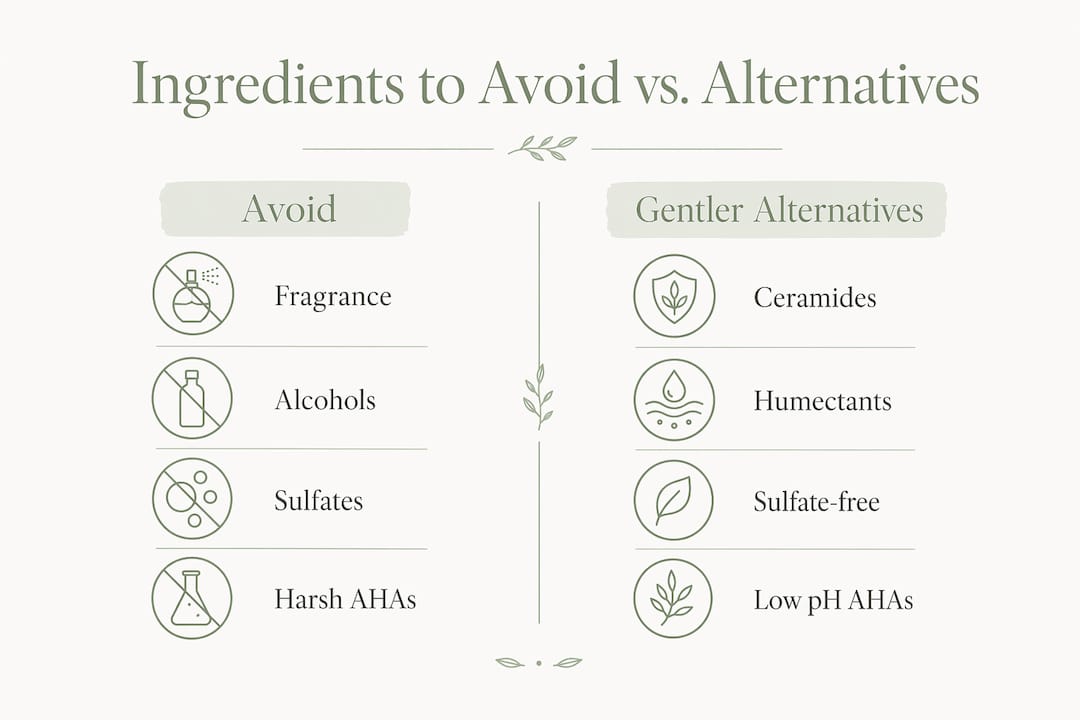
Fragrance is the broadest and most deceptive category. Synthetic fragrance hides under “fragrance” or “parfum” on an INCI list. Natural fragrance compounds, including limonene, linalool, eugenol, and citronellol, appear individually by their chemical names. Both types can trigger irritant contact dermatitis or, with repeated exposure, allergic sensitization. Essential oils marketed as “clean” alternatives are frequent sensitizers and carry the same risk. Watch for them in toners, facial mists, serums, and any product labeled “aromatherapy.”

Denatured and drying alcohols
Alcohol denat., SD alcohol, and isopropyl alcohol evaporate quickly, which feels refreshing but strips lipids from the skin surface and disrupts the barrier over time. These appear in lightweight serums, toners, and some sunscreens. Fatty alcohols, such as cetyl alcohol, stearyl alcohol, and cetearyl alcohol, behave completely differently: they are emollients and are safe for sensitive skin. The name “alcohol” alone tells you nothing; the full INCI name does.

Sulfates (SLS and SLES)
Sodium lauryl sulfate and sodium laureth sulfate are powerful surfactants that produce rich lather but strip the skin’s natural oils, raising skin pH and leaving the barrier vulnerable. They appear most often in foaming cleansers, shampoos, and body washes. Milder alternatives include cocamidopropyl betaine and sodium lauroyl glutamate, both of which clean effectively without the same disruption.
Strong AHAs and BHAs
Glycolic acid at concentrations above 5–7% and salicylic acid used daily or at high strength can cause prolonged redness, peeling, and stinging in reactive skin. These exfoliants work by loosening the bonds between dead skin cells, which is useful in a stable routine but damaging when the barrier is already compromised. They appear in toners, serums, masks, and some cleansers. If your skin is currently reactive, pause them entirely until the barrier recovers.
Benzoyl peroxide
Effective against acne-causing bacteria, benzoyl peroxide is also a known oxidizing agent that causes dryness, peeling, and bleaching of fabrics. Sensitive skin often cannot tolerate it even at 2.5%. If you need an acne-targeting ingredient, niacinamide at 4–5% or azelaic acid at 10% are gentler starting points.
High-strength retinoids and retinol
Vitamin A derivatives accelerate cell turnover, which is why they cause the classic “retinoid reaction”: dryness, flaking, and redness in the first weeks. Clinical guidance recommends delaying retinoids until the barrier is stable and starting at 0.25% or lower, applied once weekly, before increasing frequency. Prescription-strength tretinoin and adapalene are best introduced under dermatologist supervision for reactive skin.
Formaldehyde-releasing preservatives
DMDM hydantoin, imidazolidinyl urea, diazolidinyl urea, and quaternium-15 slowly release small amounts of formaldehyde to prevent microbial growth. Formaldehyde is a recognized contact allergen and can cause delayed allergic reactions. These preservatives appear in shampoos, conditioners, liquid foundations, and some moisturizers. Phenoxyethanol and ethylhexylglycerin are generally better-tolerated alternatives.
Menthol and camphor
Both create a cooling sensation by activating cold-sensitive receptors in the skin, but they can trigger burning, stinging, and prolonged redness in people with rosacea or eczema. They appear in acne treatments, foot creams, and some “refreshing” toners. There is no functional benefit for sensitive skin that justifies the risk.
Citrus oils and psoralens
Lemon, lime, bergamot, and grapefruit oils contain psoralens, compounds that become reactive under UV light and cause phototoxic reactions: uneven darkening, burning, and in severe cases, blistering. They appear in brightening serums, body oils, and hair products. Even if you apply them at night, residue can remain on skin the next morning.
Comparison: ingredient categories to avoid vs. gentler alternatives
| Category | Common irritants | Gentler alternatives |
|---|---|---|
| Fragrance systems | Fragrance, parfum, essential oils, limonene, eugenol | Fragrance-free formulas, certified hypoallergenic |
| Foaming surfactants | SLS, SLES | Cocamidopropyl betaine, sodium lauroyl glutamate |
| Exfoliants | High-strength glycolic acid, frequent salicylic acid | Low-dose lactic acid (5% or less), polyhydroxy acids |
| Preservatives | DMDM hydantoin, quaternium-15, imidazolidinyl urea | Phenoxyethanol, ethylhexylglycerin |
| Drying solvents | Alcohol denat., SD alcohol, isopropyl alcohol | Fatty alcohols (cetyl, stearyl), glycerin |
Pro Tip: pH matters as much as the ingredient itself. A well-formulated AHA serum at pH 3.5 delivers more acid to the skin than a higher-pH version at the same concentration. If your skin is reactive, look for exfoliants formulated at pH 4.5–5.5, which are less aggressive while still effective.
How to patch-test and introduce new products safely
A patch test takes less than five minutes to set up and can save you weeks of recovery time.
- Choose a test site. Apply a small amount of the new product to your inner forearm or behind the ear, both areas with skin that is sensitive but not your face.
- Apply a pea-sized amount. Use the same quantity you would apply to your face. Cover with a bandage if the product is a rinse-off formula.
- Leave it undisturbed for 48–72 hours. Do not wash the area. Check at 24 hours and again at 48–72 hours for redness, swelling, itching, or blistering.
- Interpret the result. Redness appearing within minutes to a few hours usually signals irritant contact dermatitis. A reaction appearing at 48–72 hours is more consistent with allergic contact dermatitis, which involves the immune system and tends to recur with re-exposure.
- Introduce one product at a time. Wait one to two weeks before adding the next new item. This is the only reliable way to identify which product caused a reaction if one appears.
- For active ingredients, start slowly. Begin with once-weekly application for retinol or exfoliants, then increase to twice weekly after two to three weeks if your skin tolerates it. Combining treatments safely takes patience; a guide on layering actives can help you sequence products without stacking irritation risk.
Stop immediately and see a clinician if you notice: blistering, a rash spreading beyond the application site, significant swelling, difficulty breathing, or any sign of infection such as warmth, pus, or fever. These are not normal adjustment reactions.
Barrier-supporting ingredients your skin actually needs
Replacing irritants is only half the work. Choosing the right gentle skincare ingredients to fill those gaps is what actually restores calm.
- Ceramides (NP, AP, EOP): These lipids are the mortar between skin cells. A ceramide blend that mimics the skin’s natural ratio (ceramide NP, AP, and EOP together) reinforces the barrier and reduces water loss more effectively than a single ceramide type alone.
- Glycerin (3–10%): A reliable humectant that draws moisture into the skin. Effective from around 3% and commonly used up to 10% in balanced formulations, it becomes difficult to formulate elegantly at higher concentrations, so look for it in this range for the best balance of hydration and texture.
- Niacinamide (2–5%): Reduces redness, supports ceramide synthesis, and calms the appearance of irritation. At 2–5%, it is well-tolerated by most reactive skin types. Higher concentrations can occasionally cause flushing in very sensitive individuals.
- Hyaluronic acid (multiple molecular weights): Low-molecular-weight HA penetrates more deeply; high-molecular-weight HA sits on the surface and reduces transepidermal water loss. Products combining both offer layered hydration.
- Squalane: A stable, plant-derived oil that mimics the skin’s own sebum. It absorbs without greasiness and does not clog pores, making it one of the safest oil-phase ingredients for reactive skin.
- Panthenol (provitamin B5): Soothes, hydrates, and supports wound healing. It appears in many sensitive-skin formulas and is exceptionally well-tolerated.
- Oat beta-glucan: Derived from colloidal oatmeal, this ingredient has a long clinical track record for calming itch and redness in eczema-prone skin. The National Eczema Association recognizes colloidal oatmeal as a skin protectant.
- Dipotassium glycyrrhizinate and stearyl glycyrrhetinate: Both are licorice-derived anti-inflammatory agents. Stearyl glycyrrhetinate is oil-soluble, which allows it to integrate into the skin’s lipid lamellae and support barrier repair at a structural level.
A minimal sensitive-skin routine built from these ingredients looks like this: a gentle, sulfate-free cleanser with panthenol or oat extract, followed by a ceramide-rich moisturizer containing glycerin and niacinamide, finished with a mineral sunscreen (zinc oxide or titanium dioxide, unfragranced).
Pro Tip: When your barrier is significantly compromised, oil-soluble soothing agents like stearyl glycyrrhetinate can outperform water-soluble alternatives because they work within the lipid layers where the damage actually occurs. Look for it in the first half of the oil-phase ingredients on a moisturizer label.
Why “natural” and “unscented” labels can mislead you
The belief that natural equals safe is one of the most persistent misconceptions in skincare, and the data does not support it.
A Stanford Medicine analysis of retail products found that more than 94% of items labeled “natural” contained at least one known contact allergen, with fragrance mix appearing in 36.6% of products studied. Labels like “natural,” “clean,” or “organic” carry no standardized safety definition in the United States. They are marketing terms, not regulatory categories. A product can be 100% plant-derived and still be loaded with potent sensitizers.
The “unscented” label is a separate trap. An unscented product may contain masking fragrances, added specifically to neutralize the smell of other ingredients, without disclosing them as fragrance. “Fragrance-free” is the label that actually means no fragrance compounds were added. Even then, reading the full INCI list matters, because individual fragrance chemicals like limonene and linalool can appear under their chemical names without the word “fragrance” appearing anywhere.
The barrier-first clinical strategy follows directly from this evidence. Restoring the barrier with ceramides, humectants, and gentle emollients reduces reactivity and is more effective long-term than cycling through active treatments while the barrier remains compromised. Delay high-strength actives until your skin is calm and stable. For a deeper look at decoding product labels, the LaTerraTales guide on choosing natural products for sensitive skin walks through what to look for beyond the front-of-pack claims.
Skin conditions that raise sensitivity further: Eczema, rosacea, and perioral dermatitis all involve a compromised or dysregulated barrier, which means the threshold for irritation is lower and reactions can be more intense. If you have one of these conditions, the ingredient list above is not optional caution; it is clinical necessity. Environmental factors, including UV exposure, cold dry air, stress, and pollution, also temporarily weaken the barrier and can make ingredients you normally tolerate suddenly problematic.
When to stop a product and when to see a dermatologist
Mild adjustment reactions, a little dryness or mild redness in the first week of a new product, are normal. Anything beyond that warrants attention.
Stop using the product immediately if you notice:
- Burning or stinging that does not subside within 30 minutes of application
- Redness that spreads beyond the area where you applied the product
- Blistering or open sores
- Significant swelling, especially around the eyes or lips
- Difficulty breathing or throat tightness (a systemic allergic reaction; call emergency services)
- Signs of infection: warmth, pus, crusting, or fever
If mild irritation persists for more than a week after stopping the product, or if you cannot identify which product caused the reaction, see a board-certified dermatologist. Patch testing performed in a clinical setting can identify specific allergens and rule out conditions like contact dermatitis or rosacea that require targeted treatment. For guidance on calming your skin while you wait for an appointment, the LaTerraTales article on soothing skin after a reaction covers practical aftercare steps.
What to bring to your dermatology appointment:
- A written or photographed timeline of when the reaction started and how it progressed
- Photos of the reaction at its worst
- The full ingredient lists of every product you used in the two weeks before the reaction (screenshots work)
- Your prior allergy history, including food, drug, and environmental allergies
- A list of current medications and supplements, since some increase photosensitivity or skin reactivity
Key Takeaways
Fragrance is the single most common skincare irritant for sensitive skin; removing it and rebuilding around ceramides, glycerin, and niacinamide resolves most reactive-skin flare-ups faster than any active treatment.
| Point | Details |
|---|---|
| Fragrance is the top trigger | Both synthetic fragrance and essential oils are leading causes of contact dermatitis; choose fragrance-free products confirmed by reading the full INCI list. |
| Not all alcohols are harmful | Denatured alcohols (alcohol denat., SD alcohol) strip the barrier; fatty alcohols (cetyl, stearyl) are safe emollients. |
| Patch-test every new product | Apply to your inner forearm for 48–72 hours before face use; introduce one product at a time with one to two weeks between additions. |
| Barrier repair comes first | Ceramide blends, glycerin (3–10%), panthenol, and squalane restore the barrier before you reintroduce any active ingredients. |
| LaTerraTales approach | LaTerraTales formulates without synthetic fragrance, with minimal ingredient lists and barrier-supporting actives suited to sensitive and reactive skin. |
A note from LaTerraTales on building gentle formulas
The most common mistake we see is people treating reactive skin with more actives, not fewer. When the barrier is compromised, even well-intentioned ingredients like vitamin C serums or exfoliating acids can push skin further into distress. The evidence points clearly toward one starting principle: restore first, correct later.
At LaTerraTales, every formula begins with the question of what the skin actually needs at its most vulnerable, not what a trend cycle is promoting. That means fragrance-free bases, ceramide-compatible emollients, and ingredient lists short enough to read in under a minute. Sustainability and gentleness are not in tension here; simpler formulas with fewer, better-chosen ingredients tend to be both kinder to reactive skin and lighter on the planet. The clean beauty ingredient checklist on the LaTerraTales knowledge hub is a practical tool for anyone who wants a reference they can use while shopping.
A gentle LaTerraTales option for your sensitive-skin routine
If you are rebuilding your routine from scratch, the place to start is a cleanser that does not undo the barrier work your moisturizer is trying to do. The LaTerraTales Natural Handmade Cleanser Bar is formulated without synthetic fragrance, SLS, or SLES, with a minimal ingredient list designed specifically for sensitive and reactive skin. It removes makeup and daily buildup without stripping, which means your ceramide moisturizer has a clean, intact surface to work on. For readers who want to browse the full range of sensitive-skin-safe options, the natural skincare collection includes cleansers, oils, and lip care built on the same barrier-first principles this guide covers. View the cleanser bar and check availability directly on the product page.
Further reading and authoritative sources
| Source | What it covers |
|---|---|
| Stanford Medicine: Are “natural” skin products irritating your skin? | Analysis showing high allergen prevalence in “natural”-labeled retail products; foundational for fragrance and labeling guidance. |
| National Eczema Association: skincare ingredients to avoid | Dermatologist-sourced list of top irritants for eczema-prone skin; covers fragrances, preservatives, and dyes. |
| Epiphany Dermatology: Sensitive skin — avoid these common irritants | Clinical guidance on patch testing, ingredient-list reading, and the significance of early-listed ingredients. |
| Skinmiles: Ingredients to avoid when your skin is reactive | Clinical guide covering denatured alcohols, retinoid introduction timing, and the barrier-first strategy. |
| INCIdecoder: Glycerin | Ingredient-level analysis of glycerin’s effective concentration range and formulation trade-offs. |
| Shaanxi Huatai Bio-Fine: Best skincare ingredients for sensitive skin in professional formulations | Formulator guidance on oil-phase soothing agents, including stearyl glycyrrhetinate and barrier-repair mechanisms. |


