
5 Medical Causes of Chapped Lips: What to Avoid for Sensitive Skin
Chapped lips, medically called cheilitis, most commonly come from environmental exposure, repeated lip licking, contact with irritating cosmetics or oral products, certain medications, or nutritional deficiencies. Most cases respond well to barrier repair and avoiding the trigger. But a patch that’s unilateral, spreading, bleeding, or refusing to heal after a few weeks needs a clinician’s eyes, not another lip balm.
TL;DR:
- Most cases of chapped lips are caused by environmental factors, lip licking, irritant contact, systemic issues, or infections, requiring different treatments.
- Habitual lip licking and sun exposure worsen dryness by dissolving the lip’s protective lipids and damaging keratinocytes, potentially leading to premalignant changes.
- People at higher risk include outdoor workers, fair-skinned individuals, those on retinoids, and people with eczema or dentures, who should seek medical advice if symptoms persist or worsen.
- Protecting lips with petrolatum or beeswax balms, using SPF, staying hydrated, and avoiding known irritants effectively prevent and manage most chapped lips.
- Persistent or unusual lip lesions should prompt a clinician’s evaluation for underlying conditions like actinic cheilitis, herpes, or infections, rather than relying solely on home remedies.
Table of Contents
- Chapped Lips Causes: The Five Categories You Should Know
- Why These Triggers Actually Crack Your Lips
- Who’s at Higher Risk, and When to See a Doctor
- Prevention and Home Treatment That Actually Works
- Conditions That Look Like Chapped Lips But Aren’t
- LaTerraTales and the Sensitive-Skin Approach
- A Formulator’s View on Fixing Chapped Lips
- Where the Natural Arnica Lip Balm Fits Into Your Routine
- Sources
- FAQ
Chapped Lips Causes: The Five Categories You Should Know
Your lips have almost no protection built in, which is exactly why they crack faster than the skin on your cheek. Understanding which category your chapped lips fall into changes what actually fixes them. Here’s how dermatology sources break it down.
- Environmental: Low humidity, cold wind, indoor heating or air conditioning, and direct sun all pull moisture out of the thin lip surface. This is why dry lips in winter are so common, and why the same dryness shows up in hot, arid climates too.
- Behavioral: Frequent lip licking, mouth breathing (often from nasal congestion or sleep habits), and lip picking all strip away what little natural moisture your lips hold.
- Contact and allergic: Cosmetics, lip balms, toothpaste, and mouthwash can all trigger contact cheilitis. Fragrances, colophony (a rosin derivative in some balms and adhesives), castor oil, nickel, azo dyes, and certain preservatives are the usual suspects.
- Systemic and medication related: Dehydration, low vitamin B or iron levels, and drugs like systemic retinoids (isotretinoin is the classic example) all show up as widespread lip dryness rather than a single sore spot.
- Infectious: Angular cheilitis (often Candida or staph at the corners of the mouth), herpes labialis (HSV-1 cold sores), and bacterial cheilitis each have a distinct look and need a distinct treatment.
Most people assume “chapped lips” means one problem with one fix. It’s actually five different problems that happen to look similar on the surface.
Why These Triggers Actually Crack Your Lips
Lips have no sebaceous glands and a barrier only a few cell layers thick, so they lose water to the air far faster than the rest of your face does. That’s the baseline vulnerability everything else builds on.
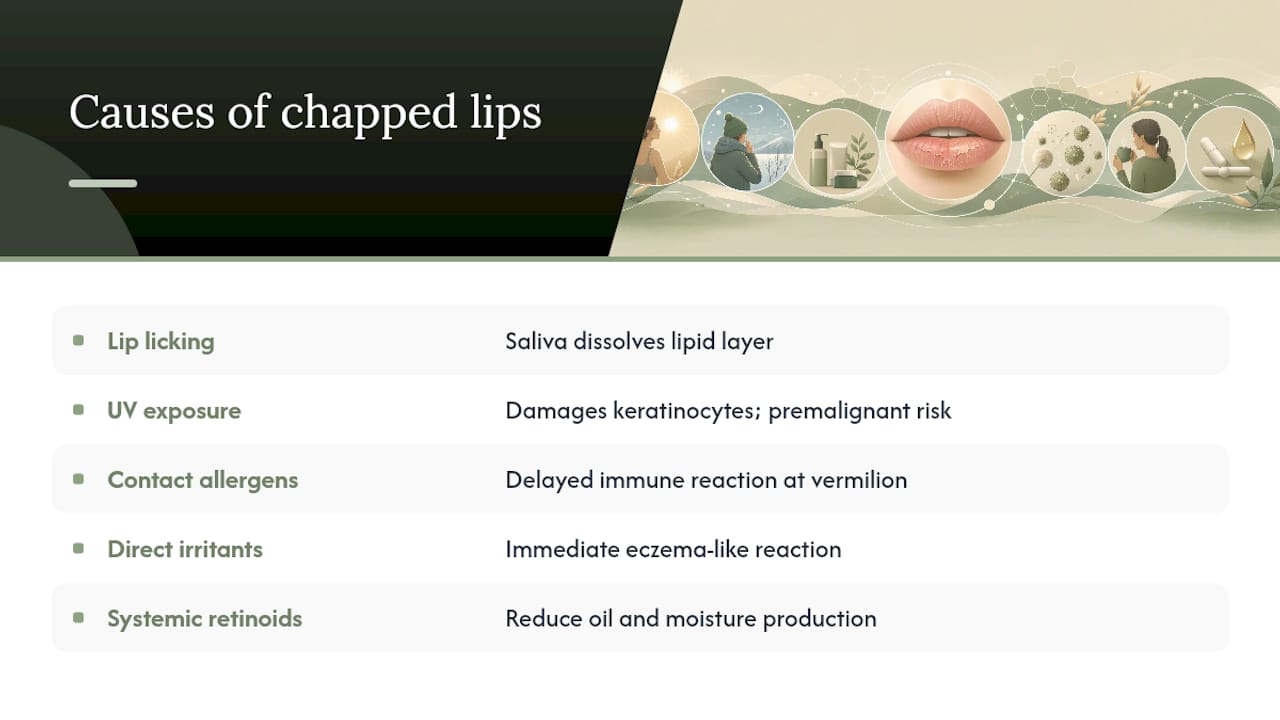
Lip licking makes it worse in a way most people don’t expect. Saliva feels soothing for a few seconds, but it contains digestive enzymes and sits at a slightly acidic pH. Each swipe of the tongue dissolves a little more of the lip’s natural lipid layer, so the relief is temporary and the damage compounds. It’s a habit that fights against itself.
Chronic sun exposure works on a slower timeline but a more serious one. Ultraviolet light damages keratinocytes, the cells that make up the lip’s outer layer, and over years this can progress to actinic cheilitis, a premalignant change. Contact allergens trigger a delayed immune reaction localized right at the vermilion border, while straight irritants cause a more immediate eczema-like reaction. Systemic retinoids reduce oil and moisture production across your entire mucocutaneous surface, which is why nearly everyone on isotretinoin experiences noticeably drier lips.
Who’s at Higher Risk, and When to See a Doctor
Some people deal with chapped lips as an occasional winter annoyance. Others fight it constantly because of who they are or what they’re exposed to.
- Outdoor workers and athletes face constant wind and UV exposure with little protection.
- Fair-skinned individuals have less natural melanin to buffer against sun damage.
- People on isotretinoin or other systemic retinoids experience near-universal lip dryness as a side effect.
- Those with atopic dermatitis or eczema already have a compromised skin barrier that extends to the lips.
- Denture wearers are prone to angular cheilitis from moisture pooling at the mouth corners.
A few signs mean it’s time to stop self-treating and book an appointment: a lesion lasting more than a few weeks, chapping that spreads past the lip border, bleeding, a firm nodule, a rough “sandpapery” patch that won’t smooth out, which can be a warning sign of actinic cheilitis, or recurrent clusters of blisters suggesting herpes simplex. A clinician evaluating persistent cheilitis will typically review your medications, run bloodwork for nutritional deficiencies, consider patch testing for suspected allergens, swab for infection, or biopsy a patch that looks premalignant.
Prevention and Home Treatment That Actually Works
Fixing chapped lips comes down to three moves: protect the barrier, remove the irritant, and know when a balm isn’t enough.
- Occlude and protect. Petrolatum or beeswax based balms seal in moisture better than waxy or oil-only formulas. Apply before you head out into wind or cold, not just after damage is done.
- Protect from UV. Use a lip product with SPF whenever you’re outdoors for extended periods, especially if you’re fair-skinned or spend your workday outside.
- Address hydration and nutrition. Drink enough fluids daily, and if chapping persists despite good habits, ask your doctor about checking vitamin B and iron levels.
- Avoid known irritants. Fragrances, menthol, camphor, salicylic acid, and certain essential oils or preservatives are common offenders in lip products, toothpaste, and mouthwash. If your lips won’t heal, check every product touching your mouth, not just your lip balm.
- Reserve medicated treatment for confirmed cases. Antifungals treat candidal or angular cheilitis, antivirals speed healing of herpes labialis, and topical steroids belong under clinician supervision only, never as a first guess.
Pro Tip: Keep a “suspect list” of every product that touches your lips, including your toothpaste and lip liner, and remove them one at a time for two weeks each. Contact allergies are notoriously hard to pin down without this kind of elimination process, and patch testing is the gold standard when self-elimination doesn’t solve it.
Conditions That Look Like Chapped Lips But Aren’t
Not every crack or sore at your mouth is simple dryness. A few lookalikes trip people up regularly.
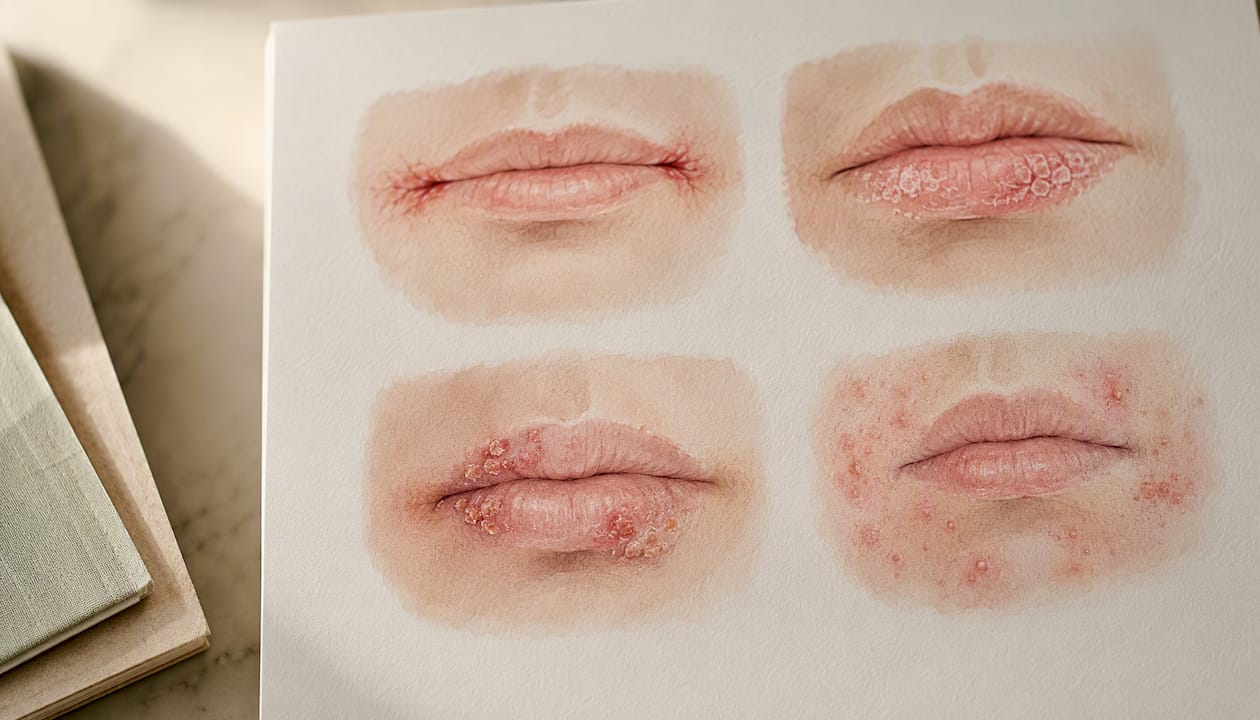
Angular cheilitis sits specifically at the corners of the mouth, often looks moist or macerated rather than flaky, and usually points to a fungal or bacterial cause, sometimes tied to denture fit. Actinic cheilitis shows up as chronic, scaly patches on the lower lip in people with heavy sun exposure. Because it’s premalignant, a persistent rough patch here deserves a biopsy rather than more lip balm. Herpes simplex (cold sores) presents as recurrent, grouped blisters that crust over, and antivirals shorten the outbreak when started early. Perioral dermatitis and allergic cheilitis tend to extend past the lip border onto surrounding skin and are frequently linked to topical steroid overuse or a cosmetic allergen you haven’t identified yet.
LaTerraTales and the Sensitive-Skin Approach
Eco-conscious, sensitive-skin-friendly formulas with minimal, transparent ingredient lists follow the principle dermatologists recommend when lips are reacting to something in a product. If you’re also managing perioral dermatitis or redness-prone skin, the same avoid-the-irritant logic applies. The Natural Arnica Lip Balm is formulated with a short, readable ingredient list for exactly this reason.
A Formulator’s View on Fixing Chapped Lips
Barrier repair beats symptom chasing every time. Keep your ingredient list short, stop licking, and don’t wait past two or three weeks on anything unusual before checking your ingredient labels or a clinician’s opinion.
— LaTerraTales
Where the Natural Arnica Lip Balm Fits Into Your Routine
If your chapped lips trace back to wind, cold, or an overzealous licking habit, a barrier-first balm with a clean ingredient list is exactly the tool this article has been describing. The Natural Arnica Lip Balm leans on that same minimal-ingredient philosophy that avoids the fragrances and irritants dermatologists flag most often.
That said, be candid with yourself about what a retail balm can and can’t do. If your lips are cracked from severe cold exposure or heavy transepidermal water loss, a straight pharmacy petrolatum product applied more frequently may serve you better in the short term. And if you’re seeing a rough patch that won’t smooth out, spreading redness, or sores that outlast two to three weeks, no lip balm replaces a clinician’s evaluation. For everyday barrier support and prevention, browse the full natural skincare collection and add the Arnica Lip Balm to your routine before your next cold snap or sun-heavy week.
Sources
For deeper clinical detail, the NCBI StatPearls entry on cheilitis covers causes and red flags in full. MedlinePlus offers plain-language patient guidance, and the American Academy of Dermatology publishes dermatologist-reviewed tips on healing dry lips.
This article is general information, not a substitute for advice from a qualified doctor. Consult a qualified healthcare professional about your own circumstances before acting on anything here.
- Allergic and irritant contact cheilitis: an overview (PMC)
- Cheilitis - StatPearls - NCBI Bookshelf
- MedlinePlus — Sore, dry lips
- Kiss chapped lips goodbye | Ohio State Health & Discovery
FAQ
What is the best treatment for chapped lips?
Occlusive balms containing petrolatum or beeswax are the most effective first-line option, since they seal moisture in rather than just coating the surface. Pair that with drinking enough fluids, running a humidifier indoors, and using an SPF lip product outdoors.
Is chapped lips a symptom of anything?
Yes. Persistent chapping can signal a vitamin B or iron deficiency, an underlying medication side effect like systemic retinoid use, or a contact allergy to something in your cosmetics or oral care products. It can also point to dehydration or, in chronic sun-exposed cases, actinic cheilitis.
What can be mistaken for chapped lips?
Angular cheilitis, herpes simplex (cold sores), perioral dermatitis, and allergic contact cheilitis all get mistaken for ordinary chapping. The distinguishing clues are location (corners of the mouth versus the whole lip), moisture versus scaling, and whether it extends past the lip border onto surrounding skin.
What is your body telling you when your lips are dry?
Dry lips usually mean your environment, habits, or a product are outpacing your lip barrier’s ability to hold moisture, since lips have no oil glands of their own. If dryness persists despite good habits, it can be a signal to check hydration, nutrient levels, or a hidden sensitivity to something in your routine, and to consider a gentler formula like LaTerraTales’ lip balm built around a shorter ingredient list.
Recommended
Share


