
Face Oil vs Moisturizer: What Your Skin Actually Needs
Face oil is defined as a concentrated lipid product that seals existing moisture into the skin, while a moisturizer is an emulsion that actively delivers water and protective lipids to skin cells. Understanding what is face oil vs moisturizer is the foundation of any effective skincare routine. These two products are not interchangeable. They work on different mechanisms, and using one without the other often leaves your skin either parched or poorly protected. The good news: when you use them together correctly, your skin gets the full spectrum of hydration and barrier support it needs.
What is face oil vs moisturizer: the core difference
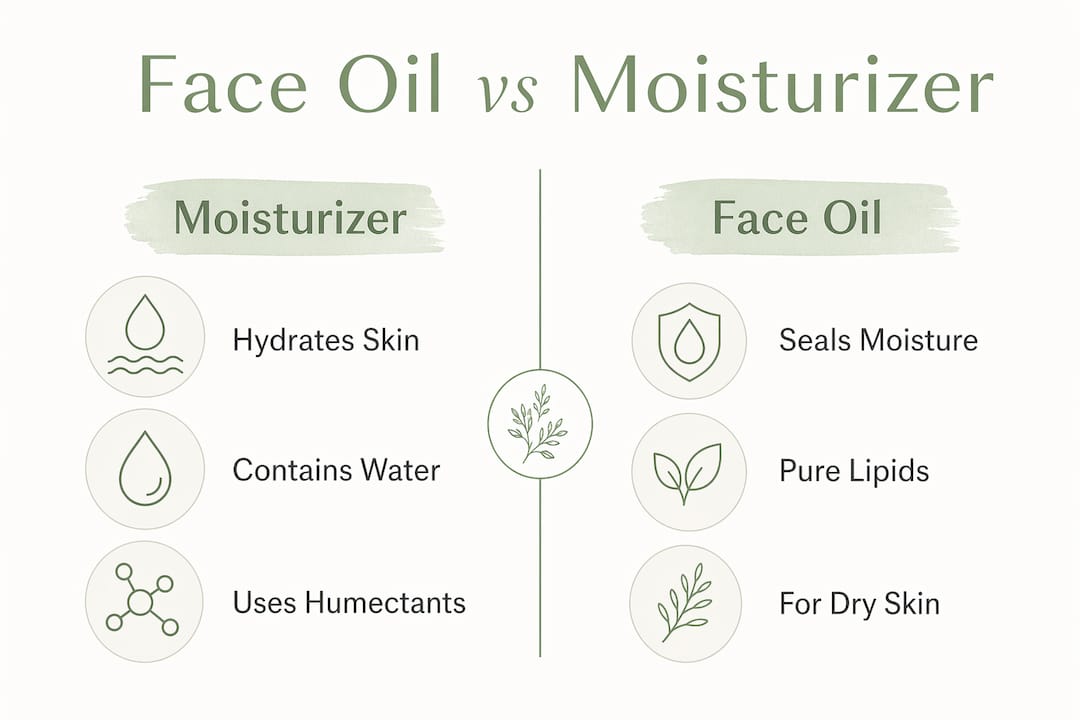
Moisturizers provide both hydration and emollience while face oils seal in existing moisture without adding water. That single distinction changes everything about how you should use them. A moisturizer is an emulsion, meaning it combines water and oil phases held together by emulsifiers. A face oil is pure lipid, with no water phase at all. Moisturizers address your skin’s need for water replenishment. Face oils address your skin’s need for a protective, lipid-rich barrier.
The dermatological terms here matter. “Hydration” refers to water content inside skin cells. “Moisturizing” refers to the broader process of managing both water and the lipid barrier that keeps it there. A face oil moisturizes in the barrier sense but does not hydrate in the cellular sense. Knowing this distinction helps you choose products with confidence rather than relying on marketing language.
How moisturizers hydrate and protect your skin
A moisturizer’s power comes from its three-part ingredient system. Humectants, emollients, and occlusives each play a distinct role in keeping skin healthy and balanced.
- Humectants (hyaluronic acid, glycerin) attract water molecules from the environment and the deeper dermis, binding them to the surface of skin cells.
- Emollients (squalane, plant-derived lipids) fill the microscopic gaps between skin cells, creating a smoother, softer surface texture.
- Occlusives (shea butter, beeswax) form a physical film over the skin that slows water from evaporating off the surface.
This three-part system is why moisturizers work so well across all skin types. Humectants pull water in. Emollients smooth the surface. Occlusives lock the water down. No single ingredient does all three jobs, which is why well-formulated moisturizers combine them.
| Ingredient type | Example ingredients | Primary function |
|---|---|---|
| Humectant | Hyaluronic acid, glycerin | Attracts and binds water to skin |
| Emollient | Squalane, ceramides | Smooths and fills gaps between cells |
| Occlusive | Shea butter, beeswax | Prevents water loss through a surface film |
Pro Tip: If your skin feels tight after washing, reach for a moisturizer with hyaluronic acid first. It replenishes water content that cleansing strips away, before you layer anything else on top.
For people with oily skin, the right moisturizer is not optional. Lightweight gel moisturizers hydrate without heaviness and prevent the compensatory sebum overproduction that dehydrated oily skin triggers. Skipping moisturizer because your skin feels oily is one of the most common mistakes in skincare.
What face oils actually do for your skin
Face oils are concentrated lipids, typically a blend of fatty acids and phytosterols, with no water content. They function primarily as emollients and occlusives. Facial oils act as a final step to prevent transepidermal water loss (TEWL) rather than hydrating skin by themselves. TEWL is the passive evaporation of water through the skin barrier. Reducing it keeps skin plump, soft, and resilient.
The face oil benefits that matter most include:
- Barrier reinforcement: Fatty acids in botanical oils mimic the skin’s natural lipid matrix, strengthening a compromised barrier.
- Reduced TEWL: The occlusive layer slows moisture from escaping, especially in dry or cold climates.
- Antioxidant delivery: Botanical oils carry antioxidants, vitamins, and fatty acids that support barrier function and reduce inflammation and fine lines.
- Surface softness: Emollient fatty acids fill micro-cracks in the skin surface, giving an immediate smoothness and radiance.
Face oils are best suited for mature, dry, or barrier-compromised skin. They are not a substitute for a hydrating moisturizer. Applying oils alone on dry skin traps dryness beneath an occlusive layer, worsening dehydration despite a soft surface feel. Your skin may look dewy but feel increasingly tight over time.
Learning about types of botanical skincare oils helps you match the right oil to your skin’s specific needs, whether that is rosehip for brightening, marula for barrier repair, or jojoba for balance.
Pro Tip: Apply your face oil while your skin is still slightly damp after moisturizer. The oil seals in the water your moisturizer just delivered, maximizing the hydration effect.
Key differences between face oils and moisturizers by skin type
The difference between facial oils and moisturizers is not just chemical. It is practical. Each skin type benefits from a different approach to combining them.
Dry and mature skin needs both products. Moisturizer delivers the water and humectants that aging skin produces less of naturally. A face oil applied afterward seals that hydration in and provides the lipid nourishment that supports a softened, more resilient barrier.
Oily and acne-prone skin benefits from a non-comedogenic moisturizer as the primary product. Non-comedogenic moisturizers and lightweight oils are recommended for oily and acne-prone skin to avoid pore clogging and balance skin hydration. If you choose to add a face oil, select a lightweight, non-comedogenic option like squalane or hemp seed oil.
Combination and normal skin can use both products but may find a well-formulated moisturizer alone is sufficient on most days. A face oil becomes useful in drier seasons or after sun exposure.
Common misconceptions about the difference between facial oils and moisturizers include the belief that oils cause breakouts. The reality is that pore-clogging depends on the specific oil’s comedogenic rating, not the fact that it is an oil. Squalane, for example, has a comedogenic rating of 0 and suits even sensitive, acne-prone skin.
Pro Tip: Check the comedogenic rating of any oil before adding it to your routine. Ratings of 0–2 are generally safe for oily and acne-prone skin. Ratings of 3 and above carry a higher risk of clogging pores.
The question of should I use face oil depends less on skin type and more on what your moisturizer already delivers. If your moisturizer contains squalane or ceramides, you may not need a separate oil daily. If your skin feels tight or looks dull by midday, adding a face oil at night is a practical next step.
How to layer face oil and moisturizer in your routine
Layering order is the most misunderstood part of using both products. Face oil application last in your routine ensures the occlusive layer seals hydrators beneath without blocking absorption. Applying oil first creates a barrier that prevents your moisturizer from penetrating the skin. The water-based products go on first, always.
Follow these steps for an effective routine:
- Cleanse your face to remove impurities and prepare skin for absorption.
- Apply toner or serum (water-based actives like niacinamide or vitamin C) while skin is still slightly damp.
- Apply moisturizer to deliver humectants and emollients directly to skin cells.
- Apply face oil as the final step to seal everything beneath it and reduce TEWL overnight.
Applying face oil last is crucial to avoid blocking absorption of water-based products. Mixing a few drops of oil into your moisturizer is an alternative that gives a lighter occlusive effect without a separate step. This works well for oily skin types who want the face oil benefits without a heavy finish.
For a deeper look at integrating these steps into a complete ritual, the guide on using facial oils in your skin ritual covers timing, quantities, and technique in practical detail.
Pro Tip: Give your moisturizer 60 seconds to absorb before applying your face oil. That brief wait lets the humectants bind water to your skin before the oil seals the surface.
Key Takeaways
Face oils and moisturizers serve distinct, complementary roles: moisturizers hydrate skin cells with water and humectants, while face oils seal that hydration in with a lipid-rich occlusive barrier.
| Point | Details |
|---|---|
| Moisturizers hydrate, oils seal | Moisturizers deliver water and humectants; oils lock in moisture by reducing TEWL. |
| Apply oil last, always | Oil’s occlusive nature blocks absorption if applied before water-based products. |
| All skin types need moisturizer | Even oily skin requires a lightweight moisturizer to prevent dehydration-triggered sebum overproduction. |
| Oils add barrier and antioxidant support | Botanical oils provide fatty acids, phytosterols, and antioxidants beyond simple occlusion. |
| Skin type guides oil selection | Non-comedogenic oils (squalane, hemp seed) suit oily skin; richer oils suit dry or mature skin. |
What I have learned from years of working with botanical formulas
At LaTerraTales, the question we hear most often is whether someone “needs” both a moisturizer and a face oil. My honest answer is that the question itself reflects a misunderstanding of what each product does. They are not competing for the same job. They are partners addressing different parts of the same cycle.
The most common error I see is people applying a beautiful botanical oil directly onto dry, unwashed skin and expecting it to fix dehydration. It will not. The oil creates a soft surface feel, but the dryness underneath gets worse over time. Moisturizer first, oil second. That sequence is not a preference. It is how skin physiology works.
The other error is skipping moisturizer entirely because skin feels oily. Oily skin is often dehydrated skin. The sebaceous glands overproduce oil to compensate for a lack of water. A lightweight gel moisturizer calms that cycle. Adding a non-comedogenic oil afterward, if needed, then reinforces the barrier without adding congestion.
The 2026 skincare science consensus supports combination approaches over single-product routines for most adults. Your skin’s needs change with age, climate, and season. A routine that worked at 25 may not serve you at 40. The willingness to adjust, based on how your skin actually responds rather than what a label promises, is the real skill in skincare.
— LaTerraTales
Natural skincare formulated for every skin type
LaTerraTales builds its skincare collection around the same principle this article covers: every product has a clear, specific role, and the best results come from pairing them thoughtfully.
Whether your skin is dry, oily, sensitive, or somewhere in between, the LaTerraTales natural skincare collection includes clean, eco-conscious moisturizers and botanical oils formulated for the 20–55 age group. Each formula is designed to work with your skin’s biology, not against it. For those looking to add a luxurious lipid layer to their routine, the Prestige Oriental dry oil delivers concentrated botanical nourishment with a weightless finish. Explore the full range and find the pairing that fits your skin’s needs today.
FAQ
What is the main difference between face oil and moisturizer?
A moisturizer delivers water and humectants to hydrate skin cells, while a face oil is a pure lipid that seals moisture in by forming an occlusive barrier. They address different steps in the same hydration cycle.
Can face oil replace moisturizer?
Face oils cannot replace moisturizers because they contain no water or humectants and cannot hydrate skin cells on their own. Dermatologists recommend using oils as a complement to moisturizer, not a substitute.
Should I use face oil if I have oily skin?
Yes, but choose a non-comedogenic oil with a comedogenic rating of 0–2, such as squalane or hemp seed oil. Oily skin is often dehydrated, and a lightweight oil applied after a gel moisturizer can support the barrier without clogging pores.
Which goes on first, face oil or moisturizer?
Moisturizer always goes on before face oil. Oil’s occlusive nature creates a seal that blocks water-based products from absorbing if applied first. Apply moisturizer, wait 60 seconds, then apply oil as the final step.
What are the best products for dry skin: oil or moisturizer?
Dry skin benefits most from using both. A moisturizer with hyaluronic acid and ceramides replenishes water and lipids, while a richer botanical oil applied afterward reduces TEWL and provides lasting softness and barrier repair.


