
Palm-Oil-Free Beauty Products: Your 2026 Lebanon Guide
Palm-oil-free beauty products are cosmetic and skincare items formulated without palm oil or any palm-derived ingredients, designed to reduce environmental harm and support sustainable beauty practices. About 70% of cosmetic products worldwide contain palm-derived raw materials, making palm oil one of the most pervasive ingredients in the industry. That scale means choosing palm-oil-free alternatives is one of the most direct ways you can reduce your personal environmental footprint. For eco-conscious shoppers in Lebanon, understanding what these products are, what they contain instead, and how to find them is the first step toward genuinely cleaner beauty.
What are palm-oil-free beauty products and why do they matter?
Palm-oil-free beauty products are formulated without palm oil, palm kernel oil, or any of their chemical derivatives. The industry term you will see on certifications and brand policies is “palm-free,” which signals a complete exclusion rather than a reduction. These products replace palm-derived ingredients with botanical oils, fermentation-derived lipids, or other plant-based fats that perform the same cosmetic functions without the associated environmental cost.
The significance goes beyond a label. Palm oil is the world’s most widely used vegetable oil, and its production drives deforestation at a rate of 300 football fields of forest cleared every hour. That loss destroys habitat for orangutans, tigers, and thousands of other species. It also releases stored carbon, contributing directly to climate change. When you choose a genuinely palm-free product, you vote with your wallet against that cycle.
For Lebanese consumers, the choice carries added weight. Lebanon’s own Mediterranean forests and biodiversity are under pressure, and the global deforestation driven by palm oil affects regional climate patterns. Supporting palm-free beauty brands connects local values to a global solution.

Why is palm oil so common in cosmetics, and what problems does it cause?
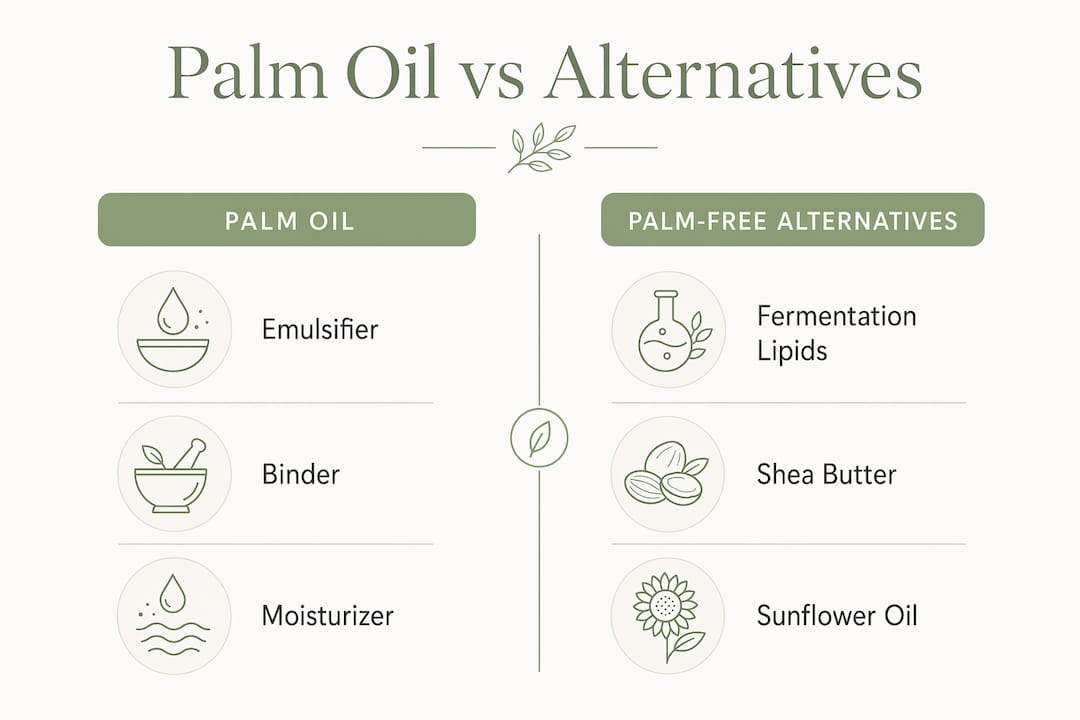
Palm oil performs several critical functions in cosmetics that make it hard to replace. It acts as an emulsifier, binding water and oil together in creams and lotions. It adds texture, giving products that smooth, spreadable feel. It also stabilizes formulas, extending shelf life without synthetic preservatives. These properties explain why global palm oil production reaches roughly 75 million tonnes annually, with the beauty industry drawing on a significant share.
The environmental consequences are severe and well-documented. Deforestation for palm plantations destroys irreplaceable ecosystems, particularly in Indonesia and Malaysia. Carbon-rich peatlands are drained and burned, releasing greenhouse gases at a massive scale. Wildlife populations collapse when their habitat disappears.
One of the most frustrating obstacles for conscious shoppers is ingredient labeling. Palm oil hides under over 200 alternative names in product ingredient lists. Common aliases include:
- Palmitic acid and palm kernel oil
- Cetyl alcohol (when palm-derived)
- Glyceryl stearate and stearic acid
- Sodium laureth sulfate (when palm-derived)
- Sodium palmate and sodium palm kernelate
This labeling complexity means a product can claim to be “natural” while still containing multiple palm derivatives. Recognizing these names is the foundation of informed shopping.
Pro Tip: Download a palm oil ingredient checker app such as the one offered by the Orangutan Alliance before your next shopping trip. Cross-referencing ingredient lists takes seconds and removes the guesswork.
What ingredients replace palm oil in palm-free cosmetics?
The most exciting development in palm-free beauty is fermentation technology. Scientists can now produce lipid complexes using yeast fermentation, creating fats that behave exactly like palm oil in cosmetic formulas. Products like ZymaLipid Complex and CleanOil are 99% pure fatty acid blends designed to replace tropical oils without any deforestation. These lab-grown fats are not a compromise. They are a performance upgrade.
Fermentation technologies can achieve over 95% lower greenhouse gas emissions compared to conventional palm oil production. That reduction is transformative for the beauty industry’s carbon footprint. Fermentation-derived oils also provide healthier unsaturated fatty acids and strengthen the skin barrier, making them beneficial for sensitive skin types.
Natural botanical alternatives also play a major role. Here is how the main options compare:
| Ingredient | Source | Environmental benefit | Skin benefit |
|---|---|---|---|
| Fermentation-derived lipids (ZymaLipid, CleanOil) | Yeast fermentation | 90%+ lower carbon emissions, no land clearing | Strengthens skin barrier, unsaturated fatty acids |
| Shea butter | Shea tree nuts | Supports African agroforestry, low deforestation risk | Deep moisture, anti-inflammatory |
| Coconut oil | Coconut palm | Lower deforestation impact than oil palm | Emollient, antimicrobial |
| Sunflower seed oil | Annual crop | Minimal habitat disruption | Lightweight, rich in vitamin E |
| Candelilla wax | Desert shrub | Drought-resistant, low water use | Texture and stability in lip products |
Lab-grown fats melt on skin and integrate well into emulsions, offering performance that matches or exceeds traditional palm-derived ingredients. Brands using these alternatives can honestly claim both sustainability and efficacy. You can read more about how natural oils benefit skin to understand why these substitutes work so well in practice.
Pro Tip: When a brand lists shea butter, sunflower oil, or fermentation-derived lipids as primary emollients, that is a strong signal the formula is genuinely palm-free. Look for these in the first five ingredients.
How do you identify genuinely palm-free beauty products?
Identifying a truly palm-free product requires more than reading the front label. Certifications help, but they are not all equal. The Roundtable on Sustainable Palm Oil (RSPO) certifies that palm oil is sourced more responsibly, but RSPO certification does not guarantee zero environmental impact and does not prevent deforestation in areas adjacent to certified concessions. RSPO is better than nothing, but it is not the same as palm-free.
The Palm Oil Free Certification Accreditation Programme (POFCAP) is the standard specifically designed for palm-free claims. A POFCAP logo means the product contains no palm oil or palm derivatives at all. The Leaping Bunny certification, while primarily focused on cruelty-free testing, often correlates with brands that also prioritize ingredient transparency and sustainable sourcing.
Practical steps for verifying palm-free status:
- Read the full INCI list. The International Nomenclature of Cosmetic Ingredients (INCI) list is the standardized ingredient declaration. Cross-reference it against a palm oil alias database.
- Check the brand’s sourcing policy. Transparent brands publish their ingredient sourcing commitments on their websites.
- Look for POFCAP or explicit “palm-free” statements. Vague terms like “natural” or “eco-friendly” do not confirm palm-free status.
- Contact the brand directly. Brands committed to palm-free formulations will answer ingredient questions clearly and quickly.
Consumers should prefer palm-oil-free brands where possible, using RSPO-certified palm only when substitution is not feasible. This balanced approach reduces deforestation more effectively than avoiding all cosmetics. Exploring plant-based skincare ingredients helps you build the ingredient literacy to shop with confidence.
What are the benefits and challenges of palm-free beauty in Lebanon?
Choosing palm-free beauty products delivers real environmental benefits. Every palm-free purchase reduces demand for deforestation-linked supply chains. It lowers the carbon footprint of your skincare routine. It also supports biodiversity, from Borneo’s rainforests to Lebanon’s own fragile ecosystems that depend on a stable global climate.
Skin benefits are equally real. Fermentation-derived lipids protect the skin barrier and deliver healthier fatty acid profiles than conventional palm-derived emollients. For sensitive skin, this matters. Formulas built on shea butter, botanical oils, and fermentation lipids tend to be gentler and less likely to cause irritation.
The challenges in Lebanon’s market are practical. Palm-free products are sometimes harder to find in conventional pharmacies and supermarkets. They can carry a higher price point because alternative ingredients cost more to source or produce. Availability varies, and not every brand that markets itself as “natural” in Lebanon has verified palm-free status.
The way to balance sustainability with accessibility is to start small. Swap one product at a time, beginning with the items you use most, such as your daily cleanser or moisturizer. Prioritize products where palm derivatives are most concentrated, like solid cleansing bars and body lotions. Over time, your routine becomes both cleaner and more intentional.
How to transition to palm-free beauty: practical steps
Switching to palm-free beauty does not require replacing everything at once. A phased approach works better and lets you evaluate each product properly.
- Audit your current products. List every product you use daily and check each ingredient list for palm aliases. This gives you a clear picture of where palm oil is most present in your routine.
- Start with cleansers. Solid cleansing bars are one of the easiest categories to swap. Many palm-free options use coconut oil, shea butter, or fermentation-derived fats and perform just as well.
- Move to moisturizers and serums. Look for formulas featuring sunflower seed oil, jojoba oil, or shea butter as primary emollients. These are widely available and well-tolerated by most skin types.
- Research brand policies. Seek out brands that publish explicit palm-free commitments and ingredient sourcing information. Transparency is the clearest indicator of genuine commitment.
- Support fermentation-based innovation. Brands using ZymaLipid Complex, CleanOil, or similar fermentation-derived lipids represent the future of sustainable cosmetics. Choosing them accelerates the industry’s shift away from deforestation.
Pro Tip: Treat your first palm-free swap as an experiment. Buy a travel size or sample before committing to a full product. This reduces waste and lets you confirm the formula suits your skin before investing.
Key Takeaways
Palm-oil-free beauty products are the most direct way to remove deforestation from your skincare routine, and fermentation technology now makes them as effective as conventional alternatives.
| Point | Details |
|---|---|
| Palm oil is pervasive | About 70% of cosmetics contain palm derivatives, often hidden under 200+ ingredient names. |
| Fermentation changes the equation | Lab-grown lipids like ZymaLipid Complex cut greenhouse gas emissions by over 90% vs. conventional palm oil. |
| RSPO is not palm-free | RSPO certification reduces deforestation risk but does not eliminate palm derivatives from a formula. |
| POFCAP is the gold standard | The POFCAP certification is the only label that guarantees complete palm-free status in cosmetics. |
| Start with cleansers | Swapping your daily cleanser is the fastest, most impactful first step toward a palm-free routine. |
Why fermentation technology is the real turning point for palm-free beauty
At LaTerraTales, we have watched the palm-free conversation shift dramatically over the past few years. For a long time, the honest answer to “can you replace palm oil without sacrificing performance?” was “not entirely.” Shea butter and coconut oil are excellent, but they do not replicate every function palm oil performs in complex emulsions. That gap gave formulators a genuine reason to keep palm derivatives in their products.
Fermentation-derived lipids close that gap. When we see ingredients like ZymaLipid Complex entering cosmetic formulas, we see a technology that removes the last real excuse for using palm oil. The performance is there. The sustainability credentials are exceptional. The supply chain is more stable than agricultural palm, which is vulnerable to weather, disease, and geopolitical disruption.
What I find most compelling is the consumer side of this shift. Lebanese shoppers are increasingly asking the right questions, reading labels, and demanding transparency from brands. That pressure works. Brands respond to purchasing decisions faster than they respond to regulation. Every time you choose a verified palm-free product, you send a signal that travels directly to formulation teams and sourcing departments.
The uncomfortable truth is that “sustainable palm oil” is a partial solution at best. It reduces harm within certified areas but does not stop the broader expansion of palm plantations. For consumers who want zero deforestation in their beauty routine, palm-free is the only honest answer. We believe that standard is achievable, and the science now supports it fully.
— LaTerraTales
Clean beauty from LaTerraTales, formulated without palm oil
At LaTerraTales, ingredient transparency is not a marketing claim. It is the foundation of every formula we create. Our natural skincare collection is built around carefully selected botanical oils, fermentation-derived actives, and plant-based fats that deliver real results without palm derivatives.
Our handmade natural cleanser bar is one of the clearest examples of what palm-free formulation looks like in practice: gentle on sensitive skin, effective at cleansing, and free from the deforestation-linked supply chains that conventional cleansers rely on. Whether you are building a new routine or refining an existing one, our collection gives you products you can trust, with ingredients you can verify. Your skin and the planet deserve nothing less.
FAQ
What does “palm-free” mean on a beauty product?
“Palm-free” means the product contains no palm oil, palm kernel oil, or any ingredient derived from either source. It is a stricter standard than “sustainable palm oil” or RSPO-certified.
How do I spot palm oil in an ingredient list?
Palm oil appears under more than 200 names, including palmitic acid, cetyl alcohol, glyceryl stearate, and sodium laureth sulfate. Cross-referencing the full INCI list against a palm oil alias database is the most reliable method.
Is RSPO certification the same as palm-free?
No. RSPO certification reduces deforestation within certified concessions but does not eliminate palm derivatives from a product. Only POFCAP certification confirms a product is completely palm-free.
Are palm-free beauty products better for sensitive skin?
Yes, in many cases. Fermentation-derived lipids strengthen the skin barrier and provide healthier fatty acid profiles, making palm-free formulas gentler and less likely to cause irritation.
Where can I find palm-free beauty products in Lebanon?
Brands with explicit palm-free policies and ingredient transparency, like LaTerraTales, offer verified options. Checking brand websites for sourcing commitments and looking for POFCAP certification are the most reliable ways to confirm palm-free status before purchasing.


