

Cut Glass Use Up to 100%: Refillable Skincare Packaging for Brands
Refillable skincare packaging works when the product is a repeat-buy category, cleansers, lotions, and select serums, where customers already reorder often enough to make a refill habit stick. Manufacturer-reported lifecycle data shows real material savings, and momentum is building fast across the industry. If you’re a brand decision-maker, the next move is straightforward: evaluate your design options and supplier partners before you commit to a format.
TL;DR:
- Refillable skincare products perform best with high-reorder categories like cleansers, lotions, and serums, as customers already buy frequently enough to establish a refill habit.
- Standardized refill systems such as click-in jars, airless cartridges, and mono-material pouches have made switching to refillable packaging more affordable and scalable for mid-size brands.
- Refillable pods can significantly reduce material use, with data showing glass cut by up to 100% and plastic by 36%, lowering environmental impact and shipping costs.
- Material choice is crucial; pairing durable outer shells with interchangeable inner components allows luxury brands to maintain aesthetics while promoting circularity.
- Common pitfalls include reformulation issues, hygiene concerns, supply chain complexity, and unverified recyclability claims, which require careful testing and validation beforehand.
Table of Contents
- Why Is the Refillable Skincare Market Growing Right Now?
- What Environmental and Commercial Benefits Do Refills Actually Deliver?
- Which Materials and Designs Actually Support Circularity?
- What Refill Formats Fit Different Skincare Products?
- What Goes Wrong When Brands Launch Refills?
- How Should You Choose a Refillable System for Your Brand?
- How LaTerraTales Approaches Sustainable Packaging
- Where Refillable Skincare Packaging Goes From Here
- Explore LaTerraTales’ Plastic-Free Skincare Collection
- Where to Go for Refill Packaging Specs and Coverage
- Sources
- FAQ
Why Is the Refillable Skincare Market Growing Right Now?
The push toward refillable beauty packaging isn’t a fringe experiment anymore. Industry initiatives like World Refill Day, which launched in 2024 with backing from major players including L’Oréal, have turned refill programs into a coordinated industry conversation rather than a scattered set of brand pilots.
Adoption isn’t even across categories. Fragrance led early, largely because perfume bottles carry enough retail markup to absorb refill infrastructure costs. Cleansers and high-loyalty creams are catching up quickly, since customers already replace them every four to eight weeks and rarely shop around once they find a formula that works.
What’s changed most is the supplier side. Packaging manufacturers have moved from custom, one-off refill tooling to standardized, market-ready systems that mid-size brands can actually afford:
- Airless cartridge systems that protect actives without a pump mechanism that traps air
- Click-in glass jars built around post-consumer recycled content
- Mono-material pouches designed for curbside recyclability
- Modular inner pods that fit multiple outer shell designs across a product line
That standardization is the real story. Refillable packaging used to require bespoke engineering. Now it’s closer to a catalog decision.
What Environmental and Commercial Benefits Do Refills Actually Deliver?
The environmental case for refillable beauty packaging isn’t theoretical anymore. It’s shown up in supplier-verified numbers, and it’s shown up in customer retention data.
Statistic Callout: L’Oréal has reported that switching certain product lines to refill pods cut glass use by up to 100%, metal by 95%, plastic by 36%, and cardboard by 31% compared to buying a new full jar each time.
Those savings compound at the shipping level too. A refill pod weighs a fraction of a full outer container, which means lighter cartons, more units per pallet, and a lower per-milliliter freight cost for anyone shipping direct-to-consumer.
The commercial upside is just as concrete:
- Refill pricing gives customers a visible reason to return to your site instead of a competitor’s
- Brands like Emma Lewisham price refills 10 to 15% below full packs, while fragrance refills can run 40 to 50% cheaper depending on volume
- A customer who buys a refill twice has effectively opted into your brand relationship, which raises lifetime value without added acquisition spend
That pricing gap is the lever most brands underuse. A discount that feels generous to the customer often costs less than the packaging you’re not remanufacturing.
Which Materials and Designs Actually Support Circularity?
Material choice is where most refill programs succeed or quietly fail. Glass, aluminum, PCR plastics, PETG, and mono-material pouches each solve a different piece of the puzzle, and none of them solves all of it alone.
- Glass offers premium shelf appeal and full recyclability, but adds shipping weight
- Aluminum is lightweight and infinitely recyclable, though it limits see-through packaging design
- PCR plastics cut virgin material use while keeping molding costs familiar to existing production lines
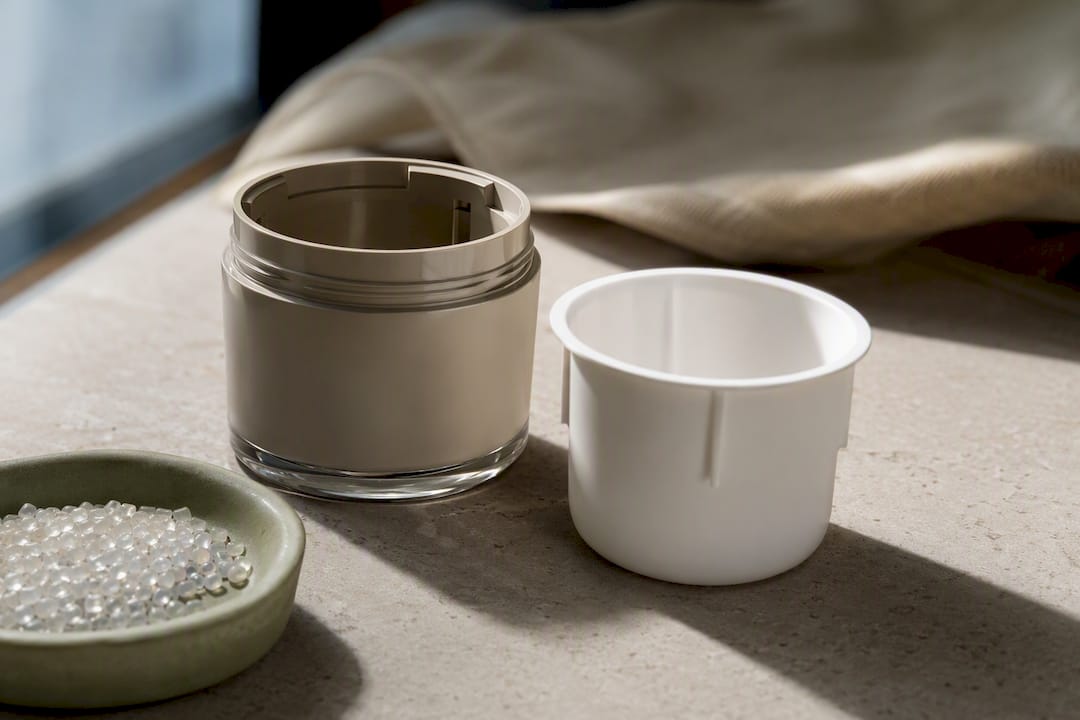
- PETG outer shells with PP inner pods, the approach used in HC Packaging’s Echo jar, separate the durable outer shell from a lower-cost replaceable inner
- Mono-material pouches simplify recycling streams but currently work best for lower-viscosity formulas
The design pattern that keeps showing up among suppliers is separation: a long-lasting outer shell paired with a swappable inner component. Gerresheimer’s Gx CyClic® jar uses this exact logic, pairing a click-in refill mechanism with up to 40% post-consumer recycled glass in the outer body.
Luxury brands have figured out how to make circularity look expensive rather than cheap. Pairing a PCR outer shell with a lightweight, replaceable inner pod lets a brand keep its signature silhouette on the shelf while swapping only the disposable component, a strategy that design teams increasingly favor for exactly this reason.
Pro Tip: Test your refill pod’s recyclability claim with your actual municipal recycling stream, not just the material’s theoretical recyclability. A “recyclable” mono-material pouch that your customers’ local facility doesn’t accept is a marketing liability waiting to surface.
What Refill Formats Fit Different Skincare Products?
Not every format suits every formula. Choosing the wrong refill mechanism for your viscosity or actives is one of the fastest ways to end up with a program customers abandon after one try.
- Click-in and twist-out inner cups work well for creams and balms; they’re intuitive, low-mess, and don’t require the customer to handle liquid formula directly.
- Airless refill cartridges, like Aptar’s Serumony Refill, suit serums and actives that oxidize easily. The system’s replaceable cartridge design supports high formula restitution, protecting sensitive ingredients from air exposure during the refill swap itself.
- Pouches and bulk refill pillows fit gels, lotions, and cleansers best. They ship flat and light, which is a real freight advantage, though flexible multilayer pouches can complicate curbside recycling if the layers aren’t mono-material.
- Standard refill jars, such as HC Packaging’s Echo, work across the broadest range of cream and lotion viscosities without requiring a specialized dispensing mechanism.
What Goes Wrong When Brands Launch Refills?
Refillable skincare packaging fails in predictable ways, and most of them are avoidable with basic planning upfront.
- Reformulation risk: a formula stable in its original container may not hold up in a different inner material or a longer shelf life between refills
- Hygiene concerns: open-refill formats need clear instructions and, ideally, a barrier design that limits direct hand contact with formula
- Supply chain complexity: deciding between mail-back refill returns and simple resupply purchases changes your inventory model, your packaging costs, and your customer’s actual experience
- Greenwashing exposure: a “recyclable” claim only holds up if you can point to verified material data, not marketing copy; industry analysts have flagged that refills alone don’t solve plastic pollution unless the underlying materials genuinely shift away from virgin plastic
None of these issues are reasons to skip refills. They’re reasons to test the format with a small SKU before rolling it across a full product line.
How Should You Choose a Refillable System for Your Brand?
Picking a refill supplier comes down to a handful of criteria that determine whether the program actually reduces waste or just relocates it.
- Score circularity honestly. Ask for material composition by weight, not just a “recyclable” label.
- Test refill convenience yourself. If your own team finds the swap fiddly, customers will too.
- Model the unit economics. Compare refill production cost against the freight and material savings on the full container it replaces.
- Check decoration flexibility. Some click-in systems limit how much you can brand the outer shell without retooling.
- Vet the supplier directly, asking about minimum order quantities, lead times, and third-party recyclability evidence rather than taking a spec sheet at face value.
That range mirrors what brands like Emma Lewisham use, and it’s wide enough to feel like a genuine reward without eroding your margin on the refill component.*
Improving the odds that customers actually rebuy also means thinking about retention mechanics, not just packaging mechanics. Tools built for beauty and wellness retention can help you track whether refill customers are actually returning at the rate your pricing model assumes.
How LaTerraTales Approaches Sustainable Packaging
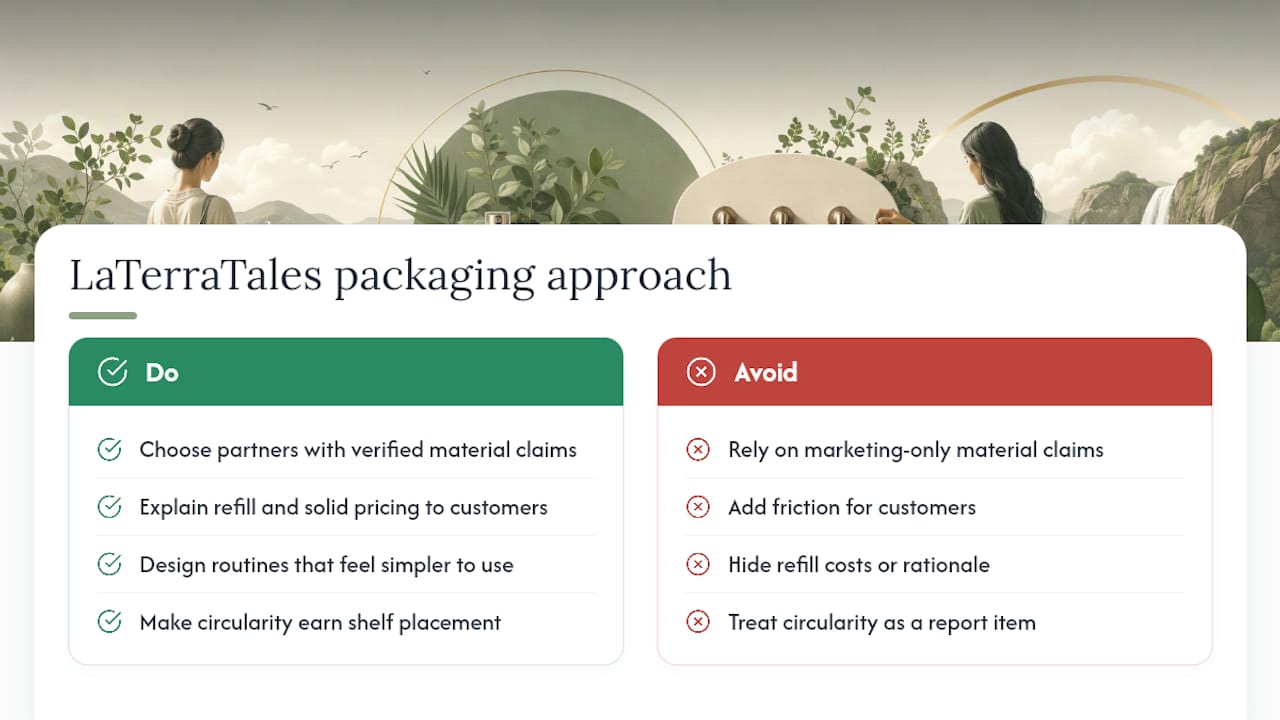
Some brands build their skincare, cleansing bars, and botanical oils around a simple rule: sensitive skin and sustainable packaging shouldn’t be in tension with each other. That means selecting materials that hold up to reformulation scrutiny and packaging choices that reduce single-use waste without adding friction for the customer.
In practice, that looks like partner selection based on verified material claims, not marketing language, plus straightforward customer education about why certain refills or solid formats cost what they do. The goal is a routine that feels simpler to use, not more complicated in the name of sustainability. Brands considering their own plastic-free product lineup face the same balancing act: circularity has to earn its place on the shelf, not just in the sustainability report.
Where Refillable Skincare Packaging Goes From Here
Expect airless and click-in systems to keep displacing single-use plastic in premium skincare over the next few years, with mono-material pouches closing the gap for lower-cost lines. Brands that win will treat refill convenience as a design requirement, not an afterthought.
— LaTerraTales
Explore LaTerraTales’ Plastic-Free Skincare Collection
This brand gives you a working example of what circular packaging looks like when it’s built around sensitive skin from the start, not retrofitted onto an existing line. The formulas in the collection are designed to pair minimal, sustainable packaging with gentle, evidence-based ingredients, so reducing single-use waste never means compromising on what actually touches your skin.
If you’re benchmarking refill and plastic-free approaches for your own brand, LaTerraTales’ natural skincare collection is a useful reference point for how packaging, formulation, and shelf appeal can work together instead of against each other. The brand’s solid cleansing bar is a straightforward example of eliminating a bottle altogether rather than just refilling one. Browse the collection to see the approach in a real product, and consider it a starting reference as you shape your own packaging roadmap.
Where to Go for Refill Packaging Specs and Coverage
For technical specs and procurement details, consult supplier pages directly: Aptar’s Serumony Refill for airless dropper systems, Gerresheimer’s Gx CyClic® for click-in glass jars, and HC Packaging’s Echo jar for double-wall cream refills. For market context, Vogue’s coverage of refillable beauty and PackagingTechToday’s analysis both offer useful industry framing.
Sources
- Refillable Packaging: What Happened to Refillable Beauty? | Vogue
- Gx CyClic® Refill jar | Gerresheimer
FAQ
What Is Refillable Skincare Packaging?
It’s a packaging system where a durable outer shell or dispenser is reused while only the inner formula container, a pod, cartridge, or pouch, gets replaced, cutting material waste per purchase.
Which Skincare Products Work Best for Refills?
Repeat-buy categories with high reorder frequency, cleansers, lotions, and some serums, adopt refills most successfully because customers already reorder often enough to justify the format.
How Much Material Waste Do Refills Actually Save?
Manufacturer data from L’Oréal shows refill pod conversions can cut glass use by up to 100%, metal by 95%, plastic by 36%, and cardboard by 31% versus a new full container.
How Should Brands Price Refills Compared to Full-Size Products?
A discount of 10 to 15% is common for creams and lotions, while fragrance refills can run 40 to 50% cheaper depending on the format and volume.
What’s the Biggest Risk When Launching a Refill Program?
Reformulation instability and unverified recyclability claims cause the most trouble; test your formula in the new container and confirm material claims with your supplier before launch.


