

What Bioavailable Means for Wellness Supplements
Bioavailable means the fraction of a nutrient that actually gets absorbed, enters your bloodstream, and reaches the cells that need it. It is not the number printed on the supplement label. Label amounts show what was added during manufacturing, not what your body will use.
Two people taking the same capsule can absorb very different amounts, shaped by age, gut health, and medications they take. That variability is well documented in research on inter-individual differences in nutrient absorption, which is why no single supplement works identically for everyone.
- Bioavailable ≠ dose on the label. The milligrams listed are a starting point, not a guarantee.
- Absorption is individual. Gut microbiota, age, and drug interactions all move the number up or down.
- There’s no universal percentage. Formulation science treats bioavailability as a range, not a fixed constant, according to a detailed review of micronutrient bioavailability factors.
Key Takeaways
Bioavailability, not the number on a label, determines whether a supplement’s nutrients actually reach the cells that need them.
| Point | Details |
|---|---|
| Bioavailable means absorbed and usable | The fraction that reaches your bloodstream and cells matters more than the milligrams on the label. |
| Form beats dose | Methylated, chelated, or liposomal forms often outperform higher doses of a cheaper form. |
| Food and timing change outcomes | Fat aids fat-soluble vitamins; calcium, coffee, and tea block iron absorption. |
| Marketing claims need evidence | Look for named chemical forms, human comparative data, and third-party testing seals. |
| Individual variation is real | Age, gut health, pregnancy, and medications all shift how much you personally absorb. |
Table of Contents
- What Does Bioavailable Mean in Wellness Supplements vs. Pharmaceuticals?
- What Factors Change How Much a Supplement You Actually Absorb?
- How Bioavailable Are Common Supplements Like Vitamin D or Iron?
- What Does “Bioavailable” Mean When It’s Used as a Marketing Claim?
- How Can You Choose Supplements That Absorb Better?
- What Are the Limits of Bioavailability Testing?
- Why Bioavailability Shapes How We Formulate at LaTerraTales
- Frequently Asked Questions
- Sources
What Does Bioavailable Mean in Wellness Supplements vs. Pharmaceuticals?
The word “bioavailable” gets used differently depending on who’s talking. Pharmacology defines it through pharmacokinetics: the rate and extent to which an active ingredient reaches the bloodstream, typically measured by area under the plasma concentration curve, or AUC, as the Merck Manual explains. Nutrition science cares less about blood-level curves and more about whether a nutrient ultimately becomes usable, whether that’s building bone, supporting red blood cells, or feeding a metabolic pathway.
The FDA’s regulatory definition under 21 CFR frames bioavailability as the rate and extent of absorption to the site of action, a standard built for drugs, not vitamins. Supplements borrow the language but rarely get the same rigorous measurement.
A simple framework called ADME helps make sense of what happens after you swallow a capsule:
- Absorption — how much crosses the gut lining into your system.
- Distribution — where it travels once inside the bloodstream.
- Metabolism — how the liver and enzymes transform it before use.
- Excretion — how the unused portion leaves your body.
Bioavailability in supplements is best understood as a proportion, not a promise. What’s absorbed, distributed, and metabolized determines whether a nutrient ever reaches the cells it’s meant to support.
What Factors Change How Much a Supplement You Actually Absorb?
Absorption depends on more than what’s inside the bottle. Formulation science treats bioavailability as the product of several interacting variables, and a few matter more than most people realize.
- Chemical form. Methylated B vitamins and chelated minerals bypass metabolic bottlenecks that block cheaper, unmethylated forms.
- Dose size. Absorption often follows saturation kinetics, meaning your gut can only process so much at once. Doubling the dose rarely doubles what’s absorbed.
- Food matrix. Fat improves uptake of fat-soluble vitamins like D and K, while phytates in grains and legumes can bind minerals and reduce absorption.
- Individual physiology. Gut microbiome diversity, age, pregnancy, and medications that induce or inhibit liver enzymes all shift outcomes.
- Delivery format and manufacturing quality. Liquids, powders, and capsules dissolve differently, and third-party testing verifies that what’s on the label matches what’s inside.
Formulators increasingly rely on delivery technologies, like lipid-based carriers and encapsulation, to boost how much of an active ingredient survives digestion, a strategy detailed in this formulation guide on bioavailability optimization.
Pro Tip: A higher dose on the label doesn’t mean a higher dose in your bloodstream. Look for the chemical form first, then worry about the milligrams.
How Bioavailable Are Common Supplements Like Vitamin D or Iron?
Abstract definitions become useful once you see them applied to nutrients people actually take.
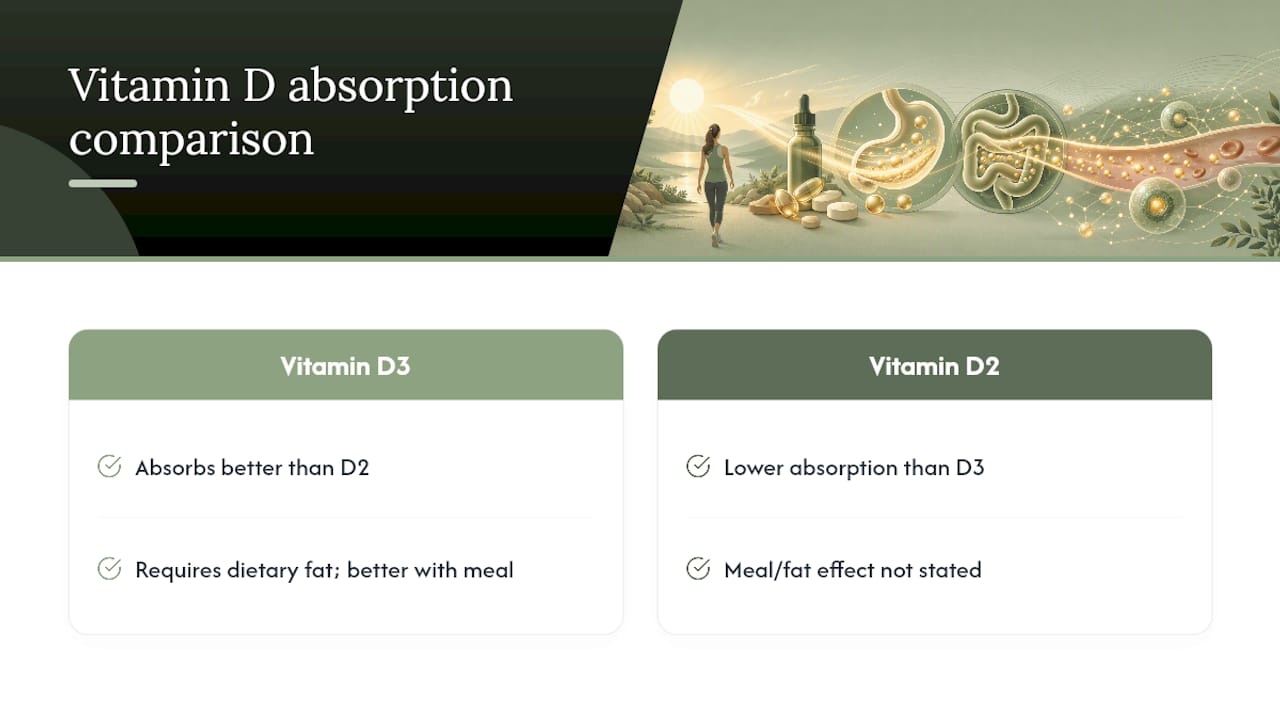
Vitamin D3 absorbs better than D2 and needs dietary fat to cross the gut wall efficiently. Taking it with a meal, rather than on an empty stomach, meaningfully changes the outcome.
Vitamin B12 in supplement form, especially methylcobalamin, can be more reliably absorbed than food-based B12 for people with reduced stomach acid or absorption issues, which becomes more common with age.
Iron varies enormously by form. Heme iron from animal sources absorbs far more readily than non-heme iron from plants or supplements, and calcium, coffee, and tea all block iron uptake when consumed at the same time.
Calcium tells a more sobering story. Consumer research on supplement absorption suggests that only a fraction of supplemental calcium may ultimately reach the bones, with the rest lost to excretion or poor uptake, depending on formulation and individual factors. Dairy-based calcium, aided by its natural food matrix, often performs better for this reason.
Curcumin and other polyphenols are notoriously poorly absorbed on their own. Pairing curcumin with black pepper extract or a fat source substantially improves how much reaches circulation.

The common thread: some nutrients are supplement-friendly, others still favor whole foods. Ingredients like beetroot illustrate how botanical compounds support skin and systemic health through their natural matrix, not isolation.
What Does “Bioavailable” Mean When It’s Used as a Marketing Claim?
When a label says “bioavailable,” it’s almost always describing relative bioavailability, a comparison between one formulation and another, not an absolute measurement against an IV dose. Absolute bioavailability, the pharmaceutical gold standard, is rarely tested for nutraceuticals because it requires comparing oral intake to intravenous delivery, according to background on how bioavailability is defined and measured.
That distinction matters when you’re reading a bottle.
Before trusting a bioavailability claim, check for:
- The specific chemical form named (methylfolate, bisglycinate, citrate), not just the nutrient name.
- Evidence of a human comparative study, not just lab or animal data.
- A third-party testing seal confirming what’s inside matches the label.
Ask for evidence, not adjectives. A real bioavailability claim names its comparator and shows its data; a marketing claim just uses the word.
Ingredient transparency matters here more than most shoppers realize, and it’s worth understanding what real transparency looks like in beauty and wellness labeling before trusting a bold claim on a bottle.
How Can You Choose Supplements That Absorb Better?
A few deliberate choices can meaningfully shift how much of a supplement your body actually uses.
- Define the need first. Get a baseline, ideally through diet review or bloodwork, before choosing a supplement.
- Choose the better-absorbed form. Look for methylated, chelated, or liposomal versions when available.
- Pair with co-factors. Vitamin D with fat, iron with vitamin C, curcumin with black pepper extract.
- Time the dose intentionally. Fat-soluble vitamins go with meals; iron goes separate from calcium, coffee, or tea, a pattern confirmed by research on how timing affects supplement absorption.
- Avoid known inhibitors. Don’t take iron and calcium together, and space mineral supplements away from coffee or tea.
- Verify third-party testing. Look for independent lab verification, not just brand claims.
- Monitor with basic labs when relevant. Periodic bloodwork can confirm whether a supplement strategy is actually working.
Quick timing reference:
- Fat-soluble vitamins (A, D, E, K) → take with a meal containing fat.
- Iron → take away from calcium, coffee, and tea.
- Water-soluble B vitamins → generally well absorbed with or without food.
Pro Tip: A registered dietitian or your primary care clinician can turn this checklist into a plan tailored to your actual bloodwork, not just general guidelines.
What Are the Limits of Bioavailability Testing?
No standardized bioavailability percentage exists for most supplement ingredients. Most published data compares one formulation’s relative performance against another, not an absolute number you can apply universally, a limitation confirmed by comprehensive research on micronutrient absorption variability.
Talk to a clinician if you notice:
- Suspected deficiency symptoms despite consistent supplementation.
- Complex medication regimens, especially drugs metabolized through liver enzymes, since documented drug-nutrient interactions can shift absorption in either direction.
- Pregnancy or plans to conceive.
- Older age combined with multiple medications.
- Digestive conditions like IBD or a history of gastrointestinal surgery.
A registered dietitian, primary care provider, or gastroenterologist can guide testing and form selection based on your specific situation.
Why Bioavailability Shapes How We Formulate at LaTerraTales
We think about bioavailability every time we choose an ingredient form for our wellness infusions and botanical oils. Gentle delivery formats, thoughtful co-factors, and minimal processing matter more to us than headline nutrient counts. That philosophy connects directly to transparency: we’d rather show you what’s in a formula and why than lean on vague claims. Explore our wellness and self-care collection to see that approach in practice, alongside our natural skincare line for sensitive skin.
Frequently Asked Questions
What does bioavailable mean in wellness supplements? It means the proportion of a nutrient that’s absorbed, enters circulation, and becomes usable by your cells, not the amount printed on the label.
Is bioavailable better than a regular supplement? A more bioavailable form typically delivers more usable nutrient per dose, but “better” depends on your individual needs, existing diet, and health status.
What are examples of bioavailable nutrients? Methylcobalamin (B12), methylfolate, chelated magnesium like magnesium bisglycinate, and curcumin paired with black pepper extract are common examples formulators cite for improved absorption.
How do I know if a supplement is actually bioavailable? Check the label for the specific chemical form, look for human comparative studies rather than vague claims, and confirm third-party testing.
Does taking more of a supplement mean better absorption? No. Absorption often follows saturation kinetics, meaning your body can only process so much at once regardless of dose size.
This article is general information, not a substitute for advice from a qualified doctor. Consult a qualified healthcare professional about your own circumstances before acting on anything here.
Sources
- Micronutrient bioavailability: concepts, influencing factors, and strategies for improvement - PMC
- PubMed article (2026 report) on inter-individual variation in absorption
- FDA guidance: Definition of Bioavailability and Bioequivalence (21 CFR excerpt)
- NCBI Bookshelf — drug-nutrient interactions and bioavailability (2023 review)


