
What Does Well-Aging Skincare Mean for Your Skin?
Well-aging skincare is the proactive maintenance of your skin’s core biological systems to preserve its health and resilience as you age. Unlike traditional anti-aging, which reacts to wrinkles and spots after they appear, well-aging works upstream. It centers on the CALM framework: Collagen integrity, Antioxidant balance, Lipid barrier health, and Mitochondrial function. These four systems determine how long your skin stays strong, tolerant, and capable of repair. That window of functional health is called your skin’s “skinspan,” and well-aging skincare exists to extend it.
What does well-aging skincare mean for your biology?
Well-aging skincare targets four biological systems that determine how your skin ages at a cellular level. Each system plays a distinct role in keeping skin functional, not just presentable.
| CALM Component | Biological Role | Well-Aging Goal |
|---|---|---|
| Collagen integrity | Provides structural support and elasticity | Preserve synthesis; slow degradation |
| Antioxidant balance | Neutralizes free radicals from UV, pollution, stress | Reduce oxidative damage before it accumulates |
| Lipid barrier | Controls moisture retention and blocks irritants | Maintain a stable, unbroken barrier layer |
| Mitochondrial function | Powers cellular energy for repair and renewal | Support ATP production for daily skin recovery |
Collagen makes up roughly 75% of your skin’s dry weight. When collagen synthesis slows and degradation accelerates, skin loses firmness and the ability to bounce back from daily stress. Antioxidant balance is equally critical. Oxidative stress from UV exposure, pollution, and poor sleep depletes your skin’s natural antioxidant reserves faster than they can be replenished.

The lipid barrier is your skin’s first line of defense. A compromised barrier lets water escape and irritants enter, triggering chronic low-grade inflammation that speeds up cellular aging. Mitochondrial function is the least discussed of the four, but it powers every repair process your skin runs overnight. When mitochondria lose efficiency with age, cellular renewal slows visibly. Supporting cellular energy pathways is one of the most forward-thinking moves in modern skincare science.
How does well-aging skincare differ from traditional anti-aging?
Traditional anti-aging skincare is corrective. It targets visible signs like fine lines, dark spots, and sagging after they have already formed. Well-aging skincare is preventive. It extends skinspan by maintaining biological pathways before visible decline sets in.
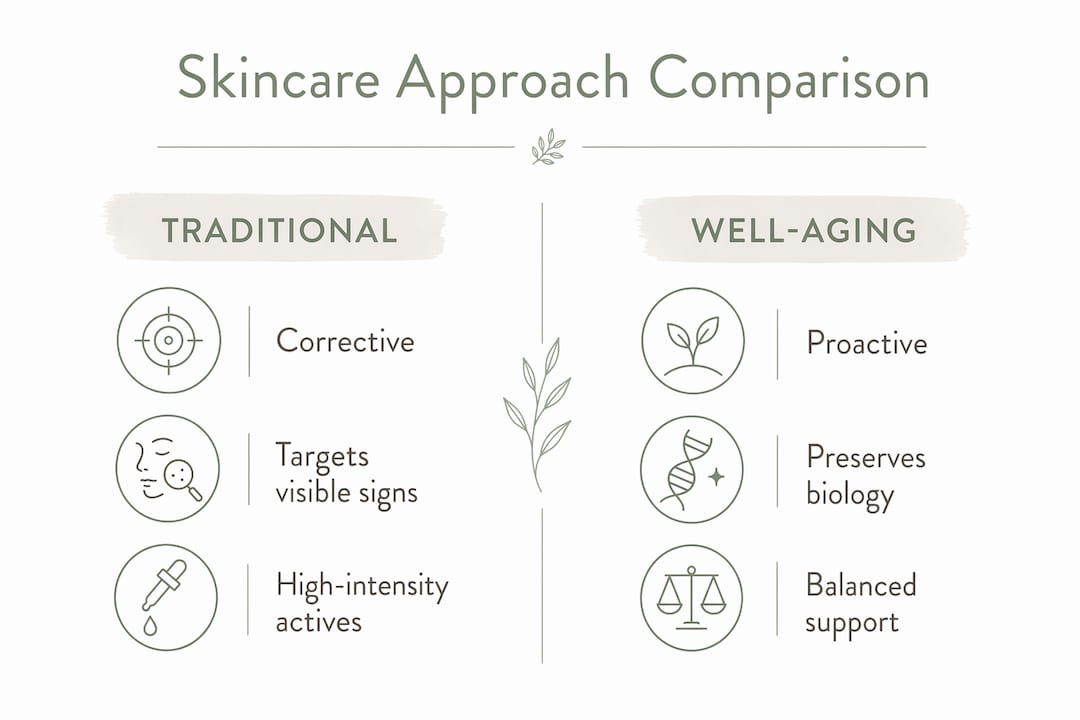
The philosophical difference matters more than it sounds. Anti-aging routines often rely on high-intensity actives like strong retinoids, aggressive exfoliating acids, and concentrated peels. These can deliver fast visible results, but they also require recovery time and can sensitize skin over repeated use. Well-aging routines prioritize ingredients that work daily without causing setbacks.
Here is how the two approaches compare in practice:
- Goal: Anti-aging targets cosmetic correction. Well-aging targets long-term skin function and resilience.
- Ingredient philosophy: Anti-aging favors maximum-effect actives. Well-aging favors repeatable results with fewer disruptions.
- Barrier approach: Anti-aging sometimes compromises the barrier for faster cell turnover. Well-aging treats barrier stability as non-negotiable.
- Lifestyle integration: Anti-aging focuses on topicals. Well-aging treats sleep, stress, and nutrition as part of the routine.
- Mindset: Anti-aging fights the aging process. Well-aging honors it while keeping skin as functional as possible.
The shift from “kill and correct” to “balance and support” is not just a marketing trend. Dermatologists and cosmetic scientists increasingly recognize that long-term barrier health and cellular communication matter more than temporary surface smoothing.
Pro Tip: If your current routine leaves your skin red, tight, or flaky after use, that is a sign your actives are working against your barrier, not for it. Swap one aggressive step for a barrier-supporting ingredient like ceramides or niacinamide and observe the difference over four weeks.
What are the practical benefits of a well-aging routine?
Adopting a well-aging approach delivers benefits that compound over time. The results are less dramatic in week one and far more significant in year three.
- Stronger barrier resilience: A stable lipid barrier holds moisture in and keeps irritants out. Skin that retains hydration consistently looks plumper and feels more comfortable without relying on heavy creams.
- Reduced chronic inflammation: Sustained antioxidant defense lowers the background inflammation that silently accelerates collagen breakdown. Ingredients like niacinamide and vitamin C target inflammation pathways at the cellular level, not just the surface.
- Better product tolerance: When your barrier is intact and your routine is gentle, your skin handles actives more effectively. You get more benefit from less product, with fewer reactions.
- Slower visible aging: Supporting collagen synthesis and mitochondrial repair slows the rate at which lines deepen and skin loses density. The change is gradual, but it is real and cumulative.
- Natural, confident aging: Well-aging does not promise to freeze time. It promises that your skin will stay healthy, resilient, and capable of repair for longer. That is a more honest and more achievable goal.
Consumer preference has shifted clearly toward routines that deliver stable, repeatable results over aggressive short-term fixes. Skin that tolerates your routine is skin that keeps improving.
How to achieve well-aging skin: habits and product choices
Building a well-aging routine follows a layered logic. You protect the barrier first, then add antioxidant defense, then introduce mild actives that support cellular function.
- Cleanse gently. Use a mild, pH-balanced cleanser that removes impurities without stripping lipids. A natural cleansing bar formulated for sensitive skin avoids the sulfates that disrupt your barrier daily.
- Prioritize photoprotection. UV exposure is the single largest external driver of collagen degradation and oxidative stress. Broad-spectrum SPF 30 or higher, applied every morning, is non-negotiable in any well-aging routine.
- Layer antioxidants. Vitamin C, vitamin E, and niacinamide work synergistically to neutralize free radicals and support barrier repair. Apply antioxidant serums after cleansing and before moisturizer for maximum absorption. A professional skincare routine sequences these steps by molecular weight for best results.
- Support the barrier with lipids. Ceramides, squalane, and botanical oils reinforce the lipid matrix that keeps moisture locked in. Facial oils rich in linoleic acid are particularly effective for aging skin that has lost natural sebum production.
- Introduce mild actives slowly. Bakuchiol is a plant-derived retinol alternative that supports collagen synthesis without the irritation risk of synthetic retinoids. It suits daily use and works well for skin that reacts to stronger actives.
- Integrate lifestyle factors. Skin resilience depends on sleep quality, stress management, and nutrition. Seven to nine hours of sleep supports overnight mitochondrial repair. Chronic stress elevates cortisol, which degrades collagen. A diet rich in polyphenols and omega-3 fatty acids feeds the antioxidant systems your topicals support.
Skin longevity research shows that many clinical trials measure ingredient effects over 8–12 weeks. Consistency is the mechanism. A routine you repeat daily for months outperforms an aggressive routine you abandon after two weeks of irritation.
Pro Tip: When adding a new active to your well-aging routine, introduce it every third night for the first two weeks before moving to nightly use. This gives your barrier time to adapt without triggering a reactive flare. Pairing a gentle skincare service with your home routine can help you identify which steps your skin tolerates best.
Key Takeaways
Well-aging skincare is the most effective long-term strategy for maintaining skin health because it preserves the biological systems that keep skin resilient, tolerant, and capable of repair over decades.
| Point | Details |
|---|---|
| CALM framework is the foundation | Target collagen, antioxidants, lipid barrier, and mitochondrial function for lasting skin health. |
| Prevention beats correction | Well-aging works before visible decline appears, not after, making it more effective long-term. |
| Barrier stability is non-negotiable | A stable lipid barrier reduces inflammation, improves product tolerance, and slows aging. |
| Consistency drives results | Clinical research measures well-aging ingredient effects over 8–12 weeks; daily repetition is the mechanism. |
| Lifestyle is part of the routine | Sleep, stress management, and nutrition directly influence the biological systems well-aging skincare supports. |
The shift I believe the skincare world needed
The anti-aging industry spent decades selling the idea that aging is a problem to be solved. Every product promised to erase, reverse, or fight time. That framing created a cycle of aggressive routines, sensitized skin, and disappointment when results faded the moment you stopped using a product.
Well-aging skincare reframes the entire conversation. Aging is not a malfunction. It is a biological process, and your skin’s job is to stay functional through it. When you support collagen synthesis, protect your antioxidant reserves, and keep your barrier intact, you are not fighting aging. You are giving your skin the conditions it needs to age well on its own terms.
At LaTerraTales, we have seen this play out with our own formulations. Customers who switch from aggressive, multi-step routines to gentle, barrier-first care consistently report that their skin feels more comfortable, reacts less, and looks healthier within weeks. Not because we added something dramatic, but because we stopped taking things away. The skin’s own repair systems are remarkably capable when you stop disrupting them.
The hardest part of well-aging is patience. Visible results from barrier repair and antioxidant defense build slowly. But the skin you have in ten years is shaped by the choices you make consistently today. That is a more honest promise than any overnight serum can make.
— LaTerraTales
LaTerraTales natural skincare for well-aging skin
LaTerraTales builds every product around the principles that well-aging skincare demands: gentle formulas, barrier-supporting ingredients, and antioxidant-rich botanicals that work daily without sensitizing your skin.
The natural skincare collection includes options suited to every step of a well-aging routine. The Bakuchiol Serum Lift & Calm delivers plant-derived collagen support without retinoid irritation, making it ideal for daily use on sensitive or reactive skin. The Bright & Tight Eye Cream targets the delicate eye area with antioxidants and barrier-supportive actives. For those who want to support skin health from the inside out, the Gut-Glow tea works on the gut-skin axis, addressing one of the lifestyle factors that well-aging science recognizes as genuinely influential. Every formula is eco-conscious, free from harsh sulfates, and designed for the kind of consistent, repeatable use that well-aging requires.
FAQ
What does well-aging skincare mean exactly?
Well-aging skincare is a proactive approach that preserves your skin’s core biological functions, including collagen integrity, antioxidant balance, lipid barrier health, and mitochondrial function, rather than correcting visible aging signs after they appear.
How is well-aging different from anti-aging skincare?
Anti-aging skincare corrects visible signs like wrinkles and spots using high-intensity actives. Well-aging skincare maintains the biological systems that keep skin resilient and functional over time, prioritizing stability and tolerance over dramatic short-term results.
What ingredients support a well-aging routine?
Niacinamide, vitamin C, ceramides, squalane, and bakuchiol are well-aging ingredients. They target inflammation pathways, support barrier repair, and influence cellular energy without requiring recovery time between uses.
How long does it take to see results from well-aging skincare?
Clinical research on well-aging ingredients typically measures results over 8–12 weeks of consistent use. The benefits build gradually and are more durable than results from aggressive, high-intensity routines.
Can you start well-aging skincare in your 20s?
Yes. Well-aging skincare is most effective when started before visible decline appears. Beginning barrier care, antioxidant support, and photoprotection in your mid-20s preserves the biological systems that determine how your skin ages over the following decades.


