

Why Natural Oils Benefit Skin: Your 2026 Guide
Natural oils are plant-derived lipids that restore the skin barrier, lock in moisture, and deliver antioxidants and essential fatty acids your skin needs to stay healthy. Oils like jojoba, argan, rosehip, and coconut have moved from traditional remedies into evidence-backed skincare because they work at the cellular level, not just on the surface. Understanding why natural oils benefit skin means understanding how your skin barrier functions and what it needs to repair itself. This guide covers the science, the best oils for each skin type, and how to use them safely in your daily routine.
Why natural oils benefit skin at the barrier level
Your skin barrier is a layered structure of cells and lipids that keeps moisture in and irritants out. Natural oils mimic the skin’s own sebum lipid composition, which makes them highly compatible with your skin’s chemistry. That compatibility is the core reason they outperform many basic moisturizers at barrier repair.
The mechanism is straightforward. Oils act as occlusives and emollients, filling the microscopic gaps between skin cells to reduce transepidermal water loss. Less water escaping means your skin stays plumper, softer, and more resilient throughout the day.

The antioxidant content in plant oils adds another layer of protection. Antioxidants neutralize free radicals generated by UV exposure, pollution, and stress. A 2026 study on cold-pressed botanical oils found statistically significant decreases in both melanin and erythema indexes (p<0.05) during treatment. That means measurable reductions in pigmentation and redness, not just anecdotal improvements.
Essential fatty acids in oils also support cell membrane health. Healthy cell membranes regulate what enters and exits each skin cell, which directly affects hydration, inflammation, and skin tone over time.
- Barrier repair: Essential fatty acids fill lipid gaps in the stratum corneum, the outermost skin layer.
- Moisture retention: Occlusive properties slow transepidermal water loss, keeping skin hydrated longer.
- Reduced redness: Antioxidants and anti-inflammatory fatty acids calm reactive skin.
- Pigmentation support: Cold-pressed oils have shown measurable reductions in melanin index in clinical settings.
Natural oils vs. synthetic skincare ingredients
Both natural oils and synthetic emollients reduce water loss and soften skin. The difference lies in what else they bring to the formula.
Natural oils provide antioxidants and nutrients, including vitamins A and E, essential fatty acids, and plant-specific phytonutrients. Synthetic emollients, such as dimethicone or mineral oil, offer consistent texture, long shelf life, and predictable performance. They do not, however, deliver the same nutritional profile.
| Feature | Natural oils | Synthetic emollients |
|---|---|---|
| Nutrient content | High (vitamins A, E, fatty acids) | Minimal to none |
| Barrier compatibility | Mimics skin’s own lipids | Creates surface film |
| Texture consistency | Varies by oil and season | Highly consistent |
| Antioxidant activity | Present in most cold-pressed oils | Absent |
| Shelf life | Shorter, requires careful storage | Longer, more stable |
| Best for | Nourishment and barrier repair | Texture and moisture sealing |
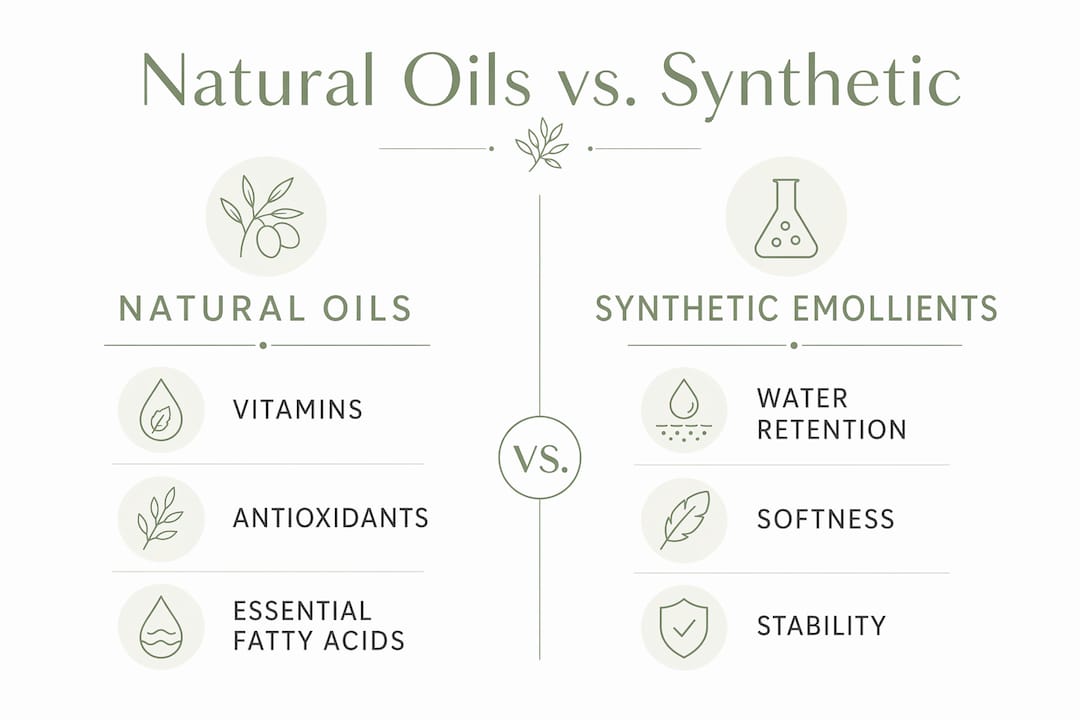
The most effective skincare routines combine both approaches. Natural oils deliver nutrients and barrier-compatible lipids, while lab-derived ingredients add precision and stability. Treating them as competitors misses the point. They are complementary tools.
Pro Tip: If your skin feels tight after applying a serum, layer a few drops of a lightweight oil like squalane or jojoba on top. The oil seals in the serum’s active ingredients and prevents moisture from evaporating.
What are the best natural oils for your skin type?
Choosing the right oil depends on your skin type and primary concern. Using a heavy oil on oily skin, or a lightweight oil on severely dry skin, will limit your results.
Oils for dry and sensitive skin
Coconut oil, argan oil, jojoba oil, sunflower oil, and oat oil are well-studied options for dry skin, each with documented moisturizing and anti-inflammatory benefits. Argan oil, sourced from Morocco, has clinical support for improving skin elasticity and moisture retention with regular topical use. It absorbs quickly and leaves no greasy residue, making it practical for daily use.
Oat oil works differently from most plant oils. It increases ceramide levels in the skin, which are the lipid molecules that lock moisture into the stratum corneum. For people with eczema or chronically dry patches, ceramide support is one of the most effective approaches available. Laterratales incorporates botanical oil blends specifically formulated for sensitive skin, drawing on this kind of evidence-backed ingredient selection.
Oils for oily and acne-prone skin
Oily skin does not mean you should skip oils entirely. The right oil can actually regulate sebum production by signaling to your skin that it is already moisturized. Jojoba oil is the clearest example. Its molecular structure closely resembles human sebum, which means it absorbs without clogging pores. Sunflower oil is high in linoleic acid, a fatty acid that research links to reduced comedone formation. Acne-prone skin is often deficient in linoleic acid, making sunflower oil a targeted choice rather than a generic one.
Oils with brightening and anti-inflammatory effects
Rosehip oil is rich in vitamin A precursors and vitamin C, both of which support collagen production and reduce uneven skin tone. It is one of the few plant oils with documented brightening effects backed by dermatological interest. Lavender essential oil has antimicrobial and anti-inflammatory properties, but it must be diluted in a carrier oil before skin contact. Arnica, used in Laterratales’ Arnicare Lip Balm, also carries anti-inflammatory benefits that extend to soothing reactive skin.
Pro Tip: Always choose cold-pressed, unrefined oils when possible. Heat processing destroys many of the antioxidants and fatty acids that make plant oils effective. Look for “cold-pressed” or “virgin” on the label.
How to add natural oils to your skincare routine safely
Adding oils to your routine takes a small amount of planning. The order you apply products matters as much as the products themselves.
-
Patch test first. Apply a small amount of the oil to the inside of your wrist or behind your ear. Wait 24 hours. Some plant oils contain trace compounds that can sensitize or irritate skin, especially essential oils. This step is non-negotiable for reactive or allergy-prone skin.
-
Apply oils after water-based products. Serums and toners should go on first, while your skin is still slightly damp. Oils go on last in your daytime routine, or just before moisturizer if your moisturizer is lighter than the oil.
-
Use the right amount. Two to four drops is enough for the full face. More oil does not mean more benefit. Over-application can leave a heavy film that prevents your skin from breathing and may trigger breakouts in pore-prone skin.
-
Adjust by season. Dry winter air calls for richer oils like argan or marula. Humid summer months work better with lighter options like jojoba or squalane. Applying the correct amount and order directly affects how well the oil performs and whether you experience any adverse effects.
-
Dilute essential oils without exception. Lavender, tea tree, and similar essential oils are potent concentrates. They should never be applied directly to skin. Mix one to two drops into a tablespoon of carrier oil before use.
-
Store oils correctly. Heat and light degrade plant oils quickly. Keep them in dark glass bottles away from direct sunlight. Check for rancid smell before each use. A rancid oil can cause oxidative stress on the skin rather than protecting against it.
For a structured approach to building your full routine around natural ingredients, the morning skincare routine guide from Lumina Skin Sanctuary offers practical sequencing advice that pairs well with oil use.
Key takeaways
Natural oils benefit skin most when matched to your skin type, applied in the right order, and selected in cold-pressed form for maximum nutrient retention.
| Point | Details |
|---|---|
| Barrier mimicry | Natural oils match the skin’s lipid profile, making them highly effective at barrier repair. |
| Ceramide and moisture support | Oat oil increases ceramide levels, directly improving moisture retention in dry and sensitive skin. |
| Oil selection by skin type | Jojoba and sunflower suit oily skin; argan, coconut, and oat suit dry or sensitive skin. |
| Application order matters | Apply oils after water-based serums and before or instead of a heavy moisturizer. |
| Combine with lab-derived ingredients | Pairing natural oils with ingredients like niacinamide or hyaluronic acid produces better results than either alone. |
Laterratales’ perspective: natural is not automatically safe or simple
The idea that natural always means gentle is one of the most persistent myths in skincare. Poison ivy is natural. So is undiluted cinnamon bark oil, which causes chemical burns on contact. At Laterratales, we have spent years formulating with botanical oils, and the lesson we keep returning to is this: the source of an ingredient matters less than how it is processed, concentrated, and matched to the person using it.
What we have found genuinely works is a layered approach. A well-chosen plant oil, cold-pressed and matched to your skin’s lipid needs, does something a synthetic emollient simply cannot: it feeds your skin’s biology rather than just coating it. But that same oil, applied undiluted as an essential oil or used on the wrong skin type, can cause more harm than a basic drugstore moisturizer. The nuance is real and worth taking seriously.
We also push back on the idea that you have to choose between natural and science-backed. Our Bakuchiol Serum pairs squalane, a plant-derived oil, with bakuchiol, a botanical retinol alternative with clinical support. That combination delivers results that neither ingredient achieves alone. The future of effective skincare is not natural versus synthetic. It is knowing when each belongs in the formula.
If you are new to oils, start with one. Jojoba for oily skin, argan for dry skin. Give it four weeks. Your skin’s response will tell you more than any ingredient list.
— Laterratales
Discover Laterratales’ botanical oil collection
Laterratales formulates every product with the same principle: ingredients that your skin recognizes and can actually use. Our natural skincare collection features cold-pressed botanical oils, oil-infused serums, and multi-use blends designed for sensitive, reactive, and dry skin types. Each formula balances plant-derived nutrients with evidence-backed actives for results you can see and feel. If you are not sure where to start, our Prestige Oriental Dry Oil is a lightweight, multi-use option that works on face, body, and hair. Not sure which products suit your skin? Take our skin diagnostic quiz for a personalized recommendation.
FAQ
What makes natural oils good for dry skin?
Natural oils like argan, coconut, and oat oil reduce transepidermal water loss by filling gaps in the skin barrier. Oat oil specifically increases ceramide levels, which lock moisture into the skin’s outer layer.
Can oily skin benefit from natural oils?
Yes. Jojoba oil closely mimics human sebum and absorbs without clogging pores. Sunflower oil, high in linoleic acid, can help regulate sebum production and reduce comedone formation in acne-prone skin.
Are essential oils the same as carrier oils?
No. Essential oils are concentrated plant extracts with potent active compounds. Carrier oils are fatty plant oils used to dilute essential oils before skin application. Essential oils should never be applied undiluted to skin.
How do natural oils compare to synthetic moisturizers?
Natural oils deliver vitamins, antioxidants, and essential fatty acids that synthetic emollients do not contain. Synthetic ingredients offer more consistent texture and longer shelf life. The most effective routines use both.
How long does it take to see results from natural oils?
Most people notice improved skin texture and hydration within two to four weeks of consistent use. Pigmentation and elasticity changes, supported by clinical studies on cold-pressed oils, take longer and typically show measurable improvement after six to eight weeks.


