

Benefits of Oil-Based Facial Cleansing: What Dermatologists Say
Oil-based facial cleansing is one of the most effective methods for removing oil-based makeup, sunscreen, and daily grime without stripping your skin’s natural moisture. Dermatologists consistently point to its barrier-preserving properties as a key advantage over conventional foaming cleansers, and the science behind it is straightforward: oil dissolves other oils, lifting impurities cleanly from the skin’s surface. Whether your skin is dry, sensitive, or even acne-prone, the benefits of oil-based facial cleansing are real and worth understanding before you dismiss the method.
Here’s what oil cleansing actually delivers:
- Removes waterproof makeup and SPF without harsh scrubbing
- Preserves the skin barrier and its natural lipid layer
- Hydrates as it cleanses, leaving skin softer rather than tight
- Reduces irritation compared with sulfate-heavy foaming cleansers
- May support a balanced skin microbiome when used consistently
Pro Tip: Before committing to a new cleansing oil, do a 24-hour patch test on your inner arm. Choose a noncomedogenic formula, especially if you’re prone to breakouts.
Table of Contents
- What is oil-based facial cleansing, and what forms does it come in?
- The specific skin benefits of oil-based cleansing, explained
- How to choose a cleansing oil that actually works for your skin
- How to oil cleanse: step-by-step for beginners
- Will oil cleansing cause breakouts? Purging vs. acne, explained
- What dermatologists say and what the evidence actually shows
- Who benefits most from oil cleansing, and how to start this week
- Key Takeaways
- The case for going back to basics with your cleanser
- Gentle cleansing, naturally: LaTerraTales’s approach
- Useful sources and further reading
What is oil-based facial cleansing, and what forms does it come in?
The oil cleansing method is built on one simple principle: like dissolves like. Oil-based cleansers bind to sebum, oil-based makeup, sunscreen residue, and environmental pollutants on your skin’s surface, then lift them away when you rinse or wipe. Unlike soap or foaming cleansers that rely on surfactants to strip the skin, oil cleansers work with your skin’s own chemistry rather than against it.
You’ll find this method in several product formats:
- Cleansing oils: Lightweight, pourable formulas that spread easily on dry skin and emulsify with water for rinsing. Most popular for daily use.
- Cleansing balms: Solid or semi-solid textures that melt on contact with skin. Often richer, making them well-suited for dry or mature skin.
- Solid cleansing bars: Compressed bars formulated with plant-based oils and butters. LaTerraTales’s natural handmade cleanser bar is a good example of this format, designed specifically for sensitive skin.
- Multi-purpose dry oils: Lightweight, fast-absorbing oils that can double as a cleanser or treatment, depending on how they’re used.
Oil cleansing fits naturally into both single-cleanse and double-cleanse routines. Some people use it as their only cleanser; others follow it with a gentle water-based cleanser to remove any remaining residue. Neither approach is wrong. Your skin type and how much makeup or sunscreen you wear will guide which works best for you.
The specific skin benefits of oil-based cleansing, explained
1. It removes waterproof makeup and sunscreen thoroughly
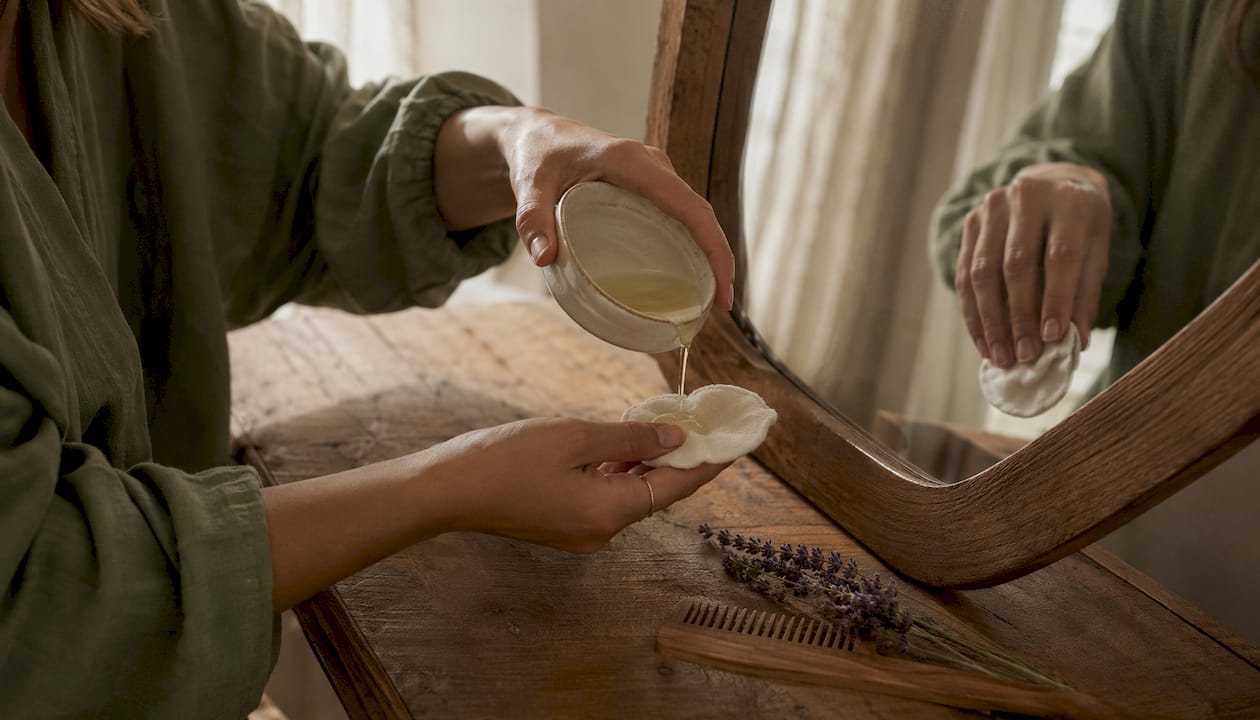
Oil-based cleansers dissolve oil-based makeup because oil dissolves other oils. This makes them especially effective on waterproof mascara, long-wear foundation, and mineral or chemical sunscreens that water alone can’t fully remove. WebMD notes that oil cleansers are among the most reliable options for clearing these stubborn residues without aggressive rubbing.
2. It preserves your skin barrier
Your skin’s outermost layer, the stratum corneum, is held together by a lipid matrix that keeps moisture in and irritants out. Harsh surfactants found in many foaming cleansers can disrupt this matrix with repeated use. Oil cleansers, by contrast, clean without disturbing those lipids, which is why dermatologists often recommend them for people with compromised or sensitive skin.
“Oil cleansers are a great option for people with sensitive skin because they cleanse without disrupting the skin barrier.” — Dr. Maryam Safaee, as cited in Glamour
3. It hydrates while it cleanses
Many cleansing oils leave a thin, nourishing film on the skin after rinsing, which can reduce the tight, dry feeling that follows a traditional wash. Some users find they need a lighter moisturizer afterward because their skin simply doesn’t feel as depleted. This is a meaningful shift, especially for anyone who has been layering heavy creams to compensate for a stripping cleanser.

4. It can reduce irritation for people using active ingredients
If you use retinoids, glycolic acid, or other exfoliating actives, your skin is already working hard to renew itself. Adding a harsh foaming cleanser on top can push irritation further. Experts note that oil cleansing reduces irritation for active users because it avoids the aggressive surfactants that compound sensitivity.
5. It may help balance sebum production
Counterintuitively, oil cleansing can help oily skin. When a foaming cleanser over-strips the skin, the skin often responds by producing more sebum to compensate. Healthline explains that oil cleansers lift excess sebum without triggering that rebound effect, which may lead to more balanced oil levels over time.
6. It delivers antioxidant and anti-inflammatory compounds
Plant-based oils used in cleansing formulas, such as argan and olive oil, carry antioxidants and anti-inflammatory compounds that can support skin healing. WebMD highlights these properties as an added benefit beyond simple cleansing, though the contact time during cleansing limits how deeply these compounds penetrate.
7. It may support a healthier skin microbiome
Your skin hosts a community of beneficial microorganisms that contribute to its defense and resilience. Aggressive surfactants can disrupt this microbiome. Healthline notes that oil cleansing, when used properly, may support a more balanced microbiome by avoiding the chemical disruption that harsh cleansers cause.
How to choose a cleansing oil that actually works for your skin
Not every oil is created equal, and comedogenicity (the tendency of an ingredient to clog pores) varies significantly between oils. The table below gives you a practical starting point.
| Oil | Best for | Notes |
|---|---|---|
| Jojoba | Oily, acne-prone, combination | Structurally similar to sebum; low comedogenic rating |
| Squalane | All skin types, sensitive | Lightweight, stable, noncomedogenic |
| Grapeseed | Oily, combination | Astringent, lightweight, low comedogenic rating |
| Argan | Dry, mature, normal | Rich in vitamin E; moderate comedogenic rating |
| Sunflower | Dry, sensitive | Barrier-supportive; low comedogenic rating |
| Olive oil | Dry, mature | Higher comedogenic rating; avoid if acne-prone |
| Coconut oil | Dry, body use | High comedogenic rating; not recommended for facial use |
Medical News Today notes that different botanical oils have distinct properties, with some supporting barrier repair and hydration while others can be more astringent. The key is matching the oil’s profile to your skin’s needs.
A few things to look for and avoid:
- Seek: Noncomedogenic oils (jojoba, squalane, grapeseed), minimal fragrance, no synthetic dyes, clean emulsifiers
- Avoid: Coconut oil if acne-prone, heavy mineral oils, artificial fragrances if sensitive, alcohol-heavy formulas
- Check the full formula: A single low-comedogenic oil in a poorly formulated base can still cause breakouts. The whole product matters, not just one ingredient.
Comedogenic ratings are guides, not guarantees. Skin response is individual, and formulation context changes how an oil behaves on your skin. That’s why patch testing is non-negotiable.
Patch-test steps:
- Apply a small amount of the cleansing oil to your inner arm or behind your ear.
- Leave it for 24 hours without washing.
- Check for redness, itching, or small bumps.
- If clear, try it on a small area of your face for 3–5 days before making it part of your full routine.
Pro Tip: If you’re acne-prone, start with a squalane or jojoba-based formula. Both are lightweight, noncomedogenic, and well-tolerated by most skin types. For a deeper look at botanical oil types, LaTerraTales has a full ingredient guide worth bookmarking.
How to oil cleanse: step-by-step for beginners
The basic technique
- Start with dry hands and a dry face. Water prevents the oil from binding to impurities. Apply a quarter-sized amount of cleansing oil directly to your dry skin.
- Massage for 60 seconds. Use gentle, circular motions across your entire face, including around the nose, jawline, and eye area. This is where the oil lifts makeup, sunscreen, and sebum.
- Emulsify with water. Wet your fingertips and continue massaging. The oil will turn milky white as it emulsifies, binding the lifted impurities for removal.
- Rinse thoroughly. Use lukewarm water and rinse until the skin feels clean but not tight. Pat dry with a soft cloth.
- Follow with your usual routine. Apply serum, moisturizer, or any actives as normal.
The double-cleanse option
If you wear heavy SPF, full-coverage foundation, or waterproof makeup, following your oil cleanse with a gentle water-based cleanser removes any remaining residue. This is the double-cleanse method, and Cleveland Clinic explains it as a two-step process where the oil cleanser handles oil-based debris and the second cleanser addresses any remaining water-based impurities. Skip the second step on low-makeup days or if your skin is very dry.
How often should you oil cleanse?
| Skin type | Recommended frequency |
|---|---|
| Dry or sensitive | Once daily, evening only |
| Normal or combination | Once daily, evening; morning optional |
| Oily or acne-prone | Once daily, evening; monitor closely |
Troubleshooting:
- Residue feeling: You may not be emulsifying long enough. Add more water and massage for an extra 30 seconds.
- Stinging or redness: The formula may contain fragrance or an ingredient your skin reacts to. Discontinue and patch-test a different product.
- Increased breakouts in week 1–2: This may be purging (see next section). Monitor for 4–6 weeks before switching.
For guidance on integrating facial oils into your routine, LaTerraTales’s skincare ritual guide walks through timing and layering in practical detail.
Will oil cleansing cause breakouts? Purging vs. acne, explained
This is the question that stops most people from trying oil cleansing, and it deserves a candid answer.
Purging vs. new acne:
- Purging happens when oil cleansing accelerates the skin’s natural cell turnover, bringing trapped debris to the surface faster than usual. It typically appears as small whiteheads or blackheads in areas where you already break out, and it usually resolves within 4–6 weeks.
- New acne from a product reaction tends to appear in new locations, feels more inflamed, and doesn’t improve with time. This is a sign the formula isn’t right for your skin.
Healthline notes that a purging phase is common in the initial weeks and recommends consistency during this period to see long-term improvement. The key is monitoring where and how breakouts appear.
Oil does not automatically clog pores. The idea that any oil on the face causes acne is a myth. The risk depends on which oil you use, how comedogenic it is, and how well you rinse. Heavier oils like coconut oil or olive oil carry a higher risk for acne-prone skin, while lightweight options like jojoba and squalane are much less likely to cause problems.
Red flags that mean you should stop:
- Persistent, inflamed cystic acne that worsens beyond week 4
- Allergic reaction: hives, intense itching, swelling
- Burning or stinging that doesn’t resolve after rinsing
- Rosacea flares or visible broken capillaries
If any of these occur, discontinue use and consult a dermatologist. Oil cleansing is not appropriate for everyone, and severe acne or active dermatitis may require a medically supervised approach.
What dermatologists say and what the evidence actually shows
Dermatologist guidance on oil cleansing is largely consistent: it’s a gentle, effective option for most skin types, particularly sensitive and dry skin, but it’s not a universal solution.
Dr. Maryam Safaee emphasizes barrier preservation as the primary goal for sensitive skin when choosing oil-based cleansers. Dr. Whitney Hovenic, also cited in Glamour’s dermatologist roundup, notes that oil cleansing is especially well-suited for people using active ingredients like retinoids or exfoliating acids because it avoids the compounding irritation that harsh surfactants can cause.
“For patients already dealing with a compromised barrier, switching to an oil cleanser is often the single most impactful change they can make to their routine.” — Clinical guidance summarized from dermatologist observations in Glamour
The evidence base, however, has real limits. Medical News Today points out that robust clinical trials on oil cleansing as a formal therapy are limited, and that many recommendations come from dermatologist observation and smaller studies rather than large randomized controlled trials. This doesn’t mean the method doesn’t work. It means the evidence is clinical and experiential rather than trial-based, which is worth knowing.
When oil cleansing is most clearly supported:
- Sensitive or reactive skin prone to barrier disruption
- Dry or dehydrated skin that feels tight after conventional cleansing
- People wearing heavy SPF or full-coverage makeup daily
- Anyone using retinoids, AHAs, or BHAs who needs a gentler cleansing step
- Skin that produces excess sebum and may be over-stripped by foaming cleansers
When to consult a dermatologist first:
- Active cystic acne or acne requiring prescription treatment
- Diagnosed rosacea or perioral dermatitis
- Eczema or atopic dermatitis with an active flare
- Any condition where the skin barrier is severely compromised
Oil cleansing can complement medically supervised regimens, but it should be introduced with your dermatologist’s knowledge if you’re managing a skin condition.
Who benefits most from oil cleansing, and how to start this week
Oil cleansing tends to deliver the clearest results for specific skin profiles. Here’s a quick guide to who gains the most and how to begin safely.
Primary beneficiaries:
- Sensitive skin: Avoids the surfactant-driven irritation that triggers redness and tightness
- Dry or dehydrated skin: Cleanses without depleting the lipid layer, reducing the need for heavy post-cleanse moisturizers
- Heavy SPF or makeup wearers: Removes oil-based products more thoroughly than water-based cleansers
- Active ingredient users (retinoids, acids): Provides a gentler cleansing step that doesn’t compound barrier stress
- Oily skin prone to rebound: May reduce excess sebum production over time by avoiding over-stripping
Your starting plan:
- Choose a noncomedogenic oil (jojoba, squalane, or grapeseed) in a clean formula with minimal fragrance.
- Patch-test for 24 hours before applying to your full face.
- Start with evening use only, twice a week, then increase to nightly if your skin responds well.
- Monitor your skin for 4–6 weeks before judging effectiveness.
- Reassess your moisturizer. You may find a lighter formula is enough once your barrier is better supported. The face oil vs. moisturizer guide from LaTerraTales is a helpful reference for this adjustment.
Key Takeaways
Oil-based facial cleansing preserves the skin barrier, removes oil-based impurities thoroughly, and is gentler than foaming cleansers for most skin types when the right formula is chosen.
| Point | Details |
|---|---|
| Barrier preservation | Oil cleansers clean without disrupting the skin’s lipid matrix, reducing dryness and irritation. |
| Makeup and SPF removal | Oil dissolves oil-based products like waterproof makeup and sunscreen more effectively than water-based cleansers. |
| Choosing the right oil | Noncomedogenic oils like jojoba, squalane, and grapeseed are safest for acne-prone and sensitive skin. |
| Purging is normal | A brief purging phase in weeks 1–4 is common; monitor for 4–6 weeks before switching products. |
| LaTerraTales | LaTerraTales’s natural handmade cleanser bar offers a minimal-ingredient, sensitive-skin-friendly option for those ready to try oil-based cleansing. |
The case for going back to basics with your cleanser
There’s a tendency in skincare to treat cleansing as the least interesting step, the thing you do before the “real” products. Oil cleansing challenges that assumption in a way that actually holds up under scrutiny.
What strikes us most about the evidence is how much damage a poorly chosen cleanser can do quietly, over time. Tight skin after washing isn’t a sign of cleanliness. It’s a sign of barrier disruption. And once that barrier is compromised, every active ingredient you apply afterward becomes harder to tolerate and less effective. Switching to an oil-based cleanser doesn’t just change how you wash your face. It changes the foundation everything else in your routine is built on.
At LaTerraTales, our philosophy has always been that the gentlest effective formula is the right formula. That’s why our cleansing formulations prioritize plant-based oils, minimal fragrance, and ingredient transparency, because your skin shouldn’t have to recover from being cleaned. The benefits of natural oils for skin go well beyond cleansing, but cleansing is where the relationship between your skin and your routine begins.
Gentle cleansing, naturally: LaTerraTales’s approach
For readers who want to put oil cleansing into practice with a formula they can trust, LaTerraTales’s natural handmade cleanser bar is built around exactly the principles this article covers: plant-based oils, minimal fragrance, and a formulation designed specifically for sensitive skin. It’s solid, travel-friendly, and free from the synthetic surfactants that compromise the barrier over time.
If you’d like to explore a wider range of gentle, barrier-conscious options, the natural skincare collection includes cleansers, botanical oils, and supporting products formulated with the same minimal-ingredient philosophy. Every product is sustainably sourced and designed to simplify your routine without sacrificing efficacy. Browse the collection and find the right starting point for your skin.
Useful sources and further reading
The following sources were used in researching this article. Each is worth bookmarking if you want to go deeper on oil cleansing or the science behind skin barrier health.
- Healthline: Oil Cleansing Method — Covers the basics of the oil cleansing method, purging timelines, and sebum-balancing effects. A reliable starting point for anyone new to the method.
- Glamour: How to Use an Oil Cleanser, According to Dermatologists — Features direct quotes from dermatologists Dr. Maryam Safaee and Dr. Whitney Hovenic on barrier preservation and active-ingredient compatibility.
- WebMD: Deep Oil Cleansing — Practical overview of oil cleansing benefits, including makeup removal and antioxidant properties of plant oils.
- Medical News Today: Oil Cleansing Method — Balanced review of botanical oil properties and an honest assessment of the evidence gaps in clinical research.
- Cleveland Clinic: Double Cleansing Explained — Clear explanation of the double-cleanse method and when it adds value versus when it’s unnecessary.
- LaTerraTales: Why Natural Oils Benefit Skin — The brand’s ingredient-focused guide to natural oils, with practical notes for sensitive skin audiences.
- LaTerraTales: How to Use Facial Oils in Your Skin Ritual — Guidance on integrating facial oils and oil-based cleansers into a complete skincare routine.
This article is for general informational purposes only and does not constitute medical or dermatological advice. For personalized guidance, especially if you have a diagnosed skin condition, consult a licensed dermatologist.


