

One Week Test: Herbal Tea for Sleep That Fits Your Evening Routine
Chamomile, valerian, lavender, lemon balm, passionflower, and magnolia bark carry the strongest research signals for easing you into sleep, with rooibos and low-caffeine green tea as gentle, caffeine-conscious backups. The smartest approach: pick one caffeine-free herb, sip it 30 to 60 minutes before bed for a week, and check with a clinician first if you’re pregnant, nursing, or on sedating medication.
TL;DR:
- Valerian, chamomile, lavender, and lemon balm have the strongest clinical support for improving sleep quality, especially when used short-term.
- Proper brewing—such as steeping chamomile for 5 to 10 minutes and valerian for over 10 minutes—maximizes their sedative effects.
- Testing one herb at a time for several nights is crucial to identify what truly helps your sleep rather than relying on multi-herb blends.
- Pregnant individuals, allergy sufferers, and those on sedatives or alcohol should consult a clinician before trying strong herbs like valerian or magnolia.
- Consistency in timing, routine, and sleep hygiene enhances herbal tea’s effectiveness, with noticeable improvements typically seen after one to two weeks.
Table of Contents
- The Best Herbal Teas for Sleep and How They Actually Work
- How Do You Brew Herbal Tea for Sleep the Right Way?
- Is Herbal Sleep Tea Actually Safe for You?
- How Do You Choose the Right Sleep Tea for Your Situation?
- Why LaTerraTales Takes a Measured View on Botanical Sleep Support
- What’s Actually Happening in Your Body When These Herbs Work?
- What Does the Research Actually Say About Herbal Sleep Teas?
- Beyond Tea: Tinctures, Capsules, and Other Herbal Sleep Formats
- How Should You Combine Herbal Tea with Other Sleep Habits?
- How Long Before Herbal Sleep Tea Actually Works?
- Our Take: Skip the Miracle Blend, Trust the Boring Basics
- LaTerraTales Wellness Infusions for Your Evening Ritual
- Sources
The Best Herbal Teas for Sleep and How They Actually Work
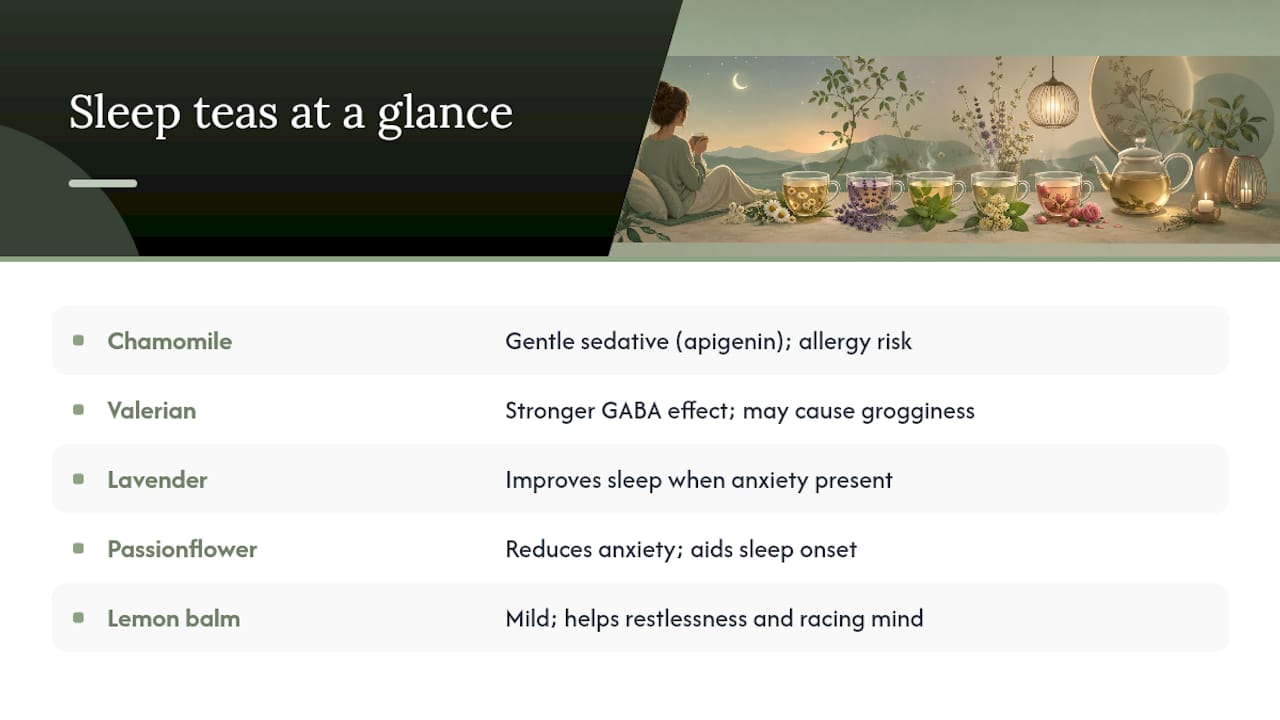
Not every “calming tea” on a shelf has real evidence behind it, and the ones that do work through different mechanisms. Some nudge your nervous system through GABA receptors, the same pathway targeted by prescription sedatives. Others simply give you a ritual that trains your brain to associate a warm cup with winding down. Knowing the difference helps you pick a tea that matches your actual problem, not just a pretty label.
Chamomile is the most forgiving place to start. It contains apigenin, a flavonoid that binds to benzodiazepine receptors and produces a mild sedative effect, and short clinical trials show modest improvements in sleep quality after regular use. It’s gentle enough for nightly rotation, though anyone with a ragweed or daisy allergy should skip it. Chamomile belongs to the Asteraceae family, and cross-reactivity is a real, well-documented caution.
Valerian is the heavier hitter. It’s long been used to address nervousness and occasional sleeplessness, and its influence on GABAergic activity gives it a plausible mechanism beyond folklore. The tradeoff is taste (earthy, borderline medicinal) and a documented risk of morning grogginess in some users. Valerian works best as a short-term trial, not a forever habit.
Lavender shows up in both oral and aromatherapy studies, with evidence pointing to improved sleep quality especially when anxiety is what’s keeping you up. It tastes floral rather than medicinal, which makes it an easier daily sip than valerian for most people.
Passionflower has short-term evidence for reducing anxiety and supporting sleep onset. It’s often blended with valerian, since the two appear to work on complementary pathways rather than duplicating the same effect.
Lemon balm, a member of the mint family, brings a milder, more citrusy profile. Clinical signals point to benefits for restlessness and anxiety-linked wakefulness, making it a reasonable pick if your sleep trouble is more “racing mind” than “can’t physically relax.”
Magnolia bark contains honokiol, a compound with GABA-interacting properties and a long history in traditional use. Evidence suggests it can shorten the time it takes to fall asleep, though its effect on nighttime awakenings is less consistent.
Banana tea (often brewed from the peel) has more anecdotal appeal than clinical backing. The rationale rests on potassium and magnesium content, both linked to muscle relaxation, but the research base is thin. It’s low risk, just don’t expect it to outperform the herbs above.
Low-caffeine green tea and rooibos deserve a mention because of L-theanine, an amino acid shown to promote relaxation. The catch is caffeine: standard green tea can cancel out the calming effect it’s known for. Stick to labeled low-caffeine or fully decaffeinated versions, or skip straight to rooibos, which is naturally caffeine-free.
Overall, the clinical picture is strongest for valerian, chamomile, lavender, and lemon balm, with banana tea and magnolia bark sitting on thinner evidence. That doesn’t make the weaker-evidence herbs useless. It means you should treat them as low-risk experiments rather than reliable fixes.
Pro Tip: Test one herb for several nights before switching or blending. If you jump straight to a five-herb “sleep blend,” you’ll have no idea which ingredient actually helped, or which one gave you the weird dream.
How Do You Brew Herbal Tea for Sleep the Right Way?
Brewing wrong is the fastest way to waste a good herb. Weak steeping under-extracts the active compounds; oversteeping some herbs (valerian especially) can push the flavor from earthy to genuinely unpleasant.
- Chamomile: Steep 1 to 2 teaspoons in just-boiled water for 5 to 10 minutes, covered, to trap the volatile oils.
- Lavender: Use sparingly, about ½ to 1 teaspoon, steeped 5 to 10 minutes. Too much reads soapy rather than floral.
- Valerian: Needs a longer infusion, 10 minutes or more, or works better as a tincture if the taste is a dealbreaker.
- Passionflower: Steep 5 to 10 minutes; pairs well in a blend with lemon balm for a smoother taste.
- Lemon balm: Steep 5 to 10 minutes in water just off the boil to preserve its lighter aromatic notes.
Drink one cup roughly 30 to 60 minutes before you intend to sleep. That window gives mild sedative compounds time to take effect without forcing you to chug a full mug right at lights-out, which just guarantees a 2 a.m. bathroom trip. Keep the cup modest, one serving, not a whole pot, and skip anything with added caffeine, including regular black or green tea blended in for flavor.
Treat the cup as the start of a routine, not a standalone fix. Pair it with screens off, dim lighting, and the same time each night. Your body responds to repetition faster than it responds to any single ingredient.
Is Herbal Sleep Tea Actually Safe for You?
For most healthy adults, occasional herbal tea is low risk. But “natural” doesn’t mean “risk-free,” and a few groups need a more cautious approach.
Who should be more careful:
- Pregnant or breastfeeding individuals should avoid stronger herbs like valerian, magnolia, and concentrated blends without a clinician’s approval.
- Anyone with a ragweed, daisy, marigold, or chrysanthemum allergy should skip chamomile and try lemon balm or rooibos instead.
- People on benzodiazepines, opioids, sedating antidepressants, or anyone drinking alcohol regularly should not combine those with sedative herbs. The sedative effects can stack, and that additive sedation is where things get genuinely risky.
Clinical guidance on herbal sleep aids consistently points to the same theme: short-term trials, close attention to what else you’re taking, and a call to your doctor if insomnia sticks around past a few weeks rather than resolving.
Common side effects that mean it’s time to stop: morning grogginess, stomach upset, unusually vivid dreams, or daytime sleepiness that outlasts the tea’s supposed benefit. None of these are dangerous on their own, but they’re your signal to switch herbs or dial back the dose.
A safe-use checklist is simple: start with a low dose, test one herb at a time, keep stronger herbs like valerian to short-term use, and jot down how you feel the next morning. That log matters more than most people expect. Memory is unreliable at 6 a.m.
How Do You Choose the Right Sleep Tea for Your Situation?
The right tea depends on what’s actually disrupting your sleep, not which blend has the prettiest packaging.
If your issue is a racing mind or mild daily stress, chamomile or lemon balm fits the routine-relaxation category well. If you’re dealing with occasional, harder insomnia, an evening where you genuinely cannot switch off, valerian or a valerian-passionflower blend has stronger evidence behind it. Anxiety-linked wakefulness responds particularly well to lavender.
Beyond the herb itself, weigh a few practical filters:
- Caffeine status: confirm it’s labeled caffeine-free, especially with green tea or rooibos blends.
- Allergies: skip chamomile if you react to ragweed or related plants.
- Medication list: check for sedative interactions before adding anything stronger than chamomile or lemon balm.
- Flavor tolerance: valerian’s earthy taste isn’t for everyone; blends can soften it.
- Single-herb vs. blend: start single, blend later once you know what works.
Pro Tip: Run a three-step test: pick one herb, drink it at the same time for three to seven nights, then evaluate. If nothing changes and the sleep problem persists past a few weeks, that’s your cue to loop in a clinician rather than keep herb-hopping.
Why LaTerraTales Takes a Measured View on Botanical Sleep Support
LaTerraTales builds its wellness infusions around the same principle guiding this guide: gentle, evidence-informed formulas over inflated claims. A calming tea works best as one piece of an evening ritual, not a standalone fix, which is why we often talk about pairing tea with an evening skincare routine or a broader wind-down practice. For sleep problems that persist, a clinician’s advice matters more than any single herb.
What’s Actually Happening in Your Body When These Herbs Work?
The herbs with the best evidence tend to share a common thread: some interaction with GABA, the brain’s primary inhibitory neurotransmitter. GABA is what quiets neural activity down at night, and research suggests certain botanical compounds influence that same pathway, which is also the target of prescription sedatives like benzodiazepines, just at a far gentler intensity.
Chamomile’s apigenin binds to benzodiazepine receptor sites directly, which explains its mild but measurable sedative signal. Valerian and passionflower are believed to work through related GABAergic influence, though the exact potency and reliability vary from person to person and study to study. Magnolia bark’s honokiol compound appears to interact with GABA receptors too, part of why it shows promise for reducing the time it takes to fall asleep.
Lavender and lemon balm seem to take a different route, working more through anxiety reduction than direct sedation. If your sleeplessness stems from a spinning mind rather than physical restlessness, that anxiolytic action may matter more than raw sedative strength.
None of these mechanisms rival a prescription sleep medication in potency. That’s the tradeoff: gentler action, gentler risk profile, and a much wider margin for daily, low-stakes use.
What Does the Research Actually Say About Herbal Sleep Teas?
The honest answer: evidence quality varies a lot by herb, and treating them all as equally “proven” oversells the weaker ones.
A review of clinical evidence on herbal sleep aids found solid, if still evolving, support for valerian, chamomile, lavender, and lemon balm, each backed by controlled studies showing measurable sleep quality improvements. Magnolia bark and banana tea sit in a different tier, more traditional use and small studies than large-scale trials.
Where evidence is thinner, systematic reviews recommend a pragmatic approach: test at a low dose, keep the trial period short, and track your own response rather than assuming a universal result. Herbal research also runs into a structural challenge that plain sleep-tracking apps don’t face, individual variation in gut absorption, herb potency, and brewing method all shift outcomes from one cup to the next.
None of this means the research is weak across the board. It means confidence should scale with the herb: strong for chamomile and lavender, moderate for valerian and lemon balm, cautious for magnolia and banana tea. That’s a more honest way to read the literature than lumping every “natural sleep aid” into one bucket.
Beyond Tea: Tinctures, Capsules, and Other Herbal Sleep Formats
Tea isn’t the only delivery method, and for some herbs it’s not even the most efficient one. Valerian tinctures, for instance, sidestep the earthy taste problem entirely while still delivering a concentrated dose, which is part of why so many people who dislike valerian tea reach for drops instead.
Capsules offer the most precise, consistent dosing, useful if you want to track exactly how much of an herb you’re taking night to night. They’re also the most portable option for travel, when you don’t want to pack loose-leaf tea and a strainer.
Tinctures (alcohol or glycerin-based extracts) act faster than tea since there’s no steeping delay, and they let you fine-tune dose drop by drop. The tradeoff is less ritual value, no warm cup, no wind-down pause, just a quick dose and done.
Standardized extracts, found in some capsules, guarantee a specific concentration of the active compound (like a set percentage of honokiol in magnolia products), which tea brewing simply can’t replicate consistently. Whichever format you choose, the safety guidance stays the same: single-herb testing, low starting doses, and clinician input if you’re layering anything on top of existing medication. The format changes; the caution doesn’t.
How Should You Combine Herbal Tea with Other Sleep Habits?
A cup of chamomile tea won’t outmuscle a bedroom lit up by a phone screen or a room that’s too warm to sleep in comfortably. Herbal tea works best as reinforcement for good sleep hygiene, not a replacement for it.
Pair your tea with a consistent bedtime, ideally within the same 30 minute window every night, since your circadian rhythm responds to repetition more than to any single ingredient. Dim the lights an hour before bed and put screens away; blue light exposure works directly against whatever calming effect your tea is providing.
Temperature matters too. A cool room, generally somewhere in the mid to high 60s Fahrenheit, supports the natural drop in core body temperature that precedes sleep onset. If you’re sipping a hot tea right before bed, give yourself enough buffer time that the warmth doesn’t spike your temperature right as you’re trying to wind down.
Consider stacking your tea ritual with a scent-based practice, an evening aromatherapy routine built around lavender or similar calming notes can reinforce the same signal your tea is sending. And if sleep hygiene basics like consistent timing and light exposure aren’t dialed in yet, practical guidance on building better sleep habits is worth reading before adding more herbs to the mix.
How Long Before Herbal Sleep Tea Actually Works?
Don’t expect a single cup to knock you out like a sleep aid pill. Most people notice the ritual effect (feeling calmer, more ready for bed) within a few nights, but measurable improvement in sleep quality tends to build over one to two weeks of consistent use.
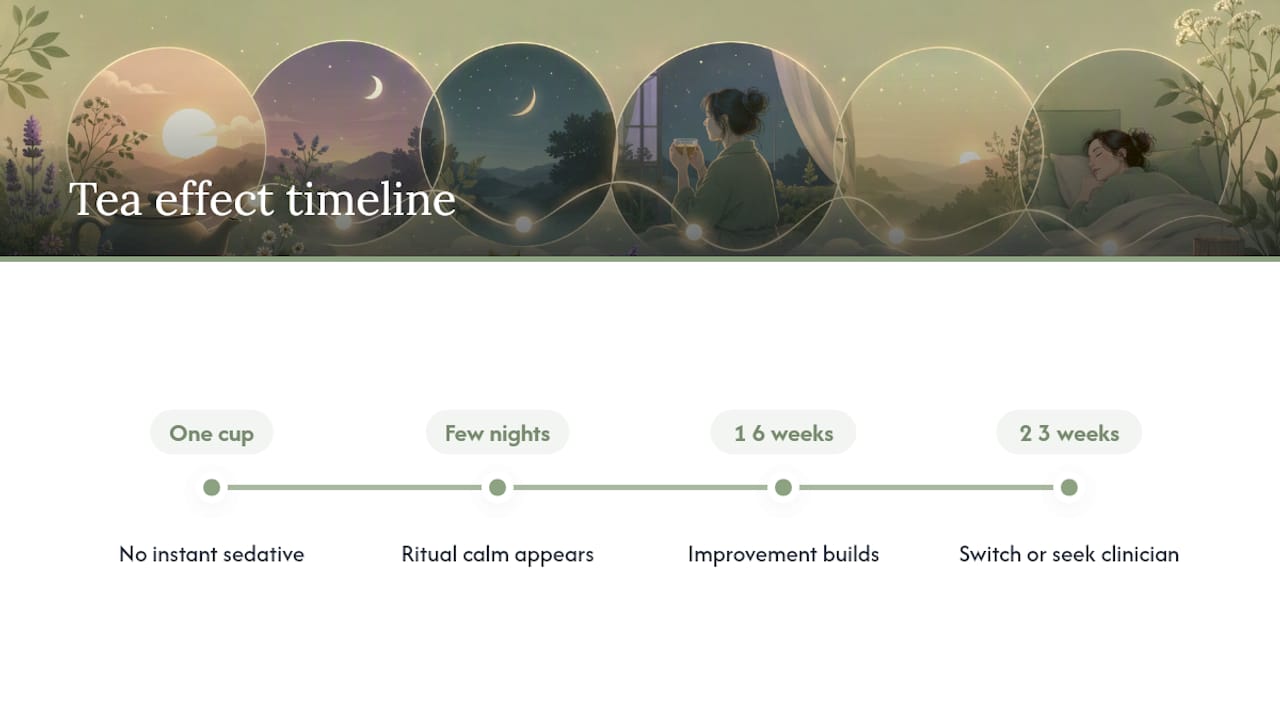
That timeline lines up with how most sleep-focused clinical trials are structured. Studies on chamomile and lavender often run several weeks before researchers see statistically meaningful shifts in sleep quality scores, not because the herbs are ineffective, but because sleep architecture responds gradually to consistent input, not one-off doses.
If you’ve tried the same herb nightly for two to three weeks with zero change, that’s a legitimate signal to switch herbs or formats rather than pushing through. Chronic insomnia lasting more than a few weeks deserves a conversation with a clinician regardless of how promising your tea routine has been. Herbal tea is a support tool, not a substitute for medical evaluation when sleep problems are persistent or severe.
Our Take: Skip the Miracle Blend, Trust the Boring Basics
The biggest myth in herbal sleep tea marketing is the multi-herb “ultimate sleep blend” promising to knock you out in one cup. Our research points the other way: single-herb trials, run for a week at a time, give you real information. A ten-ingredient blend gives you guesswork.
Conventional wisdom oversells magnolia bark and banana tea as equivalent to chamomile or valerian. They’re not, at least not yet, evidence-wise. That doesn’t mean skip them; it means try them with modest expectations and watch your own results rather than the marketing copy.
What we’d prioritize first: consistency over novelty. The same caffeine-free tea, at the same time, for a full week, tells you more than trying five different “calming” blends in five nights. Pair that consistency with an evening ritual, not because the ritual is magic, but because your body responds to repeated cues faster than to any single ingredient.
— LaTerraTales
LaTerraTales Wellness Infusions for Your Evening Ritual
LaTerraTales approaches evening self-care the same way we approach skincare: gentle formulas, minimal ingredients, and no promises we can’t back up. Our wellness and self-care collection includes botanical infusions designed to complement a calming nighttime routine, not replace medical guidance for persistent sleep issues.
Our Gut-Skin Axis Tea is a good example of that philosophy in action: a botanical blend meant to support your evening wind-down alongside your skin, not a sleep cure on its own. If chronic insomnia or a medication interaction is part of your picture, talk to your healthcare provider before adding any new herb to your routine. Otherwise, browse the wellness collection and find an infusion that fits the ritual you’re already building.
Sources
- Herbal influences on GABAergic activity — NCBI PMC
- Chamomile and sleep-related studies | PubMed
- Lavender and sleep quality research | PubMed
- Review of herbal sleep aids and clinical evidence | NCBI PMC
- L-theanine research (green tea) | PubMed
Recommended
يشارك


