
Natural vs Synthetic Skincare Ingredients: What Works Best
Natural skincare ingredients are substances derived from plants, minerals, or botanical sources, while synthetic skincare ingredients are compounds engineered in a lab for consistent, targeted performance. The debate over natural vs synthetic skincare ingredients is one of the most misunderstood in beauty. Neither category is inherently safer or more effective. What matters is the specific ingredient, its concentration, and how your skin responds to it. This guide cuts through the marketing noise and gives you a clear, science-grounded comparison so you can build a routine that actually works for your skin.
What are natural vs synthetic skincare ingredients?
Natural skincare ingredients come from plant, mineral, or animal sources with minimal processing. Common examples include aloe vera, shea butter, jojoba oil, green tea polyphenols, and chamomile extract. Each of these brings genuine skin benefits: aloe vera soothes inflammation, shea butter seals in moisture, and green tea polyphenols fight oxidative stress. They feel familiar, and for many people, they carry a sense of purity and trust.
Synthetic ingredients, by contrast, are manufactured in controlled lab environments. Retinoids, niacinamide, peptides, hyaluronic acid, and salicylic acid are all lab-engineered compounds with decades of clinical research behind them. The key difference is not origin. It is consistency, potency, and predictability.

One critical fact shapes this entire conversation: no legal definition for “natural” exists in the US FDA or EU Cosmetics Regulation frameworks. That means a product labeled “natural” faces no legal standard to meet. Safety depends entirely on ingredient-specific testing, not the source of the ingredient. Knowing this changes how you read a label.
The ISO 16128 standard provides guidance on defining and calculating natural origin content in cosmetics, but certification remains inconsistent across brands and markets. Your best tool is the INCI (International Nomenclature of Cosmetic Ingredients) list on every product. INCI names are standardized, legally binding declarations that reveal exactly what is in a formula, including synthetic preservatives hiding inside “natural” products.
What are the characteristics of natural skincare ingredients?
Natural ingredients offer real benefits, but they come with real trade-offs. Here is what you need to know before assuming “plant-based” means problem-free.
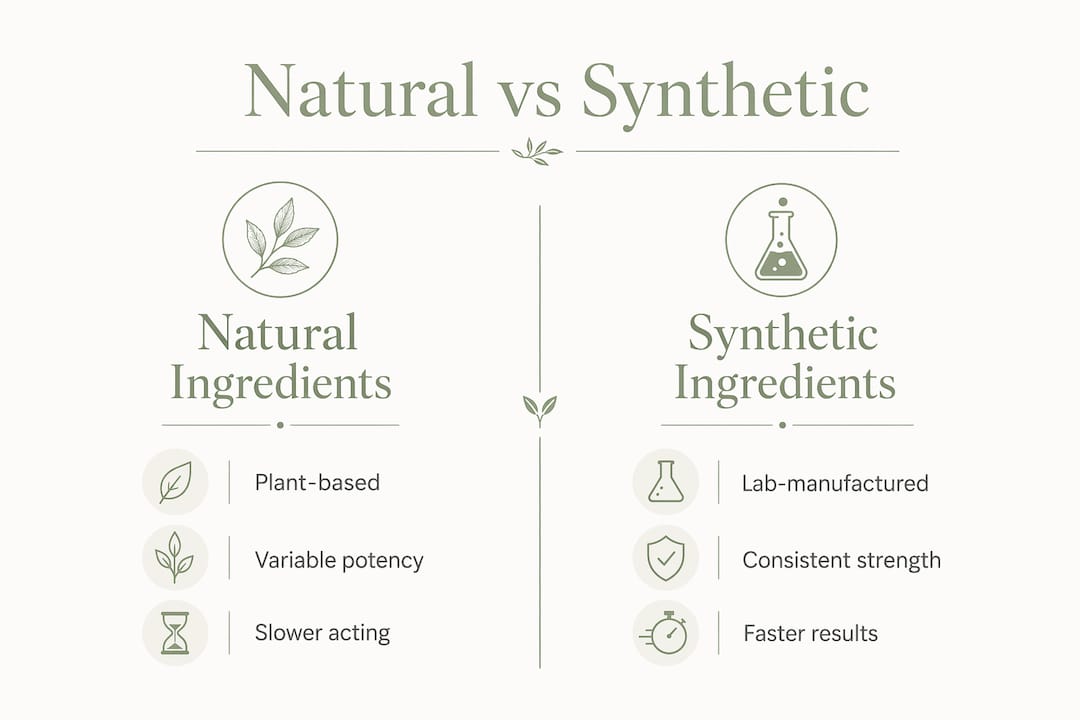
- Potency variability. Natural ingredient potency varies significantly based on harvest timing, soil quality, and growing conditions. Two batches of rosehip oil from different harvests can perform very differently on your skin.
- Allergen risk. Essential oils, plant extracts, and fragrant botanicals are among the most common triggers for contact dermatitis. The assumption that natural equals gentle is a myth worth discarding.
- Preservation challenges. Natural formulas lack the built-in stability of synthetic ones. Without effective preservatives, they spoil faster and carry a higher risk of microbial contamination.
- Certification gaps. ISO 16128 offers a framework for natural origin content, but no single global certification guarantees what “natural” means on a label.
- Genuine strengths. Ingredients like aloe vera, oat extract, and chamomile have solid evidence for soothing sensitive and reactive skin. Their benefits are real when the formulation is done right.
Pro Tip: When shopping for natural skincare, look for products that list specific botanical extracts by their INCI names rather than vague terms like “plant complex.” Specificity signals transparency.
Understanding why natural skincare takes longer to work also helps set realistic expectations. Natural actives often work more gradually than their synthetic counterparts, which is not a flaw. It is simply how they function.
How do synthetic skincare ingredients differ in performance and safety?
Synthetic ingredients are engineered for precision. They deliver consistent results because their molecular structure is controlled from the start. Synthetic actives like retinoids, niacinamide, peptides, and hyaluronic acid carry decades of clinical proof for addressing specific skin concerns including aging, hyperpigmentation, acne, and dehydration.
Here is what sets synthetics apart:
- Consistency. Every batch of lab-made niacinamide contains the same molecule at the same purity. There is no harvest variability.
- Stability. Lab-made hyaluronic acid mimics the skin’s natural moisture-binding compound with better shelf stability than most plant-derived alternatives.
- Clinical backing. Retinoids remain the gold standard for anti-aging, supported by more clinical trials than any natural alternative currently available.
- Preservative safety. Synthetic preservatives like phenoxyethanol are permitted at a maximum of 1.0% concentration per EU Annex V. Regulated concentrations keep them safe and effective for maintaining product integrity.
- Irritation potential. Synthetics can irritate skin, particularly at high concentrations. Retinoids cause purging and dryness in many people, especially at the start of use.
The important nuance: many products marketed as “natural” already contain synthetic preservatives like phenoxyethanol, ethylhexylglycerin, or sodium benzoate. Botanical products routinely include these compounds because natural preservation alone cannot reliably protect a formula. Reading the INCI list reveals this reality immediately.
How do natural and synthetic ingredients compare in effectiveness and safety?
The honest answer is that neither category wins outright. Effectiveness and safety depend on the specific ingredient, the formulation, and your skin type.
| Factor | Natural ingredients | Synthetic ingredients |
|---|---|---|
| Consistency | Variable by batch and harvest | Uniform and controlled |
| Shelf life | Shorter without synthetic preservatives | Longer with regulated preservatives |
| Clinical evidence | Growing but often limited | Extensive for key actives |
| Irritation risk | High for essential oils and botanicals | Present but predictable at tested doses |
| Allergen potential | Significant for fragrant plants | Lower, though sensitivities exist |
| Sustainability | Land and water intensive | Energy intensive in production |
Bakuchiol is a useful case study. This plant-based compound functions as a natural retinol alternative with less irritation and is well-suited for sensitive skin. LaTerraTales formulates with bakuchiol precisely because it bridges efficacy and gentleness. That said, synthetic retinoids still carry more clinical validation for reversing visible signs of aging. Bakuchiol is a strong choice. It is not yet a complete replacement.
Contact dermatitis affects over 94% of cases involving natural skincare product reactions. That statistic challenges the widespread belief that natural ingredients are universally gentle. Your skin does not care about a product’s origin story. It responds to chemistry.
Pro Tip: Patch test every new product, natural or synthetic, on your inner arm for 48 hours before applying it to your face. This is especially important with botanical extracts and essential oil-based formulas.
What environmental and regulatory factors shape ingredient choices?
Sustainability and regulation both influence which ingredients end up in your products, and neither story is simple.
On the environmental side:
- Natural ingredient farming consumes significant land and water resources. Shea butter production, for example, depends on wild-harvested trees in West Africa, creating supply chain pressures tied to climate and land use.
- Synthetic production reduces agricultural pressure but involves energy-intensive chemical processes and, in some cases, petrochemical inputs.
- Environmental tradeoffs between growing botanicals and lab synthesis are real on both sides. Neither approach is automatically greener.
On the regulatory side:
- The FDA and EU Cosmetics Regulation evaluate ingredient safety based on toxicological profiles, not origin. A synthetic ingredient that passes safety testing is treated the same as a natural one.
- No legal definition of “natural” creates space for misleading marketing. Brands can use the word freely without meeting any standard.
- INCI labeling is your most reliable tool. It cuts through marketing language and shows you exactly what is in the formula.
Transparency matters more than labels. Ingredient transparency starts with reading INCI lists and understanding what each entry means for your skin. Brands that publish full ingredient lists and explain their choices earn trust that vague “natural” claims never can.
For men navigating these same choices, a practical skincare checklist for 2026 breaks down ingredient selection by skin concern rather than by origin, which is exactly the right framework.
How to build an effective skincare routine with both ingredient types
Dermatologists recommend focusing on evidence-based product performance rather than marketing labels. The most effective routines blend both ingredient categories based on what your skin actually needs.
- Start with a gentle cleanser. Plant-based cleansers with oat extract or aloe vera remove impurities without stripping your skin barrier. Pair this with a natural cleansing bar formulated for sensitive skin to keep the first step calm and effective.
- Add a targeted synthetic serum. Niacinamide addresses uneven tone and enlarged pores. Hyaluronic acid pulls moisture into the skin. These actives deliver results that most plant-based serums cannot match at the same speed.
- Layer in botanical support. A bakuchiol serum works well as a gentler evening active, especially if your skin reacts to retinoids. It supports cell turnover with less dryness and peeling.
- Finish with mineral sunscreen. Zinc oxide is a mineral-derived UV filter with an excellent safety profile and broad-spectrum protection. It works for sensitive skin and sits comfortably in a natural-leaning routine.
- Match actives to your skin concern. Acne-prone skin benefits from salicylic acid. Dry, sensitive skin responds well to ceramides and botanical oils. Aging concerns call for retinoids or bakuchiol, depending on your tolerance.
Pro Tip: Introduce one new active at a time and wait two weeks before adding another. This makes it easy to identify what is helping and what is causing a reaction.
A professional skincare routine built on this hybrid approach gives you the soothing, skin-friendly qualities of botanicals alongside the proven performance of synthetic actives. The combination is not a compromise. It is the most informed choice you can make.
Key Takeaways
The most effective skincare routine combines evidence-backed synthetic actives with carefully chosen natural botanicals, selected by skin need rather than by label.
| Point | Details |
|---|---|
| No legal “natural” standard | The FDA and EU do not define “natural,” so safety depends on ingredient testing, not origin. |
| Natural ingredients carry allergen risk | Contact dermatitis is a documented risk with botanical and essential oil-based products. |
| Synthetics offer proven consistency | Niacinamide, retinoids, and hyaluronic acid have extensive clinical backing and batch uniformity. |
| Hybrid routines outperform single-source | Blending plant-based cleansers with synthetic serums delivers balanced, evidence-backed results. |
| INCI labels reveal the full picture | Reading INCI names exposes synthetic preservatives in “natural” products and supports informed choices. |
What LaTerraTales has learned about the natural vs synthetic debate
The most persistent myth in skincare is that “natural” means safe and “synthetic” means harmful. At LaTerraTales, we have seen this belief lead people to avoid effective ingredients and embrace ones that irritate their skin. The truth is more useful and more freeing.
Marketing terms like “natural” and “clean” do not guarantee ingredient safety or efficacy. We have tested formulas where a single essential oil caused more irritation than a well-formulated synthetic serum. We have also seen plant-based actives outperform synthetic alternatives for specific skin types. The pattern is always the same: the ingredient and the formulation matter. The label does not.
What we advocate for at LaTerraTales is a hybrid approach grounded in science. Natural skincare products increasingly integrate synthetic actives to balance tradition with proven results. Our own formulas reflect this. Bakuchiol sits alongside squalane. Botanical oils are paired with carefully selected, regulated preservatives. We are transparent about every ingredient because we believe you deserve to know exactly what you are putting on your skin.
The best skincare decision you can make is to stop asking “is this natural or synthetic?” and start asking “does this work for my skin, and is it safe?” That shift in thinking leads to better results, less irritation, and a routine you can trust.
— LaTerraTales
LaTerraTales products for every skin type and ingredient preference
Your skin deserves products built on both botanical wisdom and scientific rigor, not one at the expense of the other.
LaTerraTales formulates every product with full ingredient transparency, combining plant-based actives with safe, regulated synthetics where they improve results. Whether your skin is sensitive, dry, or prone to breakouts, the natural skincare collection offers clean, effective options designed for real skin concerns. From a gentle solid cleansing bar to a bakuchiol serum that rivals retinoids without the irritation, each product reflects a commitment to ingredients that earn their place in your routine. Explore the full range and find what your skin has been asking for.
FAQ
Are natural skincare ingredients safer than synthetic ones?
Not automatically. Natural ingredients can trigger allergic reactions and contact dermatitis, while synthetic ingredients are typically tested at regulated concentrations for safety. Safety depends on the specific ingredient and your skin’s response.
What does “natural” mean on a skincare label?
It has no legal definition under the FDA or EU Cosmetics Regulation. Brands use the term freely without meeting any regulatory standard, so reading the INCI ingredient list is the only reliable way to verify what is actually in a product.
Can I use natural and synthetic skincare ingredients together?
Yes, and dermatologists recommend it. A balanced routine combining plant-based cleansers with synthetic serums like niacinamide or hyaluronic acid delivers better results than relying on one ingredient category alone.
Is bakuchiol a good alternative to retinol?
Bakuchiol is a plant-based compound that supports cell turnover with less irritation than synthetic retinoids. It is a strong option for sensitive skin, though retinoids still hold more extensive clinical validation for anti-aging results.
How do I know if a “natural” product contains synthetic ingredients?
Check the INCI list on the packaging. Ingredients like phenoxyethanol, ethylhexylglycerin, and sodium benzoate are synthetic preservatives that appear in many natural-labeled products. INCI names are standardized and legally required, making them the most reliable source of ingredient truth.


