

Research Backed Cold Pressed Camellia Oil for Sensitive Skin
Camellia oil is a lightweight, oleic-acid-rich botanical oil that hydrates skin, supports the moisture barrier, and conditions hair while absorbing quickly, without the greasy after-feel of heavier plant oils. Preclinical research backs its moisturizing, antioxidant, and anti-inflammatory potential, though human clinical trials remain limited. Most skin types tolerate it well, but a patch test before regular use is always the smart move.
TL;DR:
- Camellia oil’s oleic acid content helps reduce water loss and improves skin barrier function, but effects on barrier repair are primarily supported by animal studies.
- Most people tolerate camellia oil well, but those with active acne or sensitive skin should introduce it gradually and patch test beforehand.
- The oil’s antioxidant compounds, such as tocopherols and polyphenols, are preserved in cold-pressed varieties, which are more potent than refined oils.
- Application methods vary: a pre-shampoo mask, light serum on ends, or nightly cuticle massage are effective routines for hair, skin, and nails.
- Shelf life is typically one to two years, and rancid oil will smell sour and feel sticky; storage away from light and heat helps maintain quality.
Table of Contents
- What Are the Skin Benefits of Camellia Oil?
- How Does Camellia Oil Help Hair and Nails?
- What Makes Cold-Pressed Camellia Oil Different?
- What Does the Research Actually Show?
- How Do You Use Camellia Oil in a Routine?
- Is Camellia Oil Safe? Side Effects and Shelf Life
- Can Camellia Oil Cause Allergic Reactions or Other Contraindications?
- LaTerraTales’s Take on Camellia Oil for Sensitive Skin
- Try Camellia Oil in a Routine Built for Sensitive Skin
- Sources
- FAQ
What Are the Skin Benefits of Camellia Oil?
Camellia oil’s dominant fatty acid, oleic acid, integrates into the outer skin layer and helps seal in moisture, which reduces transepidermal water loss and leaves skin feeling less tight and dehydrated. That single mechanism explains most of what people notice within days of using it: smoother texture, a softer feel, and less flaking on dry patches.
The barrier support goes deeper than surface hydration. A mouse model of atopic dermatitis found that topical camellia oil upregulated filaggrin production and showed evidence of reducing inflammatory markers, improving lesion scores in some measures more than a standard moisturizing cream. Filaggrin is a protein your skin needs to build a functional barrier, so this is a meaningful signal, even though it came from an animal study rather than a human trial.
The oil’s antioxidant load adds another layer of protection. Composition analysis shows camellia oil carries tocopherols, polyphenols, and squalene alongside its high unsaturated fatty acid content, compounds that help buffer skin against everyday environmental stress.
Here’s what that combination realistically delivers:
- Smoother, softer texture within days of consistent use
- Less tightness and visible flaking on dry or normal skin
- A lightweight feel that layers well under makeup
- Cell-culture evidence of procollagen activation and reduced collagen breakdown, a mechanism relevant to anti-aging claims
One caveat worth flagging: if you deal with active acne breakouts, introduce camellia oil slowly and watch how your skin responds. Its comedogenic rating runs low to moderate depending on the source, so most people do fine, but reactive or acne-prone skin deserves extra caution. For layering strategy, our guide on using facial oils in your skin ritual and our broader look at why natural oils benefit skin both walk through the sequencing in more detail.
How Does Camellia Oil Help Hair and Nails?
Camellia oil coats the hair shaft in a thin film that smooths the cuticle, cuts down on friction between strands, and reflects more light, which is the actual reason hair looks shinier after use. Less friction also means less breakage from brushing and styling, so the shine benefit and the strength benefit come from the same mechanism.

Application method matters more than most people assume. A pre-shampoo mask, left on for 20 to 30 minutes before washing, lets the oil penetrate before water and surfactants compete for space in the hair shaft. A leave-in serum, used sparingly on mid-lengths and ends, tames frizz without the mask’s commitment. Fine hair and oily scalps do better skipping roots entirely and sticking to ends only, since even a light oil can weigh down thin strands or accelerate scalp greasiness.
Nails benefit from the same emollient properties that help skin. Massaging a drop into each cuticle nightly softens hardened skin around the nail bed and can reduce the hangnails that come with chronic dryness.
- Pre-shampoo mask: apply to dry hair, leave 20 to 30 minutes, then shampoo normally
- Leave-in serum: one to two drops on damp ends, avoiding the scalp
- Cuticle care: massage nightly, focusing on the base of each nail
Pro Tip: Start with cuticles and hair ends only for the first two weeks. If your scalp or hairline stays clear, you can experiment with light root application afterward.
What Makes Cold-Pressed Camellia Oil Different?
Camellia oil’s fatty acid profile runs comparable to olive oil, with oleic acid typically making up the majority share, alongside smaller amounts of linoleic and palmitic acid. That high-oleic structure is why the oil absorbs fast and feels light rather than tacky.
The real quality difference shows up in what surrounds those fatty acids. Tocopherols (vitamin E) contribute antioxidant defense, squalene mimics skin’s own natural lipids for easy compatibility, and phytosterols and polyphenols support the oil’s anti-inflammatory reputation. None of that matters much if the extraction process strips them out.
- Cold-pressed oil retains more polyphenols and tocopherols, preserving the bioactive content that gives camellia oil its edge over a plain emollient
- Refined oil loses color, scent, and some of those actives, trading potency for a neutral, shelf-stable product
- Look for “cold-pressed” and “cosmetic-grade” on the label, and store your bottle away from heat and direct light
- Food-grade camellia oil sold for cooking is not formulated or tested for topical use, so keep the kitchen bottle out of your skincare routine
What Does the Research Actually Show?
The strongest evidence for camellia oil comes from cell and animal studies, not large human trials, and that distinction matters for how you read any benefit claim. The atopic dermatitis mouse model is the standout: topical application reduced inflammation and increased filaggrin expression, with barrier markers improving alongside visible lesion scores.
Composition research adds a second layer of confidence. Studies measuring camellia oil’s unsaturated fatty acid content, tocopherols, and squalene consistently find levels that plausibly support moisturizing and antioxidant claims, since these are the same compounds studied in other well-established emollient oils.
Here’s a rough confidence scale worth keeping in mind:
- High confidence: moisturizing and emollient effects, backed by composition data and broad consensus across botanical oil research
- Moderate confidence: barrier repair and anti-inflammatory action, backed by animal studies and cell assays
- Lower confidence: anti-aging and eczema-specific therapeutic claims, where reviewers explicitly call for more clinical trials before treating the oil as a proven treatment
Treat camellia oil as a well-supported cosmetic ingredient, not a substitute for dermatologist-directed treatment of diagnosed skin conditions.
How Do You Use Camellia Oil in a Routine?
Camellia oil works across face, body, hair, and nails, but the amount and technique change with each use case.
- Face: Press two to four drops onto slightly damp skin after cleansing, then follow with serum and moisturizer to lock in hydration. Daily use suits most skin types; dry skin can go twice daily.
- Body: Mix a few drops into your regular lotion, or apply straight after a shower while skin is still damp, to seal in water before it evaporates.
- Hair: Run a pre-shampoo mask weekly, or use one to two drops as a leave-in serum on ends between washes.
- Nails: Massage a small drop into each cuticle nightly, ideally before bed so it can absorb undisturbed.
Storage affects how well any of this works. Keep camellia oil in a cool, dark spot, away from bathroom humidity if possible, and screw the cap on tight after every use to limit oxygen exposure.
Pro Tip: Warm the oil between your palms for a few seconds before applying to skin or hair. It spreads thinner and absorbs faster than oil applied cold.
Is Camellia Oil Safe? Side Effects and Shelf Life
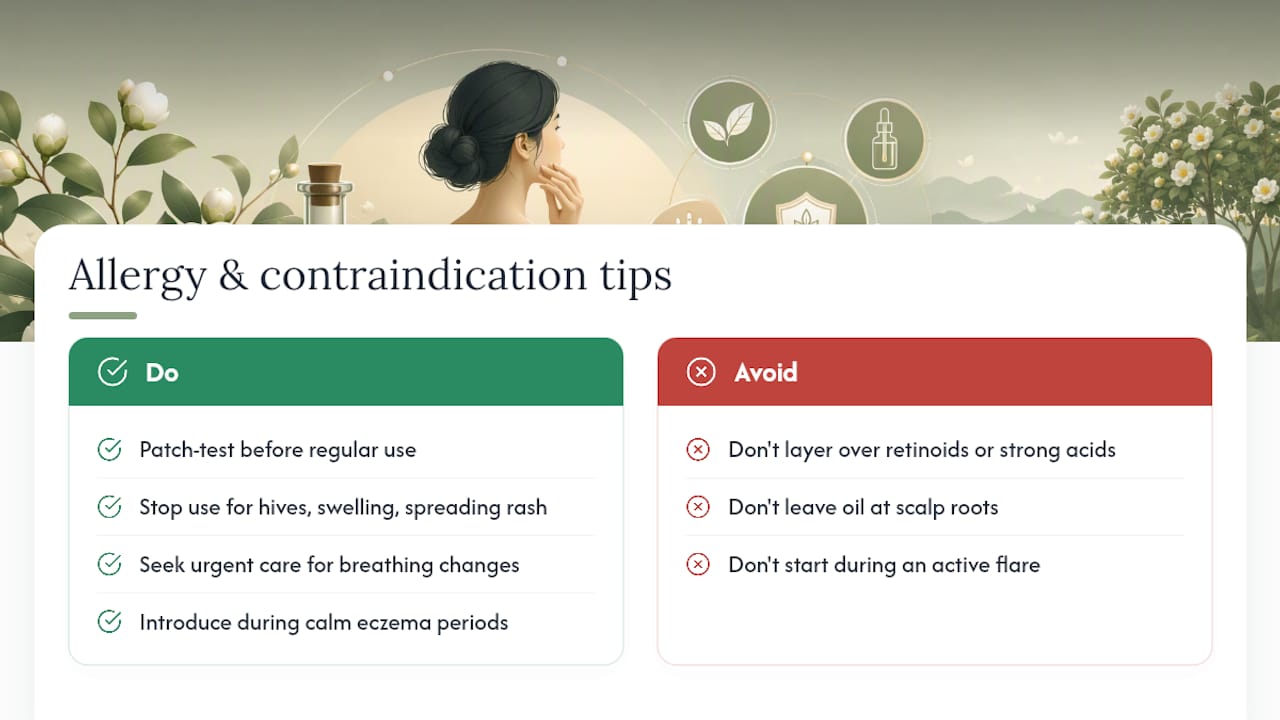
Patch test before any new oil enters your routine: apply a small amount to your inner forearm, wait 24 to 48 hours, and check for redness, itching, or bumps before using it on your face or scalp.
- People with known allergies to camellia family plants, or a history of reacting to new botanical oils, should patch test with extra caution
- Active inflammatory acne or an already-compromised skin barrier warrants a dermatologist check before adding any new oil
- Rancid oil smells sour or sharp instead of faintly nutty, and it may feel sticky rather than silky. Discontinue use if you notice either sign
- Shelf life typically runs one to two years unopened, shorter once opened and exposed to air and light repeatedly
- Choose cosmetic-grade oil for topical use rather than substituting a food-grade bottle meant for cooking
Can Camellia Oil Cause Allergic Reactions or Other Contraindications?
True allergic reactions to camellia oil are uncommon, but they do happen, particularly in people with existing sensitivities to plants in the Theaceae family or to tree nut oils that share similar lipid structures. Symptoms to watch for beyond simple irritation include hives, swelling around the eyes or lips, or a rash that spreads beyond the application site. Any of those warrants stopping use immediately and, if swelling or breathing changes occur, seeking medical attention rather than waiting it out.
A few groups deserve extra care even without a diagnosed allergy. If you have eczema or another chronic inflammatory skin condition currently flaring, introduce the oil during a calmer stretch rather than mid-flare, since a newly irritated barrier reacts unpredictably to any added ingredient. Anyone using prescription retinoids or strong exfoliating acids should apply camellia oil after those treatments have settled into the skin, not layered directly on top, to avoid compounding sensitivity. Scalp conditions like seborrheic dermatitis can also worsen with oil left too close to the roots, since oil can feed the yeast associated with flaking and itchiness.
Pregnant or nursing readers with specific ingredient concerns should run any new topical oil by their physician, as should anyone managing a diagnosed skin disease under active dermatological care. None of this makes camellia oil unusually risky compared to other botanical oils. It simply means the same patch test and slow introduction rules apply to everyone, with a little more attention paid if you fall into one of these categories.
LaTerraTales’s Take on Camellia Oil for Sensitive Skin
We formulate with cold-pressed camellia oil because sensitive, redness-prone skin needs emollients that work without added fragrance load or heavy refining that strips out the antioxidants doing the real work. Getting that balance right—retaining polyphenols and tocopherols while keeping scent gentle—is the difference between a filler oil and one that earns its place in a formula. Start small, patch test, and build up.
— LaTerraTales
Try Camellia Oil in a Routine Built for Sensitive Skin
Reading about camellia oil’s barrier-supporting, antioxidant-rich profile is one thing; finding a formula that pairs it responsibly with the rest of your routine is another. Some brands bundle botanical oils with sensitive-skin-friendly staples to help guide layering in a skincare routine.
If your interest leans toward body and hair rituals rather than face-only care, the wellness and self-care collection includes multi-purpose oils suited to massage and hair conditioning alike, including the Prestige Oriental dry oil formulated for both body and hair use. For a full skincare routine built around gentle, evidence-based formulas, browse the natural skincare bundles, where patch-test-friendly sizes make it easy to trial a new oil before committing to a full bottle. Pick a bundle, patch test on your forearm for 24 hours, and build from there.
Sources
- Restorative effects of camellia oil on the skin-barrier function in a model of DNCB-induced atopic dermatitis (PMC11788714)
- The Extraction Technologies, Nutritional Compositions, and Health Benefits of Camellia oleifera Seed Oil̶A Review (J-Stage)
- Bioactive substances and therapeutic potential of camellia oil: An overview (ScienceDirect)
FAQ
What can I use camellia oil for?
Camellia oil works as a face moisturizer booster, body oil, pre-shampoo hair mask, leave-in hair serum, and nightly cuticle treatment, thanks to its fast-absorbing, oleic-acid-rich profile.
Is camellia oil good for the face?
Yes, for most skin types. It hydrates without heaviness and offers antioxidant support from tocopherols and squalene, though acne-prone skin should introduce it gradually and patch test first.
What are the side effects of camellia oil?
Side effects are uncommon but can include irritation, breakouts on reactive skin, or a true allergic reaction with hives or swelling in rare cases. A patch test before regular use catches most issues early.
Does camellia oil go rancid?
Yes, typically within one to two years, faster once opened. Rancid oil develops a sour smell and a sticky feel instead of its usual light, silky texture, so discard it if either sign appears.
Recommended
Partager


