
Decode Natural Cosmetics Labels: A Lebanese Buyer's Guide
Decoding natural cosmetics labels means understanding ingredient lists, third-party certifications, and marketing claims to make safe, informed choices for your skin. The beauty aisle in Lebanon is full of products labeled “natural,” “clean,” or “pure,” yet most of these terms carry no legal definition. Certifications like COSMOS and NATRUE are the only objective proof that a product meets real natural standards. Without knowing how to read a label, you risk buying into greenwashing instead of genuine skin care. This guide gives you the tools to read every label with confidence.
How to decode natural cosmetics labels: reading the ingredient list
The ingredient list is the most honest part of any cosmetic product. Every ingredient must be listed using the International Nomenclature of Cosmetic Ingredients (INCI) system, which standardizes names across countries. That is why you see Latin botanical names on labels: Butyrospermum Parkii is simply Shea Butter, and Aloe Barbadensis is Aloe Vera. Once you recognize a few of these names, the list becomes far less intimidating.
Ingredients are listed in descending order by weight, from highest to lowest concentration. The first five ingredients typically account for about 80% of the product’s total formula. That means the base, the main active, and the primary moisturizer are all sitting near the top. If water (Aqua) is first and a celebrated botanical oil appears tenth, that oil is present in a very small amount regardless of what the front label claims.
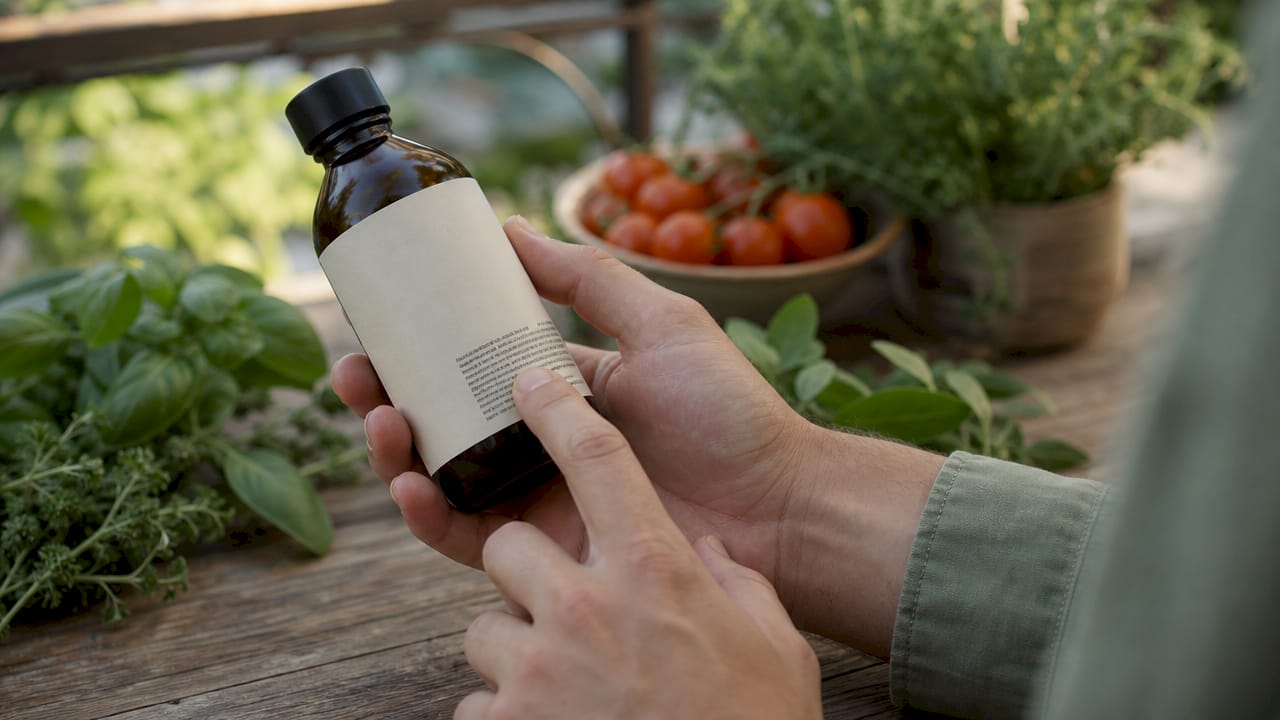
The “1% line” is the most useful concept for reading any ingredient list. Ingredients above 1% are listed in strict descending order; those at or below 1% can appear in any order the brand chooses. Preservatives like Phenoxyethanol and fragrances listed as “Parfum” almost always sit at or just below this line. When you spot Phenoxyethanol or Parfum, everything listed after it is likely present at less than 1% concentration.
Here is what to look for as you scan an ingredient list:
- Water (Aqua): Almost always the first ingredient. It is the base of most liquid formulas.
- Emollients and oils: Ingredients like Simmondsia Chinensis (Jojoba Oil) or Rosa Canina (Rosehip Oil) appear high on clean formulas.
- Humectants: Glycerin and Sodium Hyaluronate draw moisture into the skin and typically appear in the top half of the list.
- Preservatives: Phenoxyethanol, Sodium Benzoate, and Potassium Sorbate appear near the bottom, usually below 1%.
- Fragrance and allergens: “Parfum” is a catch-all term that can hide dozens of individual chemical compounds.
- Active botanicals: Extracts like Centella Asiatica or Calendula Officinalis often appear near the bottom, meaning their concentration is low.
Pro Tip: Watch for ingredient splitting. Some brands list two forms of the same sugar separately (for example, Glucose and Fructose instead of combined Sucrose) so each appears lower on the list. This makes a high-sugar formula look like sugar is a minor ingredient. Knowing this trick helps you see through label manipulation.
What do cosmetics certifications actually guarantee?
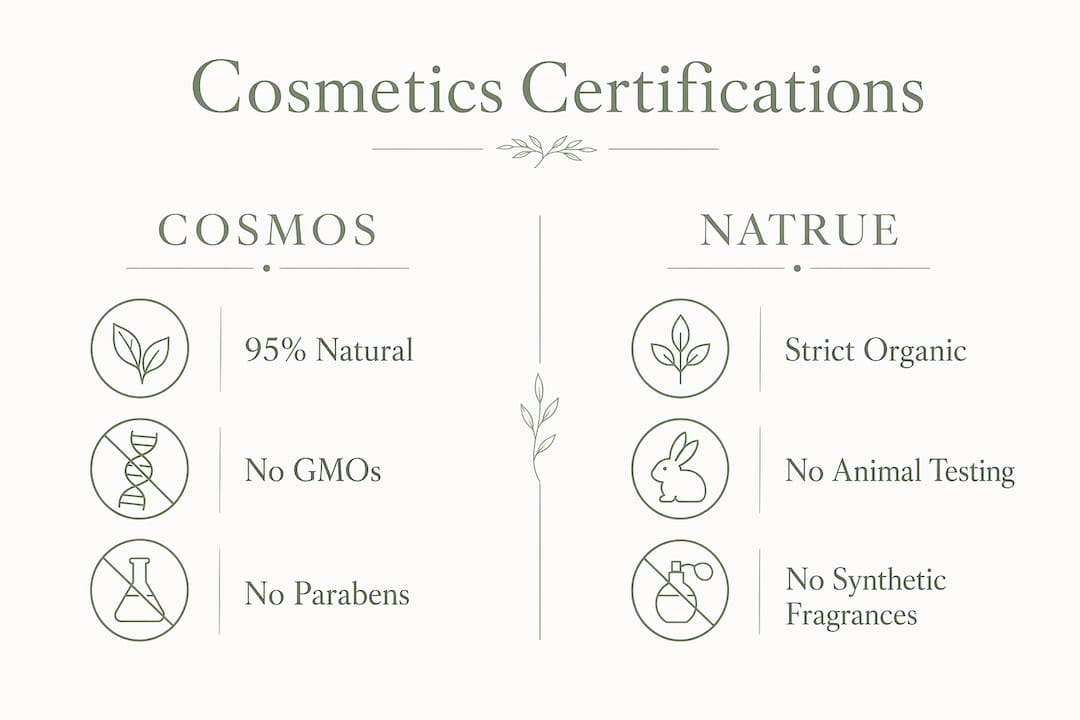
Third-party certifications are the only reliable way to verify a “natural” claim. COSMOS Natural requires at least 95% natural-origin ingredients, while COSMOS Organic goes further by requiring 95% of plant ingredients to be organically grown and at least 20% organic content in the total formula. NATRUE sets thresholds between 40% and 100% depending on product type. Products without these logos have not been independently verified, regardless of what the front label says.
These certifications also ban specific ingredients. COSMOS Organic prohibits GMOs, parabens, and synthetic fragrances, and requires traceability throughout the supply chain. NATRUE bans petrochemicals, synthetic fragrances, and animal testing. Seeing one of these logos on a product tells you a certifying body has audited the formula, not just the marketing copy.
| Certification | Natural content threshold | Organic requirement | Animal testing ban | Synthetic fragrance |
|---|---|---|---|---|
| COSMOS Natural | 95% natural origin | None required | Yes | Banned |
| COSMOS Organic | 95% natural origin | 20% total formula | Yes | Banned |
| NATRUE | 40%–100% by type | Optional tier | Yes | Banned |
Common buzzwords like “natural,” “clean,” “hypoallergenic,” and “dermatologist tested” carry no standardized legal meaning in Lebanon or most global markets. “Hypoallergenic” can still contain known allergens. “Dermatologist tested” means a dermatologist reviewed the product, not that it passed a safety trial. Always look past the front label and check for a recognized certification logo or a full INCI ingredient list.
Pro Tip: You can verify COSMOS certification by searching the brand on the COSMOS-standard.org registry. NATRUE has a similar public database. If a brand claims certification but does not appear in these registries, treat the claim as unverified.
Which allergens and irritants should you watch for?
Natural does not mean allergen-free. Many botanical ingredients are common skin sensitizers, and knowing which ones to watch for protects your skin far better than trusting a label claim. The EU requires brands to individually list approximately 80 fragrance allergens when they appear above certain thresholds. The US does not require the same disclosure, which is why EU-labeled products often give you more safety information.
The most common allergens and irritants to watch for include:
- Linalool and Limonene: Naturally occurring fragrance compounds found in lavender and citrus oils. Both are frequent sensitizers, especially in leave-on products.
- Geraniol and Citronellol: Found in rose and geranium extracts. They smell pleasant but trigger reactions in sensitive skin.
- Methylisothiazolinone (MI): A preservative linked to contact dermatitis. It is banned in EU leave-on products but still appears in some rinse-off formulas.
- Phenoxyethanol: A widely used preservative that is generally well tolerated but can irritate very sensitive skin at higher concentrations.
- Essential oils: Tea tree, peppermint, and eucalyptus oils are natural but can cause redness and stinging, particularly around the eyes.
- Cinnamal and Eugenol: Spice-derived fragrance compounds that are among the most common contact allergens in cosmetics.
“Natural ingredients can be just as irritating as synthetic ones. Linalool, Limonene, and essential oils are all plant-derived, yet they are among the most frequently reported causes of cosmetic contact allergy. The word ‘natural’ on a label tells you nothing about your skin’s reaction to what is inside.”
Build a personal ingredient watchlist based on reactions you have had in the past. If a moisturizer caused redness, look up its full ingredient list and cross-reference it with your next purchase. For sensitive skin choices, shorter ingredient lists with recognizable names are generally safer. Always patch test a new product on your inner arm for 24–48 hours before applying it to your face.
How to spot misleading marketing and read batch codes
Marketing language on cosmetic packaging is designed to sell, not to inform. Terms like “hypoallergenic” and “dermatologist tested” have no standardized legal definition and offer no guarantee of safety. “Fragrance-free” should mean no added fragrance, but some brands use masking fragrances that technically qualify as fragrance-free under loose interpretations. “Free from” claims are equally unreliable: a product labeled “paraben-free” may simply replace parabens with a different preservative that carries its own risks.
Ingredient splitting is another tactic worth recognizing. A brand might list Glucose, Fructose, and Sucrose separately so that each sugar appears lower on the ingredient list individually, even though combined they form a significant portion of the formula. Awareness of ingredient splitting lets you see through this kind of label manipulation quickly.
Reading batch codes gives you one more layer of product knowledge. Follow these steps:
- Locate the batch code. It is usually printed or embossed near the bottom of the packaging, often near the expiration date.
- Identify the format. Many brands use the Julian Date format. A batch code like 19200 means the product was manufactured on the 200th day of 2019.
- Calculate the age. Compare the manufacture date to the product’s Period After Opening (PAO) symbol, which looks like an open jar with a number (e.g., “12M” means 12 months after opening).
- Check freshness. Natural formulas without synthetic preservatives degrade faster. A product manufactured more than two years ago may have lost efficacy even if unopened.
- Request documentation. Reputable brands provide a Certificate of Analysis (COA) or Safety Data Sheet (SDS) on request. These documents confirm ingredient purity and batch testing results.
Pro Tip: If a brand does not respond to questions about batch codes, COAs, or full ingredient disclosure, that silence is itself useful information. Brands committed to natural cosmetics transparency answer these questions readily and often publish the information proactively.
Key Takeaways
Reading cosmetic labels accurately requires knowing INCI naming conventions, the 1% concentration line, recognized certifications like COSMOS and NATRUE, and common allergen names.
| Point | Details |
|---|---|
| First five ingredients matter most | They account for roughly 80% of the formula, so check them before reading marketing claims. |
| The 1% line reveals trace ingredients | Preservatives and fragrances near the bottom are present in very small amounts. |
| Certifications are the only real proof | COSMOS and NATRUE logos confirm independent auditing; front-label claims do not. |
| “Natural” does not mean allergen-free | Linalool, Limonene, and essential oils are plant-derived but are common skin sensitizers. |
| Batch codes confirm freshness | Julian Date format lets you calculate manufacture date and compare it to the PAO symbol. |
What reading labels has taught us at LaTerraTales
The Lebanese beauty market is growing fast, and so is the volume of products claiming to be natural. What I have seen repeatedly is that consumers feel reassured by words like “clean” or “botanical” without realizing those words are unregulated. That reassurance is exactly what some brands count on.
The most protective habit any shopper can build is chemically informed skepticism. That does not mean distrusting every product. It means knowing that a COSMOS logo carries weight, that Linalool near the top of an ingredient list is a flag for sensitive skin, and that a brand willing to share its COA is a brand worth trusting. Certifications matter, but so does the brand’s willingness to be transparent when you ask a direct question.
In Lebanon specifically, access to certified natural products is improving, but the market still carries many products with vague claims and incomplete labeling. Prioritize brands that publish full INCI lists online, respond to ingredient questions, and display verifiable certification logos. Your skin deserves that standard, and so does your money.
— LaTerraTales
Clean skincare you can actually read at LaTerraTales
At LaTerraTales, every product comes with a full INCI ingredient list, clear certification information, and a team ready to answer your questions about what is inside and why. The formulas are built for sensitive skin, free from synthetic fragrances, and designed to give you confidence at every step of your routine.
The natural skincare collection is curated specifically for Lebanese consumers who want clean, eco-conscious products without the label confusion. From the handmade cleanser bar with its short, recognizable ingredient list to botanical serums with transparent sourcing, every product reflects the same standard: nothing hidden, nothing vague. Shop with the knowledge you have built here, and choose products that earn your trust ingredient by ingredient.
FAQ
What does INCI mean on a cosmetics label?
INCI stands for International Nomenclature of Cosmetic Ingredients. It is the global standard for naming cosmetic ingredients, often using Latin botanical names, so that labels are consistent across countries.
How do I know if a “natural” cosmetic is genuinely natural?
Look for a COSMOS or NATRUE certification logo. These are independently audited standards. Front-label terms like “natural” or “clean” have no legal definition and require no verification.
Can natural ingredients cause allergic reactions?
Yes. Plant-derived compounds like Linalool, Limonene, and essential oils are among the most common causes of cosmetic contact allergy. Always patch test new products and check the full ingredient list for known sensitizers.
What is the 1% line in an ingredient list?
The 1% line is the point in an ingredient list where ingredients shift from being listed in descending concentration order to being listed in any order the brand chooses. Preservatives and fragrances typically mark this threshold.
How do I read a batch code to check product freshness?
Many brands use the Julian Date format. A code like 19200 means the product was made on the 200th day of 2019. Compare that date to the Period After Opening (PAO) symbol on the packaging to assess whether the product is still within its usable life.


