

4 Steps: Essential Oil Free Skincare and Patch Testing
If you have sensitive, reactive, or barrier-compromised skin, choosing essential oil free skincare usually reduces your risk of irritation and supports barrier repair. Essential oils are concentrated plant extracts that can trigger allergic contact dermatitis, even in people who tolerated them fine for years. If your skin flares easily, the safest next move is simple: check the label for volatile aromatic ingredients, and patch test anything new before it touches your face.
TL;DR:
- Essential oils like peppermint, clove, and citrus oils are high-risk for sensitive skin, especially when damaged or inflamed, and should be avoided or patch tested.
- Labels claiming “essential oil free” may still contain botanical extracts or “parfum,” so checking ingredient lists for Latin names ending in “oil” is essential.
- Patch testing new products on the inner forearm for 48 hours can prevent allergic reactions and identify sensitivities before face application.
- Reputable EO-free skincare focuses on simple ingredients like ceramides, glycerin, and niacinamide, avoiding volatile aromatics and undisclosed fragrance blends.
- Consistent, minimal routines with gentle cleansing, barrier repair, and mineral sun protection support sensitive skin recovery without exposure to irritants.
Table of Contents
- What “Essential Oil Free” Actually Means
- Why Sensitive Skin Does Better Without Essential Oils
- Essential Oils to Watch For on the Label
- How to Choose EO-Free Products With Confidence
- Patch Testing: Your Safety Net Against Cumulative Exposure
- A Minimal EO-Free Routine That Actually Works
- Why We Build Formulas Without Essential Oils
- Start With Our EO-Free Collection
- Sources
- FAQ
What “Essential Oil Free” Actually Means
Essential oils are steam-distilled or cold-pressed extracts pulled from plant leaves, bark, peels, or flowers. They are volatile, meaning they evaporate and carry scent, which is exactly why they show up in “natural” skincare so often. That volatility is also what makes them chemically reactive on skin, unlike carrier oils (jojoba, sunflower, squalane) or non-volatile botanical extracts, which don’t carry the same sensitization profile.
“Essential oil free” is not the same claim as fragrance-free skincare. A product can drop synthetic perfume and still contain lavender or tea tree oil, and vice versa. Watch for these on an ingredient list:
- Latin plant names followed by “oil” (Lavandula angustifolia oil, Melaleuca alternifolia oil, Citrus limon peel oil)
- “Aromatic extract” or “botanical distillate,” which often mean the same thing as essential oil
- “Parfum” or “fragrance” blends, which can legally hide essential oil components under one umbrella term
“Natural” and “botanical” on a front label guarantee nothing. Formulators use both words freely, even when the product contains a full aromatic oil blend.
Why Sensitive Skin Does Better Without Essential Oils
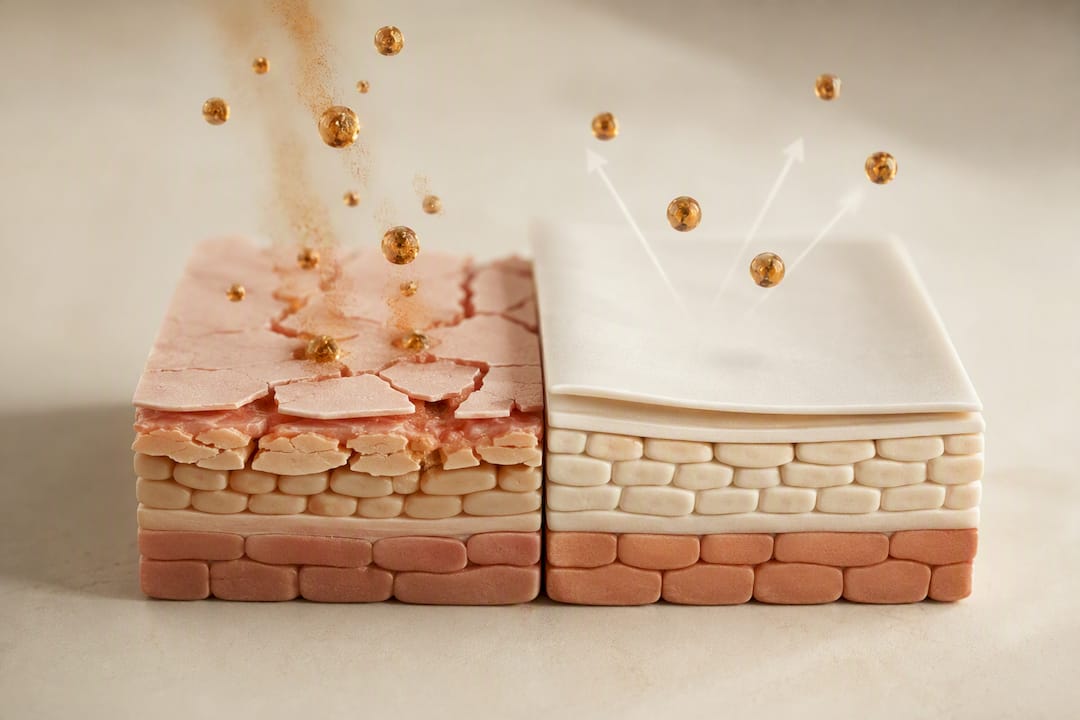
Sensitive skin isn’t a fixed category. It’s a spectrum, and where you sit on it shifts with weather, hormones, stress, and whatever product you used last week. That variability matters because damaged or inflamed skin absorbs more of whatever touches it, which means an essential oil your skin shrugged off a year ago can trigger a reaction today.
The clinical reality: essential oils can cause allergic contact dermatitis, a delayed hypersensitivity reaction that often develops only after repeated exposure. You can use a lavender-scented cream for months before your immune system decides it’s had enough.
That’s why dermatologists lean toward EO-free care for eczema, rosacea, and post-procedure skin (think chemical peels, laser treatments, or fresh microneedling). In all three cases, the skin barrier is already compromised, and the margin for irritation is thin. Removing volatile aromatics entirely gives inflamed skin room to recover without a constant irritant drip.
Essential Oils to Watch For on the Label
Not every essential oil carries the same risk, but some show up on safety warnings again and again. WebMD’s essential oil safety guidance flags these as higher-risk for irritation, sensitization, or toxicity, particularly for sensitive skin, children, or older adults:
- Peppermint oil — high menthol content, common cause of tingling that tips into burning
- Clove oil — contains eugenol, a well-documented skin sensitizer
- Cinnamon oil (bark or leaf) — one of the most frequently reported contact allergens in the oil family
- Oregano and thyme oil — potent phenols that irritate even at low concentrations
- Birch and wintergreen oil — high in methyl salicylate, absorbed readily through skin
- Citrus oils (bergamot, lemon, lime) — phototoxic, meaning they can cause burns or dark spots when skin is exposed to sunlight after application
On an ingredient list, these often appear under Latin names (Citrus bergamia, Mentha piperita) rather than their common English name, so scanning for “oil” alone isn’t enough.
How to Choose EO-Free Products With Confidence
Reading a label under fluorescent store lighting isn’t fun, but a short routine makes it fast. Here’s the sequence worth memorizing:
- Scan for Latin plant names ending in “oil.” These are almost always essential oils, not carrier oils.
- Check for “parfum” or “fragrance” with no breakdown. Brands aren’t required to disclose what’s inside a fragrance blend, so an unspecified one is a genuine red flag.
- Look for an explicit claim. “Fragrance-free” is not the same guarantee as “no added essential oils.” A product needs the second phrase, or a full published INCI list, to confirm it’s actually EO-free.
- Call or email the brand if the list is incomplete. Reputable companies will share full ingredient decks on request.
- Cross-reference proprietary blend names. “Botanical complex” or “aromatic essence” on a shorter label often means the full INCI list is buried elsewhere online.
Pro Tip: Keep a running note on your phone of ingredient names that have triggered reactions before. Pull it up while shopping. Pattern recognition beats memory every time.
Terms like “hypoallergenic” and “dermatologically tested” sound reassuring but carry no regulated definition in the U.S., so treat them as a starting point, not proof.
Patch Testing: Your Safety Net Against Cumulative Exposure
A patch test takes two days and prevents a face full of regret. Apply a small amount of the new product to your inner forearm, then leave it alone.
- Day 0: apply a small amount, note the date
- 24 hours: check for redness, itching, or bumps
- 48 hours: check again, since some reactions build slowly
- Log it: a one-line note in your phone (product name, date, result) saves you from repeating a bad experiment months later
Dermatology and aromatherapy safety sources consistently recommend using this exact window before a new product touches your face.
There’s a source of exposure most people never think to test: your laundry detergent, plug-in diffuser, and scented dish soap. Fragranced household products create cumulative exposure that can sensitize skin over time, which muddies the picture when you’re trying to isolate what actually caused a flare.

Pro Tip: If your skin is reacting and your skincare passed the patch test clean, audit your laundry and home fragrance products next. They’re the most overlooked variable in the entire routine.
See a dermatologist if you notice spreading redness, blistering, or a rash that doesn’t fade within a few days. Those signs point to allergic contact dermatitis, not simple irritation, and it typically needs medical management to resolve.
A Minimal EO-Free Routine That Actually Works
You don’t need twelve steps to take care of reactive skin. You need four, done consistently.
- Cleanse with a low-foam, pH-balanced formula that doesn’t strip your barrier
- Repair and hydrate with ceramides, glycerin, or niacinamide, which rebuild the lipid layer instead of just sitting on top of it
- Treat sparingly, and only after your skin has calmed, reaching for soothing agents like colloidal oatmeal, panthenol, or allantoin
- Protect daily with a mineral SPF (zinc oxide or titanium dioxide), which tends to sit better on reactive skin than chemical filters
While your barrier is compromised, skip strong acids, physical scrubs, and alcohol denat. All three accelerate moisture loss right when your skin needs the opposite. A gentle sensitive-skin routine built around these four steps gives inflamed skin the quiet it needs to heal.
Why We Build Formulas Without Essential Oils
We’ve watched too many customers assume “natural” meant “safe for my skin,” only to discover a lavender or citrus oil buried in the ingredient deck. Some brands formulate around transparency, focusing on minimal ingredient lists, published INCI panels, and a preference for ceramides, glycerin, and niacinamide over volatile aromatics. Our ingredient guide breaks down exactly which components we avoid and why. Before you buy anything, from us or anyone else, compare the ingredient list and patch test first. Your skin’s history is the only guide that matters.
— LaTerraTales
Start With Our EO-Free Collection
Once you know what to look for on a label, shopping gets a lot less stressful. LaTerraTales built its natural skincare collection for sensitive skin around exactly the criteria this article walks through: transparent INCI lists, minimal formulas, and no volatile aromatic oils hiding behind a “botanical” label.

The lineup includes a handmade cleanser bar formulated for reactive skin types, a focused lip balm built on arnica rather than fragrance, and body oils designed to soothe without the sensitization risk that comes with aromatic blends. Every product page lists its full ingredient panel, so you can run the same label check we just walked through before you commit to anything.
Not sure where to start? Order one item, patch test it on your forearm for 48 hours, and see how your skin responds before building out a full routine. If you need the complete INCI list for any product beyond what’s published, our customer service team will send it directly. Browse the collection and start with the piece that matches your biggest current concern.
Sources
The clinical foundation for this guide comes from a peer-reviewed review of essential oil safety, which documents allergic contact dermatitis risk, and WebMD’s essential oil safety guidance on high-risk oils. The Tisserand Institute’s safety resources informed the patch-testing and irritation guidance. If a reaction doesn’t resolve within a few days, see a dermatologist rather than waiting it out.
- Art of Prevention: Essential Oils - Natural Products Not Necessarily Safe
- How To Use Essential Oils: 16 Tips for Essential Oil Safety (WebMD)
FAQ
What Essential Oils Cannot Be Used on Skin?
Undiluted essential oils generally shouldn’t touch skin directly, and oils like cinnamon, clove, oregano, thyme, birch, and wintergreen carry elevated risk of irritation or sensitization even when diluted.
What Are the Best Oil-Free Skincare Products for Sensitive Skin?
The best options rely on ceramides, glycerin, niacinamide, and colloidal oatmeal instead of volatile aromatics, with a full published ingredient list you can verify before buying. LaTerraTales’ EO-free sensitive-skin collection is built on that same standard.
What Is the Cleanest Brand of Skincare?
There’s no single regulated definition of “clean” in skincare, so the more useful question is whether a brand publishes its full ingredient list and skips undisclosed fragrance blends. Brands that specify “no added essential oils,” rather than just “fragrance-free,” give you the clearest answer.
How Do I Get Oil-Free Skin Naturally?
For naturally balanced, non-greasy skin, prioritize gentle cleansing, oil-free moisturizers with niacinamide, and mineral sunscreen, while avoiding harsh strippers and comedogenic oils that can trigger a rebound in oil production. Consistency matters more than any single step.
Can Essential Oils Cause a Reaction Even if They Worked Fine Before?
Yes. Allergic contact dermatitis is a delayed hypersensitivity reaction that can develop after months or years of tolerated use, so past comfort with an oil doesn’t guarantee future safety.
Recommended
Partager


