

What Is a Skin Barrier and How to Protect It
Your skin barrier is the outermost functional layer of your epidermis, a living shield that locks moisture in and keeps irritants, bacteria, and environmental aggressors out. If your skin feels tight, reactive, or stings when you apply products that never bothered you before, the single most helpful thing you can do right now is simplify your routine and reach for a fragrance-free, ceramide-containing moisturizer.
This guide walks you through how the barrier works, what damages it, how to recognize dysfunction, and a clear, evidence-based routine to help it recover.
- What the skin barrier is and where it sits in the skin
- The most common causes of barrier damage
- How to tell if your barrier is compromised
- A step-by-step repair routine with ingredient guidance
- Realistic timelines and when to see a dermatologist
Table of Contents
- What is a skin barrier, exactly, and how does it work?
- What damages the skin barrier?
- How can you tell if your skin barrier is compromised?
- How to protect and repair a damaged skin barrier
- Why does skin surface pH matter so much?
- How long does skin barrier repair actually take?
- When should you see a dermatologist?
- The skin barrier’s role in immune health
- Key Takeaways
- The case for doing less, not more
- Gentle barrier care, the LaTerraTales way
- Useful sources
What is a skin barrier, exactly, and how does it work?
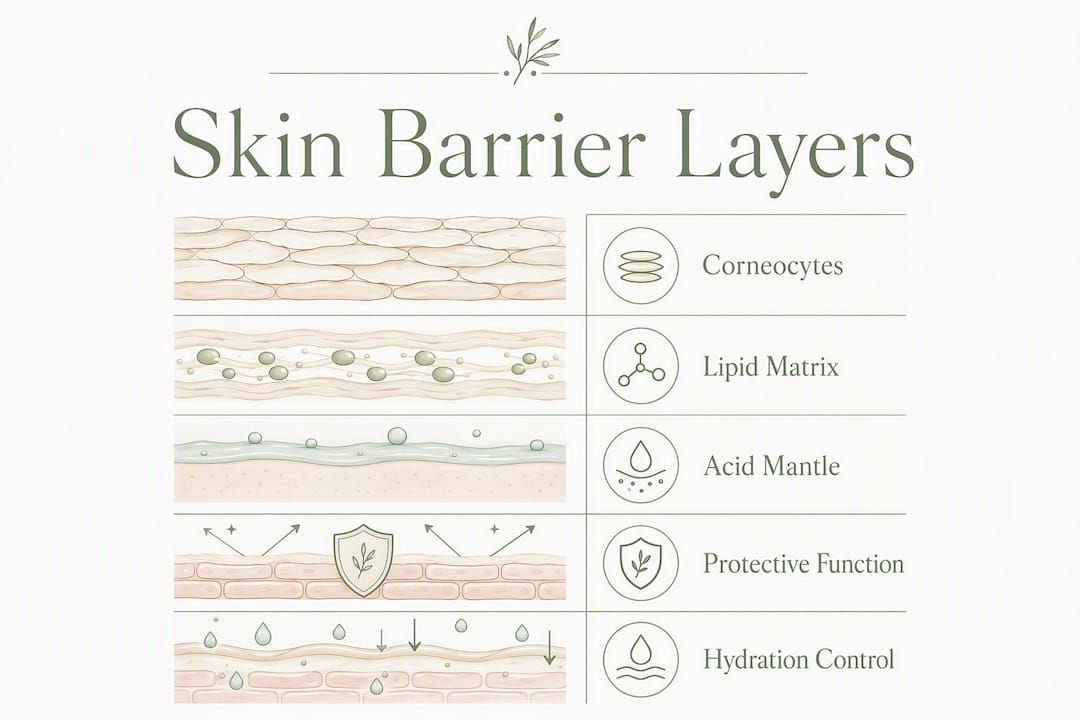
Think of your skin barrier as a brick wall. The “bricks” are flattened, protein-rich dead skin cells called corneocytes, and the “mortar” is a carefully balanced mixture of lipids, primarily ceramides, cholesterol, and free fatty acids. Together they form the stratum corneum, the outermost layer of the epidermis and the functional core of your barrier.
Beneath the corneocytes, a protein called filaggrin breaks down into smaller molecules that form your skin’s Natural Moisturizing Factor (NMF). NMF acts like a sponge inside each skin cell, drawing in water and keeping it there. When filaggrin expression drops, whether from genetics, inflammation, or harsh detergents, your skin loses its ability to hold moisture efficiently.
The lipid matrix between corneocytes is not a simple fat layer. It arranges itself into lamellar bilayers, stacked sheets that control exactly how much water passes through. Different ceramide subclasses, varying by chain length and molecular structure, each play a distinct role. A balanced mix of all three lipid types (ceramides, cholesterol, and fatty acids) is what makes the barrier truly effective. A product containing only one ceramide type cannot replicate that balance.
Sitting on top of all of this is the acid mantle, a thin film of sweat and sebum that keeps your skin surface mildly acidic. Transepidermal water loss (TEWL) is the clinical measure of how much water evaporates through the skin. Elevated TEWL is the earliest measurable sign that the barrier is failing.
| Term | What it means | Why it matters |
|---|---|---|
| Stratum corneum | Outermost skin layer, made of corneocytes | The physical barrier against water loss and irritants |
| Ceramides | Lipid molecules in the intercellular matrix | Hold the “mortar” together; essential for permeability control |
| Filaggrin | Structural protein that breaks down into NMF | Governs water-holding capacity inside skin cells |
| NMF (Natural Moisturizing Factor) | Hygroscopic molecules inside corneocytes | Keeps cells hydrated and maintains skin suppleness |
| TEWL | Rate of water evaporating through the skin | Clinical marker of barrier integrity |
| Acid mantle | Thin acidic film on the skin surface (pH 4.5–5.5) | Supports enzyme activity needed for lipid production |
What damages the skin barrier?
Most barrier damage is self-inflicted, and that is actually good news because it means the causes are within your control.
- Harsh cleansers and soaps: Traditional bar soaps have a pH of 9–10, far above the skin’s natural range. They strip the acid mantle and disrupt the lipid matrix with every wash.
- Over-exfoliation: Using a physical scrub daily, or layering a glycolic acid toner with a BHA serum and a retinoid in the same routine, is one of the most common ways people unknowingly compromise their barrier. Exfoliating more than two or three times per week is often too much for most skin types.
- Strong actives used too aggressively: High-concentration AHAs (above 10%), BHAs, and prescription-strength retinoids all accelerate cell turnover. Used without adequate recovery time, they thin the protective layer before it can rebuild.
- Alcohol-heavy formulas: Denatured alcohol (alcohol denat) in toners and serums evaporates quickly, taking lipids with it and leaving the surface dry and permeable.
- Hot water and long showers: Hot water dissolves the lipid mortar between skin cells. A 10-minute hot shower can measurably increase TEWL for hours afterward.
- Low humidity and cold air: Dry indoor heating in winter pulls moisture out of the stratum corneum faster than it can be replaced, especially when the skin is already sensitized.
- Friction: Rubbing the skin vigorously with a towel, using rough washcloths, or wearing tight synthetic fabrics against reactive skin all create micro-damage.
- Underlying conditions: Atopic dermatitis, rosacea, and acne are all associated with compromised barrier function, creating a cycle where the condition worsens barrier integrity and barrier loss worsens the condition.
- UV exposure and chlorine: UV radiation degrades lipids and proteins in the stratum corneum. Chlorine in pool water strips the acid mantle and disrupts the lipid matrix in a similar way to harsh surfactants.
How can you tell if your skin barrier is compromised?
The signs are usually unmistakable once you know what to look for. A compromised barrier does not always look “damaged” in an obvious way. Sometimes it just feels wrong.
Watch for these signals:
- Persistent dryness or flaking that does not resolve with your usual moisturizer
- Stinging or burning when you apply products that previously felt fine
- Redness or blotchiness that appears without a clear trigger
- Skin that feels tight, especially after cleansing
- Sudden sensitivity or reactivity to products you have used for months
- Chronic or worsening inflammation, including flare-ups of eczema, acne, or rosacea
Clinically, these symptoms correlate with elevated TEWL, meaning water is escaping faster than the skin can retain it. You do not need a clinical device to recognize this. If your skin stings after applying a gentle toner or your moisturizer seems to “disappear” within an hour, your barrier is likely compromised.
Sensitized skin vs. sensitive skin: Sensitive skin is a skin type you are born with, characterized by a naturally thinner or more reactive barrier. Sensitized skin is a temporary condition caused by external damage. Most people who suddenly develop reactive skin have sensitized, not inherently sensitive, skin. The distinction matters because sensitized skin can fully recover with the right care, while sensitive skin requires ongoing gentle management.
Pro Tip: If you are unsure whether your barrier is damaged, do a 24-hour product pause. Skip all actives, acids, and anything with fragrance. Use only a gentle cleanser and a plain, fragrance-free moisturizer. If your skin calms down noticeably, barrier damage is almost certainly the cause.
How to protect and repair a damaged skin barrier
Recovery starts with subtraction, not addition. Clinical guidance consistently supports paring back complex routines and removing irritants before adding anything new. Here is a prioritized order of operations:
- Cleanse gently. Switch to a soap-free, pH-balanced cleanser. Look for “syndet” (synthetic detergent) bars or low-foam gel cleansers with a pH close to 5. Avoid foaming cleansers with sodium lauryl sulfate (SLS). A gentle skincare routine starts here.
- Pause or reduce actives. If you use retinoids, AHAs, BHAs, or vitamin C, stop them entirely for one to two weeks. Reintroduce one at a time, at lower frequency, once the barrier feels stable.
- Apply a humectant. Glycerin or hyaluronic acid draws water into the skin. Apply to slightly damp skin for best absorption.
- Restore lipids with a ceramide-containing moisturizer. Look for formulas that list ceramides, cholesterol, and fatty acids together. Balanced ceramide formulations that mimic the skin’s natural lipid profile are more effective than single-ceramide products.
- Occlude when needed. For very dry or cracked skin, a thin layer of petrolatum or dimethicone over your moisturizer seals in hydration and gives the barrier time to rebuild without further water loss.
- Apply sunscreen daily. UV damage degrades the lipid matrix. A mineral sunscreen (zinc oxide or titanium dioxide) is less likely to irritate a compromised barrier than chemical filters.
Ingredients that help
- Ceramides: Replenish the lipid mortar directly
- Cholesterol and fatty acids: Work synergistically with ceramides to restore lamellar bilayers
- Glycerin: A gentle, effective humectant that draws moisture into the stratum corneum
- Hyaluronic acid: Attracts water from the environment and deeper skin layers
- Petrolatum: The most effective occlusive; forms a breathable seal over the skin surface
- Niacinamide: Soothes skin and supports barrier function without disrupting it when used at appropriate concentrations
- Panthenol (provitamin B5): Calms irritation and supports cell repair
What to avoid during repair
| Ingredient / Habit | Why it harms the barrier |
|---|---|
| Alcohol denat | Strips lipids; increases TEWL |
| Fragrance and essential oils | Common sensitizers; trigger inflammation |
| Harsh surfactants (SLS) | Disrupts lipid matrix and acid mantle |
| High-strength AHAs/BHAs | Over-exfoliate; prevent lipid rebuilding |
| Physical scrubs | Cause micro-tears in already-fragile skin |
| Hot water | Dissolves intercellular lipids |

Pro Tip: Patch-test any new product on your inner forearm for 48 hours before applying it to your face. A damaged barrier is more permeable, which means sensitizing ingredients absorb faster and reactions appear more quickly.
For a deeper look at building a minimal effective routine that supports recovery, a simplified, evidence-based approach consistently outperforms layering multiple “repair” serums.
Why does skin surface pH matter so much?
Healthy skin surface pH sits between 4.5 and 5.5, mildly acidic. That acidity is not cosmetic. The enzymes responsible for producing ceramides and free fatty acids, specifically serine proteases and lipid-processing enzymes, function optimally within that narrow pH range. Raise the pH with a high-alkaline soap and those enzymes slow down or stop working, meaning the barrier cannot rebuild its lipid mortar even when the irritant is removed.

Traditional soaps typically register between pH 9 and 10. Even one daily wash with a high-pH soap can keep the acid mantle disrupted for hours. Choosing a soap-free, pH-balanced cleanser is not a marketing preference; it is a functional requirement for barrier repair.
| Product type | Typical pH | Barrier impact |
|---|---|---|
| Traditional bar soap | 9–10 | Disrupts acid mantle; stalls lipid enzyme activity |
| Syndet (soap-free) bar | 5–6 | Preserves acid mantle; supports repair |
| Gel or foam cleanser (SLS-free) | 4.5–6 | Gentle; compatible with barrier recovery |
| AHA toner (10%+) | 3 | Temporarily lowers pH; can over-exfoliate |
| Ceramide moisturizer | 5–6 | Supports enzymatic repair environment |
When choosing a toner, look for alcohol-free, fragrance-free options with a pH above 5. Avoid astringent toners entirely during barrier repair.
How long does skin barrier repair actually take?
Recovery is not linear, and the timeline depends on how much damage has accumulated and whether you have removed all ongoing insults.
For mild sensitization, most people notice reduced stinging and improved hydration within a few days of simplifying their routine. Visible redness and flaking often improve within a couple of weeks. Full structural recovery of the lipid matrix, meaning the barrier is genuinely rebuilt rather than just calmed, typically takes several weeks.
Factors that slow recovery include age (ceramide production naturally declines with age, and barrier repair in aging skin requires additional occlusive support), ongoing exposure to irritants, low indoor humidity, and underlying inflammatory conditions like eczema.
During the first week of repair, you may notice temporary flaking as the skin sheds damaged corneocytes. This is normal and not a sign the routine is failing. Resist the urge to exfoliate. If stinging persists beyond two weeks despite a fully simplified routine, or if new symptoms appear, that is a signal to consult a dermatologist rather than continue adjusting products on your own.
Monitor progress by checking in every five to seven days. Ask yourself: Is the stinging less frequent? Does my moisturizer feel like it is absorbing rather than sitting on the surface? Is the tightness after cleansing improving? Small, consistent improvements are the right signal.
When should you see a dermatologist?
Self-care works for most cases of mild to moderate barrier damage. But some situations call for professional evaluation, and waiting too long can turn a manageable issue into a chronic one.
See a dermatologist if you notice:
- A rash that is spreading, oozing, crusting, or showing signs of infection (warmth, swelling, pus)
- Severe pain or burning that does not ease within 24–48 hours of simplifying your routine
- No meaningful improvement after two to four weeks of consistent, gentle care
- Symptoms that suggest an underlying condition, such as the characteristic distribution of eczema, the central facial redness of rosacea, or persistent cystic acne
- A reaction that appeared after a new prescription medication or medical treatment
A dermatologist can confirm whether barrier dysfunction is primary (caused by external habits) or secondary to an underlying disease. Treatment options may include topical corticosteroids for acute inflammation, calcineurin inhibitors (like tacrolimus or pimecrolimus) for longer-term management without steroid side effects, or patch testing to identify contact allergens.
When you go, bring a list of every product you currently use (including the order you apply them), photos of your skin at its worst, and a rough timeline of when symptoms started and what changed before they appeared. That information cuts the diagnostic process significantly.
The skin barrier’s role in immune health
The skin barrier does more than manage hydration. Research shows that tight junctions and the stratum corneum actively influence immune cell behavior. When the barrier is compromised, permeability loss and immune activation form a feedback loop: a leaky barrier allows allergens and microbes to penetrate, which triggers an immune response, which generates inflammatory cytokines, which further suppress filaggrin expression and lipid production, which weakens the barrier further.
This is why dermatologists now treat barrier repair as a first-line intervention in inflammatory skin disease, not just a comfort measure. Restoring the lipid matrix and maintaining the acid mantle reduces the frequency and severity of flares in eczema and rosacea, often before any prescription treatment is needed.
Pro Tip: If you have an inflammatory skin condition, prioritize barrier repair before adding targeted actives like retinoids or acids. A stable barrier makes those actives more tolerable and more effective.
Key Takeaways
A healthy skin barrier requires gentle cleansing, consistent lipid replenishment with ceramides and fatty acids, and daily sun protection to maintain its protective function and support long-term skin health.
| Point | Details |
|---|---|
| Barrier definition | The stratum corneum is your skin’s outermost protective layer, controlling moisture and blocking irritants. |
| Top repair actions | Simplify your routine, use a pH-balanced cleanser, and apply a ceramide-containing moisturizer twice daily. |
| Recovery timeline | Mild damage often calms in 3 days; full structural repair takes several weeks with consistent gentle care. |
| When to seek care | See a dermatologist if symptoms spread, show infection signs, or do not improve after 2–4 weeks. |
| LaTerraTales approach | LaTerraTales offers soap-free cleansing bars, botanical oils, and fragrance-free formulas designed to support barrier repair without irritating sensitive skin. |
The case for doing less, not more
There is a pattern worth naming honestly: most barrier damage seen in people with otherwise healthy skin comes from doing too much, not too little. The skincare industry has a financial incentive to sell you the next active, the next serum, the next exfoliant. But the research is clear. Removing irritants and giving the skin time to use its own repair mechanisms, supported by gentle, evidence-based products, is frequently more effective than adding multiple “repair” serums on top of an already-stressed barrier.
At LaTerraTales, this is the principle behind every formula we develop. Sensitive skin does not need a 10-step routine. It needs fewer, better choices: ingredients that work with the skin’s natural chemistry rather than against it, sustainable packaging that reflects the same care we put into the formulas, and a commitment to transparency about what is inside and why. Barrier health is not a trend. It is the foundation of every skin goal, from hydration to clarity to aging gracefully.
Gentle barrier care, the LaTerraTales way
If you are ready to put these steps into practice, LaTerraTales has built its collection specifically around the needs of sensitive and barrier-compromised skin.
Our natural skincare collection for sensitive skin includes soap-free cleansing bars formulated without SLS or synthetic fragrance, botanical oils that function as gentle occlusives, and lip care designed to protect the delicate barrier on your lips. Every product is built on minimal, carefully selected ingredients, because we believe your skin recovers faster when it is not processing a long list of unnecessary additives.
Start with our handmade natural cleanser bar, a pH-friendly, soap-free option that cleanses without stripping. Then layer a ceramide-rich moisturizer and, if your skin needs extra occlusion, a few drops of our botanical dry oil to seal everything in. These steps work whether you use LaTerraTales products or any other evidence-based, fragrance-free formula. The routine matters more than the brand.
Browse the full collection and find the right starting point for your skin’s recovery.
Useful sources
- Anatomy, Skin (Integument), Epidermis — StatPearls, NCBI
- Skin Barrier Function: The Interplay of Physical, Chemical, and Immunologic Properties — MDPI Cells
- Skin barrier function — DermNet NZ
- Fundamentals of Skin Barrier Physiology — Journal of Clinical and Aesthetic Dermatology
- Barrier integrity and immunity: exploring the cutaneous front line in health and disease — Annual Review of Immunology
- Skin barrier function — PMC, NCBI
Recommended
Partager


