

Why Local Skincare Brands Differ from Global Ones
Why local and global skincare brands are fundamentally different
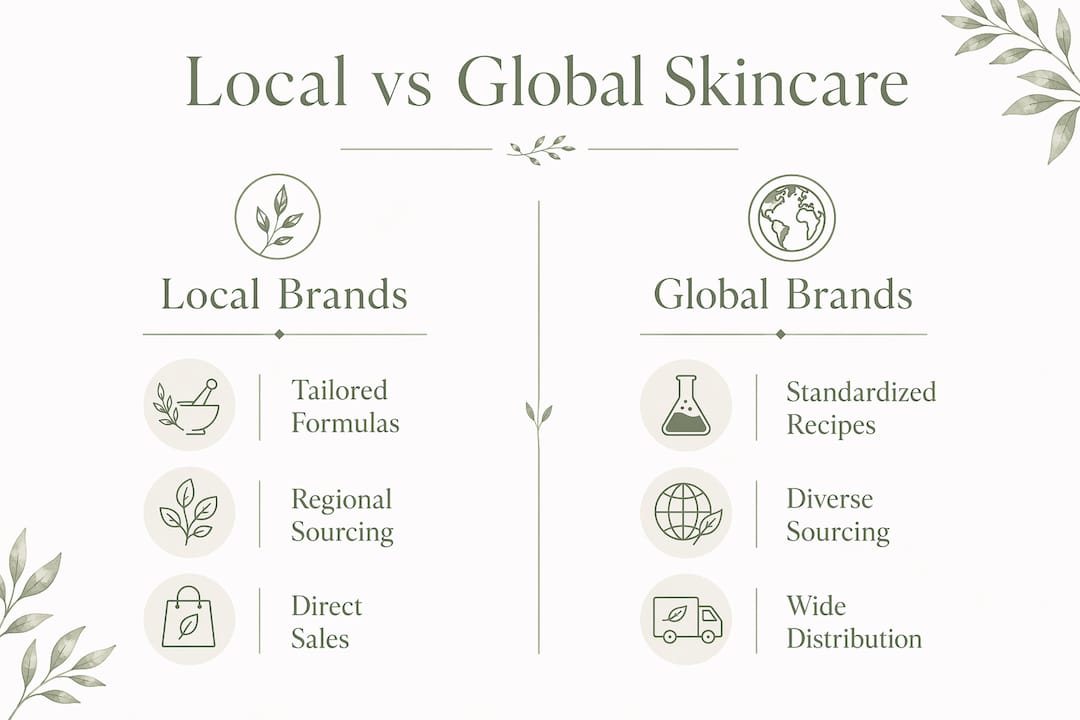
Local skincare brands differ from global ones because they build products around the actual conditions your skin lives in, not a universal formula designed to sell across 50 markets. That distinction shapes everything: the ingredients chosen, how formulas are adjusted for humidity or water hardness, how products are priced, and how brands talk to you. Understanding these differences helps you make smarter choices for your skin and your values.
Here is what drives the gap:
- Regional formulation: Local brands adjust viscosity, pH, and active concentrations for local climate conditions, including humidity, UV intensity, and water mineral content. Global brands typically deploy a single formula across multiple markets.
- Ingredient sourcing: Local brands draw on indigenous botanicals, traditional remedies, and regional agricultural networks. Less than 2% of global beauty research focuses on Indian skin tones as of 2026, a gap that local brands are uniquely positioned to fill.
- Consumer feedback loops: Local brands iterate on real, proximate feedback from customers who share the same climate, water supply, and skin concerns. Global brands rely on aggregated data that smooths out regional nuance.
- Transparency: Local brands tend to disclose ingredient concentrations and sourcing origins, building trust through legibility rather than proprietary secrecy.
- Pricing strategy: Local brands price for regional purchasing power and lower distribution overhead, while global brands factor in marketing budgets, celebrity endorsements, and multi-market logistics.
- Cultural resonance: A local brand’s story, rituals, and ingredient choices feel personal because they are. Global brands often adapt packaging and taglines without touching the formula underneath.
How global beauty trends shape what local brands actually make
Global trends set the vocabulary, but local brands write their own sentences. When barrier repair, SPF layering, or glass skin goes viral, local brands face real pressure to respond. The ones that do it well adapt the trend to local skin realities rather than copying it wholesale.
- Selective adoption: A local brand in a humid tropical climate does not simply launch a heavy ceramide cream because barrier repair is trending globally. It reformulates for a lightweight, non-occlusive texture that performs well in high humidity.
- Traditional ingredient integration: Indian brands have combined bakuchiol, a plant-derived retinol alternative from the babchi plant used in Ayurvedic practice, with modern cosmetic chemistry to create serums calibrated for skin that reacts to synthetic retinoids in humid heat.
- The trend-chasing trap: Local brands that compete on trend speed alone are playing on the wrong field. Global giants have larger R&D pipelines, faster manufacturing turnarounds, and marketing budgets that can make a trend feel like it belongs to them even when it did not originate there.
- Consumer demand as the real driver: The most durable local brands stop chasing trends and start listening. Proximity to the consumer’s actual skin, rituals, and daily life is the competitive advantage no multinational can easily buy.
- Climate-specific adaptation: Dry, temperate, and tropical climates each demand different emollient ratios, humectant concentrations, and SPF formulations. Local brands make these adjustments by default; global brands make them rarely.
What consumers actually want from local versus global skincare
Consumer preferences in local vs global skincare have shifted decisively toward transparency and efficacy over prestige. The rise of the “skintellectual” consumer, someone who actively researches actives, reads INCI lists, and compares formulations across platforms, has changed what a brand needs to offer to earn loyalty.
- Localness drives purchase intent: Studies have found that perceived brand localness positively affects consumer-brand identification and purchase intention, while perceived brand globalness does not have a significant effect.
- Ingredient transparency over brand prestige: Consumers increasingly want to know the concentration of niacinamide in a serum, not just the brand name on the bottle. Local brands that publish this information build trust faster.
- Price sensitivity is real: A 2024 survey of 122 dermatologists ranked CeraVe and Neutrogena at the top of over-the-counter recommendations, outperforming prestige brands that cost five to ten times as much. Price rarely reflects formula superiority for staple products.
- Cultural relevance matters deeply: Beauty is, as Kalindi Mehta of Estée Lauder Companies has noted, “deeply intertwined with personal aesthetics, with culture, with cultural trends, making them very uniquely personal and emotionally charged.”
- Trust through local sourcing: Knowing that an ingredient was harvested responsibly from a region you recognize creates a connection that a global supply chain cannot replicate.
Pro Tip: When evaluating any skincare product, check whether the brand discloses the concentration of its key actives. A local brand that lists 10% niacinamide is giving you more useful information than a global brand that lists “niacinamide” without a percentage.
Why local ingredient sourcing changes what ends up on your skin
Local sourcing is not just an ethical choice. It directly affects what a formula can do for your skin. When a brand sources botanicals from its own region, it gains access to ingredients that global supply chains rarely prioritize, and it can trace every step from harvest to bottle.
- Indigenous actives with real efficacy: Centella asiatica, turmeric, Papuan red fruit, and bakuchiol are examples of regionally sourced ingredients with documented skin benefits that many global brands overlook or use only as marketing accents at negligible concentrations.
- Water quality shapes formulas: Hard water, high in calcium and magnesium, affects how surfactants perform and how residue builds on skin. A formulation team working in a hard-water region notices this in user feedback within weeks and adjusts cleanser viscosity accordingly. A team based elsewhere does not have the same signal.
- Traceability builds confidence: When you can read about where an ingredient was grown and how it was harvested, you are making an informed choice. That level of ingredient transparency is a hallmark of local brands operating close to their supply chains.
- Supporting regional economies: Local sourcing keeps money in agricultural communities, supports sustainable farming practices, and reduces the carbon footprint of ingredient transport.
- Cost and quality trade-offs: Sourcing locally at small scale can cost more per unit than buying from global ingredient distributors. The best local brands absorb this cost because the quality and traceability justify it.
How local and global brands market themselves differently
The marketing gap between local and global skincare brands is as wide as the formulation gap, and it shows up in tone, channel, and what gets said about ingredients.
- Storytelling versus scale: Local brands build emotional connections through specific, culturally resonant stories: the founder’s grandmother’s remedy, the botanical harvested from a named region, the ritual tied to a particular season. Global brands rely on universal claims and high-production campaigns designed to land across dozens of markets simultaneously.
- Ingredient specificity: Local brands that built their reputations on transparency publish the concentration of every active and cite the dermatological basis for each formulation choice. That specificity changed what consumers expect to know before spending money.
- Celebrity versus community: Global brands spend heavily on celebrity endorsements and prestige positioning. Local brands tend to invest in community, direct feedback, and hyperlocal influencer ecosystems that feel more credible to their core audience.
- Digital channels, different tone: Both local and global brands use social media, but local brands use it to have conversations, not just broadcast campaigns. The tone is closer to a knowledgeable friend than a polished advertisement.
- Avoiding the prestige trap: Price often reflects marketing spend and packaging elegance, not formula superiority. For staple products like cleansers and moisturizers, marketing drives price more than ingredient quality does. Local brands that communicate this honestly earn a different kind of loyalty.
For consumers curious about how locally made skincare connects to heritage and daily ritual, the sourcing story is often the most compelling part of the brand.

LaTerraTales and what expert insight reveals about the local advantage
The competition between local and global skincare brands is shifting from a cultural contest to a science-based one, with local brands leveraging cost-efficient R&D and proximity to their consumers as their primary advantages.
That framing applies well beyond India. Across markets, the local brands gaining ground are the ones treating their regional consumer’s skin as the brief, not the afterthought. They are building proprietary knowledge about local skin types, local water quality, and local rituals that no amount of global market research can replicate quickly.
LaTerraTales exemplifies this approach. As a French-Lebanese brand, LaTerraTales develops formulas for sensitive skin with carefully selected botanicals, ethical sourcing, and sustainable packaging, combining the rigor of modern cosmetic chemistry with ingredients rooted in the natural world. Every product in the natural skincare collection reflects a commitment to ingredient transparency and environmental responsibility that global mass-market brands rarely match at this scale.
Pro Tip: Look for brands that disclose not just what ingredients they use, but why. A brand that explains the dermatological rationale behind its niacinamide or bakuchiol concentration is giving you the information you need to trust the formula.
Key markers of the local brand advantage in 2026:
- Proprietary R&D built on regional skin data and local clinical observation
- Ingredient labeling that discloses concentrations, not just names
- Ethical sourcing with traceable supply chains
- Formulas adjusted for local water quality, humidity, and UV exposure
- Consumer feedback loops that run on real proximity, not social listening dashboards
How regulations shape what goes into local versus global skincare products
Regulatory differences are one of the least visible but most consequential reasons why local and global skincare products diverge. Product standards are set at the national level, and companies comply with local law, nothing more.
Where regulations are strict, companies produce higher-quality versions to meet those requirements. Where standards are weaker or enforcement is limited, global brands can legally reduce ingredient potency or substitute cheaper components while remaining fully compliant. This is regulatory arbitrage: exploiting differences across jurisdictions to minimize costs while preserving brand value.
Global brands have been documented maintaining different ingredient standards by market, sometimes reducing active concentrations in lower-income regions. Consumers in those markets are buying the same logo but not always the same formula. Local brands, by contrast, operate under a single regulatory environment and have no incentive to produce a downgraded version for a secondary market. What you see on the label is what is in the bottle.
For consumers, the practical implication is straightforward: a global brand’s formula in the US may differ from the version sold in another country under the same name. A local brand’s formula is what it is, everywhere it sells.
Where you can actually find and buy local versus global skincare
Distribution shapes access, and access shapes which brands most consumers ever try. Global brands dominate traditional retail: department stores, large pharmacy chains, and major e-commerce platforms. Their logistics infrastructure means a product can ship from a central warehouse to almost anywhere within days.
Local brands typically reach consumers through a shorter, more transparent supply chain. Direct-to-consumer online stores, local boutiques, farmers markets, and regional specialty retailers are the primary channels. That shorter path means fresher product, lower distribution overhead, and a direct relationship between brand and buyer.
The trade-off is availability. A local brand may not stock every retailer in your city, and international shipping can add cost and carbon footprint. Consumers in markets like the UAE, for example, are increasingly finding premium local and regional skincare brands through curated specialty platforms that bridge the discovery gap.
For sensitive skin consumers, the direct-to-consumer model also means easier access to the brand team for ingredient questions, something a global brand’s customer service line rarely provides. That accessibility is part of what makes local brands feel like a more personal choice, because they often are.
Key Takeaways
Local skincare brands differ from global ones because they tailor formulas, sourcing, and marketing to specific regional skin needs, climate conditions, and consumer values that standardized global products cannot address at scale.
| Point | Details |
|---|---|
| Formulation is regional | Local brands adjust pH, viscosity, and active concentrations for local climate and water quality; global brands rarely do. |
| Localness drives loyalty | A 2026 study of 218 Indonesian consumers found brand localness increases purchase intent; globalness had no significant effect. |
| Regulatory gaps matter | Global brands legally vary ingredient potency by market; local brands operate under one standard with no incentive to downgrade. |
| Transparency builds trust | Local brands that disclose active concentrations and sourcing origins earn consumer confidence that proprietary formulas cannot. |
| Less than 2% research gap | Less than 2% of global beauty research targets Indian skin tones as of 2026, illustrating the formulation blind spot local brands are built to fill. |


